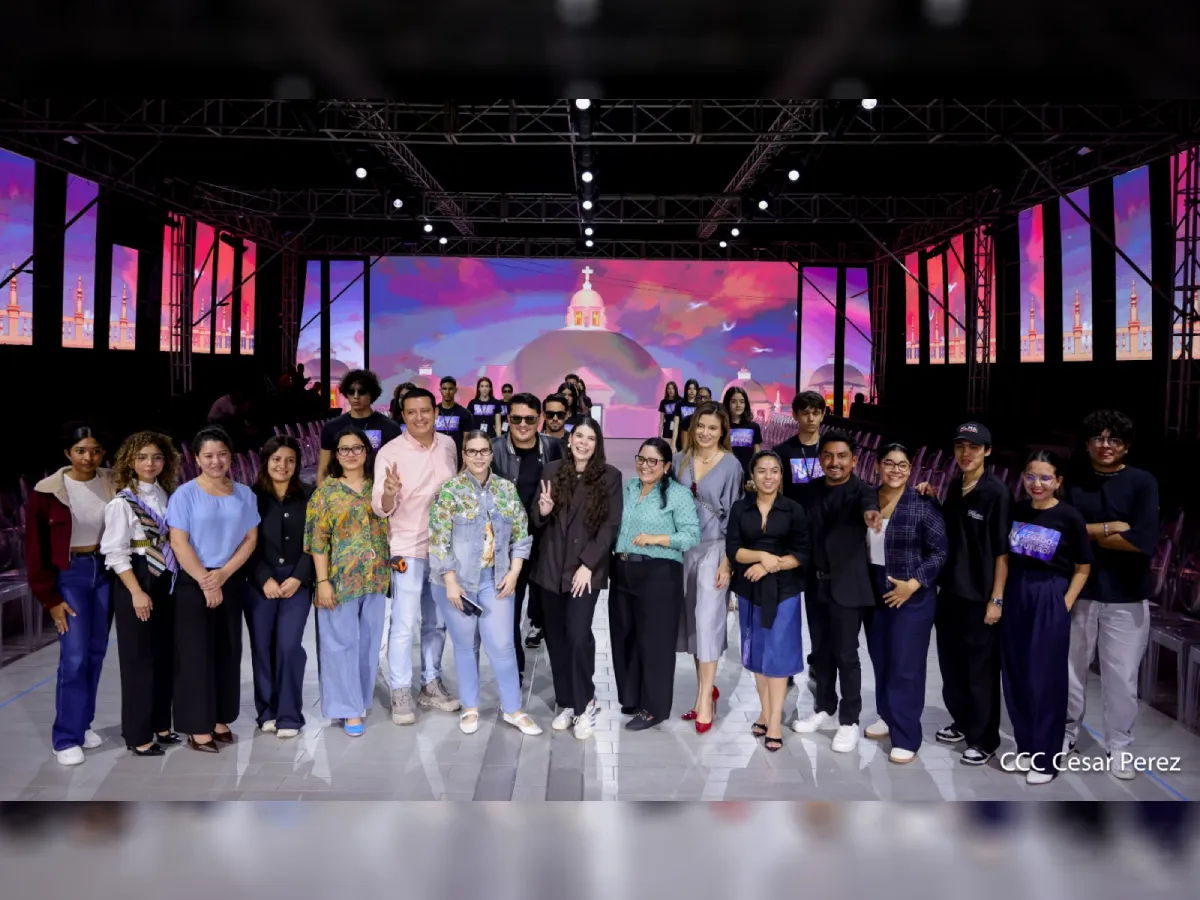








Meeting with Nicaraguan deputies before the PARLACEN
during the Consultation Process of the Constitutional Reforms
Wednesday, August 5, 2026
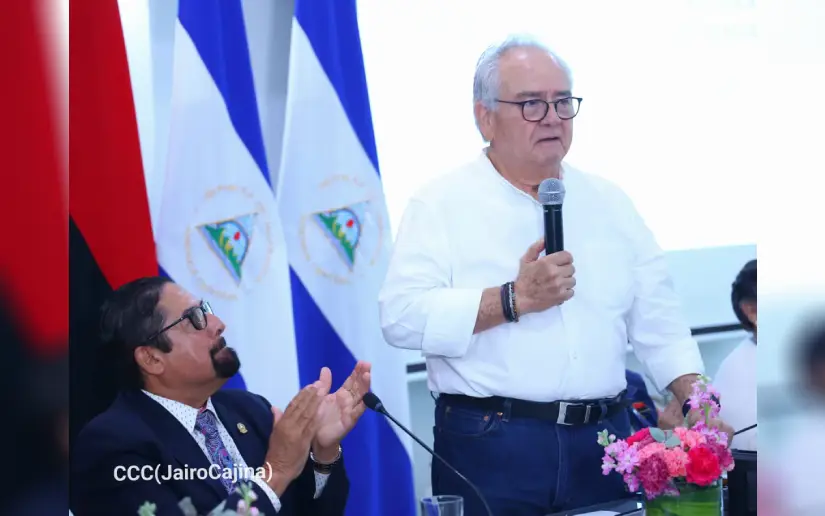
Address by Doctor Gustavo Porras
President of the National Assembly:
Good morning, Compañeras and Compañeros. We welcome you to your home, everyone gets together here, and we want to be united with you today to share, to make a presentation related to the Electoral Reforms that we are proposing, on the instructions of Comandante Daniel and Compañera Rosario.
We are here with Comandante Doris Tijerino accompanying us, who is the Head of the PARLACEN Grouping, and with Compañero Guillermo Daniel Ortega Reyes, who is Vice President in the PARLACEN for Nicaragua. Before I begin, I want to introduce you to the Compañeras and Compañeros who have been working and building Electoral Reform under the leadership of the Presidency, of our Co-Presidents.
So, we have the Members of the Executive Board. As you know, a Special Constitutional Commission was formed to work on the proposal, and the Constitutional Commission is made up of the Members of the Executive Board: Compañera Arling Alonso, who is the First Vice-President; Compañera Loria Dixon, well-known to you, who is the First Secretary.
We have our beloved Compañera Pineda, our Hero and she is the Second Vice President; we have our friend María Haydee Osuna, President of the PLC, who is the Third Vice President; we have Doctor Wilfredo Navarro, who is the Second Secretary of the Assembly, and our friend Alejandro Mejía Ferretti, who is the Third Secretary.
We are also joined by the Heads of the Political Groupings: Dr. Edwin Castro, who is the Head of the Grouping of the Sandinista Front; we have our friend Lester Flores, who is the Head of the PLC Grouping, and our friend Mario Asensio, who is the Head of the IDB Grouping. And we have two presidents of the most important Committees of the Assembly; they are all important, but these are exceptional committees.
We have Compañera María Auxiliadora Martínez, who is president of the Justice Commission, and Dr. Wálmaro Gutiérrez, who is president of the Economic Commission.
We also have to highlight the presence of our friend, more than friend, whom I call our godfather, the former Vice President of the Republic, Don Jaime Morales Carazo, someone very dear to us, much respected by all of us and we thank God, he has been with us in all our meetings. Likewise, a greeting to José Antonio Alvarado.
Well, welcome, everyone. We will try not to spend more than 35 minutes on the presentation. When Comandante Ortega, on the 19th, threw his hat at the parrot and made the whole chicken house start to crow, when he said, "There will be no elections," it was like hitting parrots with a hat. All the networks and the uproar started: "No more elections !", and everything we already know all too well, because it's an immediate reaction, activated, like when you flip a switch, and besides, well organized and well paid for that purpose.
But what he said is very clear: "There will be no elections that might allow those who are lying in wait to return to government and return to power and set us all back on everything we have achieved."
And, as a next step, he also recalled how education in our country is free, and all the other aspects in which progress has been made. At the time he noted that they want to return to government so as to again start doing business with Education, and we already know what that means for health care, privatization and so on, everything we already know.
That was the observation and, later, as he said clearly: "We are going to work with the National Assembly on the Laws necessary to put up a wall, a barrier, to all those coup conspirators who want to return to destroy the country," and he finished by saying: They will not prevail!, They Won't Be Able To!, They Won't Be Able To!
That was the order to get going, the order to start work on Reforms that had already been discussed and thought about, and to start the Consultation Process, as you are aware.
And this Reform is one more step in the entire Process of configuring Nicaragua anew; one more step in the entire Process of change, of establishing Sovereignty, Self-determination, National Dignity and Independence that the Sandinista Struggle has been engaged in since Sandino; since Sandino decided to carry out his anti-imperialist struggle.
And, before him, Zeledón, the seed that bore fruit in Sandino; Zeledón, confronting the intervention of 1912. And, if we go even further back we come to Estrada and our National Hero, Andrés Castro, with Estrada as the General of Nicaragua’s Forces, fighting against the Yankee filibusters. So, this is a historical process that we are going through.
This historical process should lead us, little by little, to perfect our Constitution until we have configured a Nicaraguan National Constitution with bases of Dignity, Stability, Peace and Security.
This is what we will see later on in Article 1 of the Constitution.
But that's how this has been built. How so? Because we are seeing that the Right of Nicaraguans to free health care, the Right of Nicaraguans to free education, the Right of Nicaraguans to water, and the Right of Nicaraguans to all existing Rights are being constitutionally established.
But, above all, in order to achieve that, we have to guarantee all the Fundamental Principles of Independence, Sovereignty and Self-Determination for which our Heroes and Heroines have fought.
Thus, this Partial Reform to the Constitution is founded on three principles or three pillars: Stability, Security and Peace. And this responds to an objective that all of us have and should keep in mind, which is the objective that Comandante Daniel, Compañera Rosario and the Sandinista Front have defined for us, and that we have been building towards, namely the objective of being victorious in the fight against poverty. That is the main objective we must always insist on.
Comandante Daniel always says: "Our main enemy is Poverty." And it's true, as long as we have poverty levels, we're going to be vulnerable, we're going to be subject to extortion, we're going to be at risk of subjugation. So, the main struggle has to be aimed at overcoming Poverty; but, to overcome Poverty there are the three Principles: Stability, Security and Peace.
Then, as a compañera said in one of the presentations, quite rightly: "I want Peace to be first." Why? Because Peace is the greatest aspiration that all the Nicaraguan people have.
But here we have not put them in order of importance, or according to what one happens to think, but in reality the three elements are absolutely intertwined and articulated. Without Peace there is no Security, and there is no Stability; without Security there is no Peace and there is no Stability. They are indissoluble concepts.
So, we researched these concepts and we found the following historical elements that should guide all of us. We know the history of foreign interference and, above all, foreign interference from colonialism, from Spanish colonial expansionism and the struggles that our indigenous anti-imperialist Heroes had.
But also, later with the expansionism of US imperialism; the Yankee filibusters were part of that expansionism, along with the appearance of the great transnational companies and all those transit companies, from one side of the continent to the other, via the two oceans, driven by Cornelius Vanderbilt and all the mercenaries who came as well.
As regards these mercenaries, we already know the history, in 1854, 1855 and 1856 the Yankee filibuster came along and as always came thanks to a group of quislings, and one of the filibusters became President of Nicaragua.
Then came the history of how we Central Americans managed to unite and defeat them, but the important thing here is that the struggle continued.
Zelaya's Liberal Revolution took place and made very important changes in Nicaragua’s development Process; however, this collided with the interests of the Yankees, of Imperialism, especially over the enduring issue: the Canal.
In practice, then came the Knox Note, the departure of Zelaya, the emergence of Zeledón. Then Zeledón was murdered by the Yankees and by the Conservatives, and the seed was sown that grew into the struggle of Sandino, after he watched the ignominy, observing how they dragged Zeledón’s body through the streets in Catarina.
Also too, by the way, you all know that General Benjamin Zeledon is buried at the entrance of the cemetery in Catarina, so, to one side of the entrance, and it is not by chance.
The Yankees, the Church of that time and the Conservatives all applied to him the existing law so, if he was not baptized, if he was not recognized by the Church and if he was regarded as an outlaw, they would not let him be buried in the cemetery.
So, that's why he's outside it, they didn't realize that what they were in fact doing was bringing him closer and closer to the heart of the People, and there he is. And that's part of our story.
Between the years 1920 to 1932, there was a series of events and legal changes which revealed the Yankee dominance and the imposition of the Yankee intervention at that time. Because the period of Adolfo Díaz, the period of the beginning of what they considered should be the path of political development for Nicaragua, was to copy Anglo-Saxon bipartisanship and transfer to Nicaragua. So, it was the Liberal-Conservative bipartisanship that was set in motion.
In 1923 an Electoral Law was made under the Presidency of Adolfo Díaz, with the advice and authorship of a Yankee academic named Dodds.
This academic was sent by the Yankee President to be hired for Nicaragua as an adviser to the Nicaraguan President and to create Dodd’s Law, a Law that came into force in 1923, with the precise idea of establishing that kind of Anglo-Saxon bipartisan system in 1923.
He established the National Elections Council to institutionalize the bipartisan system, and that bipartisan system remained in place until the Revolution: Liberals and Conservatives from 1928 to 1978.
And these were the ballot papers of the election of November 6, 1932; with Adolfo Díaz for the Conservatives and Juan Bautista Sacasa for the Liberals.
But already by 1928, remember that the Espino Negro Pact with Moncada was in 1927. Sandino did not accept it and embarked on his Anti-Imperialist, Nationalist and Patriotic Struggle. And the gringos, in the Espino Negro Pact, which some historians say was never signed, among them Dr. Wilfredo Navarro, who maintains that nothing was signed, that everything was verbal, the gringos did keep their word, because the commitment was that Moncada was to be President and that the Gringos would guarantee Moncada the Presidency.
So, to guarantee it, the Gringos took Dodds Law, revised it and, sending a Marine General, Brigadier General Frank Ross McCoy, they made him president of the National Council of Elections.
This US General, along with all the US Marines accompanying him, took over control of the Electoral Districts. Then, the presidents of the Electoral Districts were US Marines, Yankee navy officers, and the president of the National Electoral Council was General McCoy.
To ensure things on that occasion, in 1928 they promulgated a Decree that was a Law, a Decree that suspended the Law of 1923 but left in force all the scaffolding of the Law, the way to organize Elections, and so on.
However, they put it on hold until the elections were over, and clearly stated that it would be reinstated once the winner was known. How so? Because they issued a Decree which they called the Transitional McCoy Law, so as to guarantee that Moncada would be the President, which was what they had agreed on.
As you can see here, this is a copy of The Gazette of Tuesday, April 3, 1923. This is the Dodds Act. This was the way to organize the Electoral Districts and the whole process, as well as the definition of who could vote, from the Electoral Roll that defined those elections.
As you can see the universe of voters was defined as follows: "The right to vote belongs only to Nicaraguan men." To begin with, that is, suffrage belonged to 48% of the population; the 52%, which corresponded to women, did not have the right to Vote at that time; back then, only Nicaraguan men 21 years of age or older could vote.
The Nicaraguan population at that time probably consisted of more than 60% of people under the age of 20; that is, from 48%, that 60% had to be subtracted and, then, the voting population was reduced to almost 21%, and so it became even smaller.
People aged 18 could vote, that was no great concession, only so long as they had one of two characteristics: that they could read and write, which reduced the population of 18-year-olds who could read and write at that time to minimum percentages, or that they were married, on the understanding that the marriage was celebrated by the Church.
So then, these were minimum percentages, in total it was 20% of the standard population; now, that 20%, if we divide it, let's say, by six, to calculate 15% of that 20%, would give us as a result that about 3% of the population were employers, because the rest were their employees. Each employer arrived with their employees to vote, and you know how that worked; namely, they had to show him who they were voting for.
That is the democracy from which we have come, the one they praise, the one they defend; that is the reality, and we have been transforming that. Even this Electoral Law was still too loose for them. So then, the Decree was emitted which made the McCoy Law, which is this, which is a Decree. And, to make it clear who is in charge here and who puts matters in order in the house, it reads:
“The President of the Republic:
In view of the fact that the Supreme Court of Justice, by agreement of the 17th of this month, has appointed, in place of Mr. Doctor Don Joaquín Gómez, who submitted his resignation, Mr. General Frank Ross McCoy as President of the National Elections Council, and that this high official, in that capacity and having been appointed by the President of the United States, shall direct the 1928 electoral act of supreme authorities, as agreed so as to put an end to the civil war ravaging Nicaragua.”
Obviously, the agreed thing was to make sure that Moncada got the Presidency, so then, this was the reality of our Electoral Processes, and that's how it evolved. It was made up, then opened up a little; that is, all those later stages appeared, the time of “La Magnifica” and everything we know that went on until the Revolution.
All that struggle of the Nicaraguan people, the struggle of Sandino, of the Sandinistas and of the Sandinista Front brings us up to 1979, as well as the struggle of all our Compañeros and Compañeras, helping us evolve from the Constitution of 1987 to the definition of the Constitutional Reforms of last year, of 2025, so as to arrive at this Article 1 of the Political Constitution of the Republic, referring to Fundamental Principles.
And this Article One which is what should always guide us. It reads:
“Article 1: Independence, Sovereignty, National Self-Determination, Security and Peace are inalienable Rights of the People and foundations of the Nicaraguan Nation. Any foreign interference in the internal affairs of Nicaragua or any attempt to undermine those Rights threatens the life of the People. It is the duty of all Nicaraguans to preserve and defend these rights.
Consequently, all those who violate these sacred Rights will be considered traitors to the Nation.”
That is the Constitutional Guide and we are complying with it, and it is the Constitutional Guide that gives all legal weight to Comandante Daniel, Compañera Rosario, to all the Deputies and every one of us to carry out these changes. And as Comandante Daniel insists: "Look, there are going to be no elections for those to return." Who are they? All those who violate Article One of the Constitution. Those people can't come back.
In conclusion, from this, it’s clear that the people who violate this Article have no Political Rights and have no reason to participate in Elections. That's simple logic. So, on this basis and on the three Concepts we were talking about earlier, in order to direct all the effort towards the fight against Poverty, we went on to establish six proposals of elements, Concepts or Reforms that need to be made.
Which leads us to think that, indeed, this content might comprise six Articles, but we present them as Concepts so that they are not forgotten. We will easily remember them if we remember that the first Concept is: They will not prevail! Why? Because as we say: They Could Not Prevail, Nor Will They!, and because Comandante Daniel said on the 19th: They will not prevail! They Won't Be Able To! They Won't Be Able To!
So, the first Concept that has to be transformed into the article of the Constitutional Reform, has to be the concept of They Won't Prevail! Which is this here: "Citizens have the right to choose and be elected and to run for public office, except for the limitations contemplated in this Political Constitution."
That is Article 47 of the Constitution, and we have to add, of course, drafted as a Law, the Concept that coup plotters, those who commit, or have committed acts that undermine the Independence, Sovereignty and Self-Determination of Nicaragua, which is Article One, may not be candidates for popularly elected positions, nor may they hold public office by appointment of the Presidency of the Republic, or by election of the National Assembly,: Traitors to the Nation and those who violate or have violated the Fundamental Principles contemplated in this Political Constitution, these may not take part. That's the First Concept.
Now, there is a paragraph written there, because there may remain doubts about who are those who have committed or will commit violence, or undermine Independence, Self-Determination and Sovereignty. Who are they? Those who commit or have committed acts that undermine the Independence, Sovereignty and Self-determination of Nicaragua.
This is broken down as follows: ”Those who incite or promote foreign interference, call for military intervention, organize with financing from abroad, propose, manage or support economic, commercial or financial blockades and sanctions against the State of Nicaragua, its Institutions and its citizens."
So, these are the sacrileges, I would say; they are not just mortal sins, but sacrileges that cannot be committed, neither over the social networks, nor as a joke. Who is going to think of spreading on those networks that we need Nicaragua to be invaded and that there should be military intervention and, after that, saying: "I'm going to register to be a candidate"? Those who publish these things do it from the outside, for the most part, and if someone does it from the inside, they do so under cover.
But it really is sacrilege, there is no country anywhere in which such things are said by some political movement, much less in a country that has gone through a coup attempt like the one we had. That is to say, anything said in that sense is no joke, but a reality; it takes the path of reality.
So then, the second Concept we cannot forget is "Stability". The period established in the Constitution of the Republic of Nicaragua for the Positions of Popular Election and for the positions of election or ratification of the National Assembly, will be seven years.
That is to say, Stability is a concept that not only consists in having no turbulence in the normal development of political processes, but also in there being the conviction that we are going to have sufficiently long and adequate periods of time to carry out transformations, to develop projects, because, after all, what interests all of us is the fight against Poverty. So, these are periods that allow us to measure the projects we need and to provide assurance and continuity to those processes.
The proposal is to make it seven years. There are countries that have ten year periods and, as it happens, or rather it is no coincidence, those are the countries that have managed to take off economically, because they have Stability.
There are other countries that have periods of six years, we had six. Recently, some countries changed from five to six years; that is, right here in Central America. There are also countries that have five years and others that have four years.
There are countries that have four-year models and run for re-election, giving the sense that it is eight years. There is every kind of period, but there are many countries with periods of seven years. There are some countries in Europe, many countries in Africa and many countries in other latitudes that have seven-year periods. We think seven years is a good period. This brings us directly, in this period, to the next National Elections in 2028.
But we need there to be “Cohesion and Security". Cohesion is necessary because the State is one. So, if we say that the positions of Popular Election are going to be elected for seven years and the positions of appointment will be for seven years, we must also include the other positions, we put that here because these positions depend on specific Laws.
So the Constitutional Reform, with every Right to do so, will make the necessary reforms in the corresponding laws so that the terms of the Commander-in-Chief of the Military Forces and the Heads of the Police Forces will also be seven years. That gives cohesion and articulation. All the positions move forward with the period of seven years and that is also related to the Security Forces.
Then, the Third Concept has to do with the “Guarantee of our Electoral Democracy", which is the Supreme Electoral Council. The Supreme Electoral Council is the body that must guarantee Electoral Democracy, although Democracy for us goes far beyond elections.
Elections are an insignificant part of democracy. They are a way of saying: "We are going to complete seven years, we are going to evaluate those seven years and we are going to submit to the decision of the People what we have done for a new seven-year period."
That is the electoral part and may well involve the participation of different political options and political parties here, and we are moving in that direction, because we are all committed to the fight against poverty.
That is what we are working on, because Democracy is obviously much more than that. Democracy is being able to get to a good quality hospital without being charged to do so and without anyone having justification to tell you that they can't treat you. Democracy is that you can send your child to school and they won't exclude them because you haven't paid the tuition fees, or that they don't restrict your right to receive the examination grades because you haven't paid the school.
Democracy means that wherever you go, in any part of Nicaragua, you have access to electricity. Now we have 99.5% coverage. Democracy is for the peoples of the Caribbean Coast, to be able to travel overland and arrive that day to Bilwi or Bluefields; that is to say, there the life of the Caribbean Coast population was really democratized. So, all those concepts are much broader.
In Electoral Democracy, the Supreme Electoral Council has attributions and those are the ones that are modified in this Reform. Why? Because what was already established was that the Supreme Council organized and directed the Elections.
The Supreme Council can grant or deny the Legal Personalities of the Parties and exercise other powers. But here are three Reforms in different paragraphs.
In Paragraph One, the Reform establishes: "To organize and direct General, Municipal and Regional Elections every seven years." The period is already clear, the period is fixed. Why? Because the Council is the organizer, and the Constitution has to give it the attribution to hold elections every seven years; therefore, it must organize them every seven years.
In Paragraph Two it is added that: "Political Parties constituted with foreign financing will not be granted legal personality, or when one of their Directors has violated the Fundamental Principles of this Political Constitution.”
In addition, the attribute is established: "The cancellation of the Legal Personality of the Party when it, any of its Directors or its Candidates receive foreign financing or have violated said principles.”
And the third, which corresponds to paragraph 14 of Article 152, referring to the Powers of the Council, orders it to verify and impose the corresponding sanctions on any candidate, official of the Electoral Body and member of the Executive Boards of the parties who commits or has committed acts that undermine the Independence, Sovereignty and Self-determination of Nicaragua.
And the paragraph in which those who have called for military intervention, those who have received foreign financing and those who applaud or promote sanctions against Nicaraguan citizens is repeated again, among other cases. This is the guarantee of our democracy. This is the fifth concept... we are carrying forward: "They will not prevail", “Stability”, “Cohesion and Security”, “Electoral Democracy”, guaranteed by the Council.
Another Concept, we have called "PAX", so that we do not forget, because it is Darío's poem. And here, in honor of Darío, we are going to correct a historic oversight or, perhaps, a historical affront that we had made, and this is that previously changes and inaugurations were held here on January 10th while we have the birth of Rubén Darío on January 18th. So the Constitution is changed and the date of inauguration of the Co-Presidents of the Republic, will be on January 18th in tribute to our National Hero and Universal Poet, Rubén Darío.
Such that the inauguration of the Deputies and the installation of the Assembly will have to take place on January 17th so it is already installed by the time of the inauguration on the 18th.
The sixth concept, which is the last one, is the concept of “Coherence". Coherence is a very simple thing. Moreover, let's assume that we have reached this point, that the article responds to these concepts and that it is approved. So, the concepts that we have seen so far have to have their own articulation and Coherence with current reality.
What will happen to the Members of Parliament? There is going to be a gap between what currently determines that you are elected for six years and the fact that elections will determine the new parliamentarians from the next electoral process. So, there is a year’s difference. Therefore, all this must be made consistent and Coherence is precisely that: "By mandate and strict observance of Constitutional Supremacy, the terms of the authorities elected by popular vote in the last General, Municipal and Regional Elections are extended to seven years from the last election." In the case of municipal authorities, it corresponds to the following year, and in the case of regional elections, it will be applied as appropriate.
So, that's seven years. That is, the last election brings as a consequence an installation and, from there, seven years elapse, because the new election comes and the cycle repeats, and it is seven years. The term of office appointed by the President of the Republic or by election or ratification of the National Assembly is also extended to seven years, starting from the last election, appointment or ratification.
It's not that there was an election and, so, now all the positions are going to start from scratch. No, those who are elected are governed by their election. Those who are appointed have a period of seven years from the last appointment made to them. If someone was appointed, and the example we used yesterday was that of Compañera Rosa Amelia Rosales, who was recently appointed, the period will be counted from the date of that appointment and will be seven years. So, that's just to be clear.
Finally, in all legislation in which a term of office is stipulated or regulated, it will be understood that the rule has been fully reformed and that the period will be seven years, so that everything is in harmony.
Afterwards, the Compañeros and Compañeras suggested to me, and we all agreed, that we add a list of all the official positions subject to this Article. I clarify that these are not posts of popular election, these are official positions appointed or elected by the Assembly.
So, there are the Commander-in-Chief of the Military Forces and the Heads of the Police Forces; the Judges of the Supreme Court of Justice; the Supreme Electoral Council; the Office of the Attorney General of the Republic; the Office of the Comptroller General of the Republic; the President of the Central Bank; the Monetary and Financial Council; the Superintendency of Banks; the Superintendent and the Deputy Superintendent; the Board of Directors of the Production Development Bank; the Board of Directors of the National Microfinance Commission; the Members of the Customs and Administrative Tax Tribunal (TATA); the Members of the National Council of Administration and Judicial Career; the Nicaraguan Institute of Energy (INE); the National Water Authority and the National Civil Service Commission.
That is the list that is to be included. So then, there are six concepts that we cannot forget: "They will not prevail", “Stability”, “Cohesion and Security”, “The Powers of the Council”, “PAX” and “Coherence”; that is, adapting what we currently have to harmonize it with the Reforms.
And what we cannot forget is Article 1 of our current Constitution, which we must fix in our minds, as well as the elements that guide this Reform, which are Stability, Security and Peace, to continue advancing in the fight against Poverty.
That's what I want to present to you…
Thank you. The space is open, if there are opinions or suggestions.
Questions and answers space:
Deputy Socorro Reyes:
Good morning, Dr. Porras, President of the National Assembly; honorable Members who preside over this bureau of the Special Council; honorable Deputies; all Members.
It is an honor, as a Member of the Central American Parliament for Nicaragua, to express our full support for the Partial Reform of the Constitution. A reform aimed at Peace, Sovereignty, Democracy and Security of Nicaragua.
Reforms aimed to support the fight against poverty and the search for a way out of Poverty in our country. Reforms for National Self-determination and for the Good of our Country.
Thank you very much!
Deputy Margine Trujillo:
Good morning, President of the Assembly, Dr. Gustavo Porras; Directors of the National Assembly; Deputies; colleagues from the Central American Parliament and other authorities present.
Today we appear with a deep sense of responsibility to express, as the Grouping of the Central American Parliament, our total support for the Reform of the Political Constitution of Nicaragua.
Our commitment is to act responsibly in defense of National Sovereignty. We reiterate our willingness to continue working with Respect and Responsibility, always acting in function of the Well-being of the People and the strengthening of Nicaragua as a Sovereign Nation.
Thank you very much!
Deputy José Antonio Alvarado:
We greet our beloved President of the National Assembly, Dr. Gustavo Porras; the Board of Directors of the National Assembly; the Members of the Special Commission; the Heads of the Political Groupings; Brothers and Sisters, friends; my most beloved Comandante Doris Tijerino; our Brother and Sister Guillermo Daniel and Aida Blanco; Directors; our most beloved Former Vice President and Brother Jaime Morales Carazo; beloved friends, Compañeras and Compañeros.
Actually, this is an extremely necessary process for the political life of our Nation. Our Political Grouping, unanimously and enthusiastically, strongly supports the proposals that have been put to us, as expressed by our Brother Vice President Guillermo Daniel.
Definitely, the Constitutional Reforms will create the necessary legal framework to give coherence to all the changes and transformations that have been carried out by our Government. In this sense, we can observe that every achievement reached has also become a new challenge, in such a way that progress is being made along the path of building a permanent revolution.
As long as we have any doubt, any danger or any indication that those who serve foreign interests want to subvert the institutional order, we can leave neither doors, nor windows, nor chinks open. We have to close them completely to guarantee, precisely, the Stability, Security and Peace of our Nation.
Everything that has been being built, and I am sure that this new legal framework will contribute to that new vision, will make it possible to build an economically stronger Nicaragua for the fight against poverty and a much more stable Nicaragua, so that the State institutions can go on reaching the achievements that are being developed according to the tasks that our Government is promoting.
And, finally, a Nicaragua at Peace, so that our People President can develop a work agenda and support the changes we have been making. Our Parliamentary Grouping of the Central American Parliament accompanies and encourages the Permanent Commission in this very necessary and important work that our Co-Presidents, Comandante and Brother Daniel, and most beloved Sister Rosario, are promoting for the benefit of our Nicaragua.
Thank you very much!
Deputy José Antonio Zepeda:
Good morning, Brothers and Sisters.
With the responsibilities conferred on us by both the Executive Board and the Members of the Special Commission for this Partial Reform of the Constitutional Law, in what we indicated in the document, I want to emphasize the commitment, responsibility and decision of the Members of the Grouping, elected to represent Nicaragua in the Central American Parliament, to defend this Reform Process and the progress that our country has made.
We know that there are far-right forces and fascist groups in the Central American Parliament that respond to the interests of our enemies. And that is the space in which we also have to discuss and make known how Nicaragua is building, in Peace, a new reality.
Therefore, it is not just a matter of expressing our support, because these reforms are ours; we assume them as such in order to internalize and defend them. Because, if I'm from the outside, I'm not going to defend them. In that sense, the discussion and debate that we have held in our Political Grouping lead us to assume that commitment and to take responsibility for the space for which we have been elected, in order to represent Nicaragua.
We assume the commitment to recognize that Nicaragua today has many principles, much to teach and much to praise, and that it can be an example of how, when there is Peace, Tranquility, Harmony, Unity and Willingness to build a new Nicaragua, it also contributes to the development of other countries.
Therefore, I think it is important to disseminate, explain and clarify, starting with ourselves, our family, our neighbors, our compañeras and compañeros and all those around us, the importance and relevance of this Process of closing doors with triple padlocks, so that no one can try to steal our Tranquility and Peace.
That is the commitment we assume as a Parliamentary Grouping before the Central American Parliament and the responsibility that we assume before you and our People to continue fighting for Peace, Tranquility, Development and Harmony of our People.
Thank you, President.
Doctor Gustavo Porras
President of the National Assembly:
Well, Compañeros and Compañeras, we want to thank you for your presence; to thank Comandante Tijerino, Don Jaime, José Antonio, all our friends and Guillermo Daniel, and to remind you that this is to clarify doubts.
We always have someone, even inside our own house, who has doubts, and the clarification is very simple. We give all the data, but the explanation is simple. What people are asking is:
“Are there going to be elections?”. Yes, there are going to be elections.
"And are these elections the same as always?". Yes, they will be as usual. Everyone who has their ballot paper votes, in exactly the same places. Yes, it's going to be the same as always.
"And are these elections going to be calm?". Yes, all this is being done precisely to ensure stability. The elections need to be calm.
"And how often are the elections going to be?". Every seven years, because we consider that this is a period that is neither too long nor too short and that will allow us to carry out the necessary transformations, in addition to providing us with Stability.
“And who cannot take part ?”. All Nicaraguans who are of voting age can take part; everyone can take part as Members of a Political Party or as candidates, except those who do not behave as Nicaraguans, that is, the coup plotters, the quislings, the violators of the Political Constitution and those who act against Independence, Sovereignty and Self-determination. Those are the ones who cannot take part. Then we will give examples.
“And who is going to conduct the elections?”. The Supreme Electoral Council is in charge of organizing and directing the elections, and they will take place exactly as planned and as established by the Constitution. In the case of national elections, they will be held on the Sunday following November 2nd, the Day of the Dead.
Those who are elected will take office on January 18th of the year following the election. Then the Municipal Elections will come, when appropriate, that is, the following year, also on the Sunday after November 2nd.
After one year, regional elections will be held in March of the corresponding year. Everything will remain the same. And that's pretty much the summary.
Now, all those who were elected and to whom the change of term corresponds will have a seven-year term. Likewise, those who were appointed will also have the period extended to seven years, counted from the date of their last appointment.
That is, in conclusion, the synthesis with which we are going to work. We're going to try to put it together as a guide, because that's what people are requesting, that's what people are asking us for.
Well, Compañeros and Compañeras, we thank you all.