







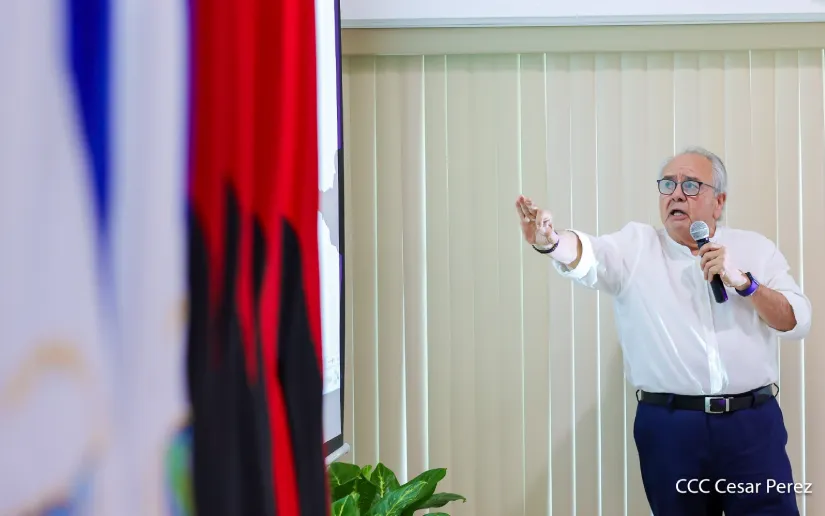
Presentation by Dr. Gustavo Porras
President of the National Assembly.
to the National Police Forces, during the Consultation Process
on the Reform of the Political Constitution
Thursday, July 30th 2026
First of all, I want to introduce you to the Compañeros and Compañeras present. And well, everyone is welcome; later we will offer our greeting, but I want to introduce you to the Compañeros and Compañeras who make up the Special Constitutional Commission. They are our brothers and sisters of the Executive Board present here, we have Compañera Loria Dixon, Doctor Wilfredo Navarro, our friend Compañero Alejandro Mejía Ferretti, our Heroine, Compañera Amadita Pineda, and our friend Compañera Maria Haydee Ozuna.
Also members of this Special Commission are the president of the Economic Commission of the National Assembly, Compañero Wálmaro Gutiérrez; Compañera Auxiliadora Martínez, who is the president of the Justice Commission; and we have Mario Asensio, who is the representative, the head of the IDB grouping, which is the Independent Democratic grouping; our friend Lester Flores, who is the head of the PLC grouping; and our brother Edwin Castro, who is the head of the Sandinista Front grouping.
We would like to welcome you all and express our greeting to First Commissioner Francisco Javier Díaz Madriz, who is Co-Chief of the Police Forces, the First Commissioner General, and to our brother General Victoriano Ruiz, Head of the Police Forces, the First Commissioner and Commissioner General.
We also have with us, so that we are all aware, Commissioner General Fernando Javier Ocón, Deputy Director General of the Police Forces. We have Commissioner General Aldo Martín Sáenz Ulloa, Deputy Director General of the Police Forces; Commissioner General Mauricio Lenin Sosa Robelo, Inspector General of the Police Forces; and also Senior and Junior Officers of the Police Forces, please be welcome all.
Without further ado, let's start this presentation, this explanation and Consultation. We, after Comandante Ortega's Speech, and since even before, following his guidance, have been working on a Constitutional Reform to gradually adapt the constitutional order related to elections, terms of office, and so on, and we received the order to go ahead on July 19th.
I think we all understood when on July 19th the Comandante clearly explained that there will be no elections here again; there will be no elections allowing the enemies of the People, the coup plotters, to try returning to government so as to take power to reverse the conquests of the People. That was a very clear orientation. And he said “We are going to work with the National Assembly on a series of laws to ensure that this happens.” And that was the mandate, a mandate which, in the end, sums up a need born of Nicaragua’s historical Process.
That is to say, when I am asked what I think of the Comandante's speech, I say that it is a speech which summarizes the history of the Nicaraguan people and makes a synthesis of what we need to do and how we Nicaraguans should move onward, that is the idea.
So, with that mandate, which is: There are not going to be elections that allow the enemies of the People to return to power. He didn't say there's not going to be an election at all, he said that there's not going to be an election allowing those demons to return. And that is what we have to guarantee, that the elections we carry out do not allow the demons to take over the instrument of government, of power, and roll back the conquests of the People.
There is a part of the speech in which the Commander says: “Why do they want to come back? To make business out of education”" He mentioned it, and I can well imagine any of those demons getting back and privatizing those beautiful hospitals which, little by little, we have been building, that was going to be their goal. That cannot be, no one can have that idea of a regression, of a return to those times.
So then, we took on the task of preparing, under the guidance of Comandante Daniel and Compañera Rosario, the bases of this Reform. And, in the end, we agree on seven concepts on which we must act to change and put into practice what they have told us to, because remember that the Comandante ordered us to put up a wall, a barrier, so that the coup plotters cannot return.
And so, to put up that barrier, that wall, to organize everything to achieve Stability, Security and Peace, which are three words necessary to combat poverty, which is the center, the ultimate goal of us all, of all Nicaraguans, Sandinistas or non-Sandinistas. The goal that unites us is to combat poverty. And, to combat poverty, we need Stability, Security and Peace.
Those three elements were the ones that guided us in the elaboration of this concept, along with not repeating history again. Do you have a slide to project of this story? As if to remind us, all of a sudden, we have found these, now we have begun this process. These are some pictures that were presented at one time by the Supreme Electoral Council, our own Supreme Electoral Council. But I'm going to read, there's this picture of the Yankees with Moncada.
"In January 1928, US marines arrived, controlled the electoral districts and, among other things, appointed Brigadier General Frank Ross McCoy as president of the National Elections Council, arranging the presidency of the country,” which was the objective they had to guarantee, General Moncada reaching the presidency of the country along with an absolutely pro-American government.
Then another one says: we are talking about 1928, when a Yankee intervention came and they seized the electoral body; that is, the Yankee brigadier was its president and the objective was to put Moncada in place. Then one might say: What an outrage! But no, worse things had been done. Remember that, almost 70 years earlier, a little more than 70 years earlier, in 1856, William Walker became President of this country. It was the most ignominious thing possible from the point of view of Sovereignty.
He totally destroyed it, made himself President and immediately reactivated slavery and that was his policy. And one has to ask: but how can this be?, well, they made the laws. Then there is an article covering how, in 1923, that is to say, five years before the elections were held, an electoral law known as Dodd’s Law was enacted.
And there are so many things to note, because here I checked the National Assembly files and there is this Dodd’s Act. There's the election law of 1923, known as Dodd’s Act. That law established the National Elections Council, which tried to institutionalize bipartisanship in the style of the Yankees, came to institutionalize it. And between 1928 and 1978 only the Liberal Party and the Conservative Party participated in elections, which was the bipartisanship established by the Yankees, who made sure to establish it from 1928 on. And here is a historical image of an official ballot recovered from that time.
The Conservative Party, whose candidate was Adolfo Díaz, and the Nationalist Liberal Party, whose candidate was Juan Bautista Sacasa. As we would say now, of both of them, and with some fear, make the Sign of the Cross totally; because whichever way you voted, you already knew you were voting for the Gringos, for intervention, as history showed.
So, this is the reality we had, Compañeros and Compañeras. So when you go back 100 years, at that time, in 1923, I was impressed, we don't have it, we're going to put it up, Section 2, of the Dodds Act. It's brutal, but I think I have it here. I am going to try reading it in its entirety, because it seems to me that this is so we can see everything that explains why we have to move onward.
Article 1 of Dodd0s Law states: "No citizen shall have the right to vote if they do not meet the conditions or qualifications required by the Constitution and by the present electoral law.” This is universal, nothing more than that every citizen has the right to vote, to choose and to be elected, as long as they meet the requirements.
But Article 2 is absolutely, let's say, descriptive of what was happening at that time, it says “The right to vote belongs only to Nicaraguan men." From there, one cuts off half the population. "21 years of age or older." The Nicaraguan population, until recently, not now, because we have changed demographic patterns, but until recently, when I say recently, I mean about 15 or 20 years ago, was constituted by 60% of children under 16.
So here we are making a reduction of the voting population to a small part of the people. Citizens, Nicaraguan males 21 years of age or older. "Those aged 18 or over will also be able to vote if they are married, naturally by the church, or can read and write.” So, right there, the voting population shrinks.
Any Nicaraguan male who, on the date of regular registration, is not of the age required by this law to have the right to vote, but who fulfilled it before the date of the next election of the supreme authority, will have the right to register if he meets all the conditions and requirements imposed by the Constitution.
So, when one sees that image, one knows that those who voted were those who walked around in bowler hats and suits. Those were the ones who voted, because they were men over the age of 21, married by the church, and, in addition, they had to be able to read and write. But no woman. That was the trick. No, that was indeed the trick, that was the imposition.
With all this in mind, we began to propose concepts. And the first concept sounds to us like a phrase that we have said and which we have to say, but it describes the concept: They won't prevail! and when I talk about concepts, I mean that these are the ones that are going to be transformed into constitutional form.
And this first concept, as it currently stands, goes like this, in Article 47: "Citizens have the right to elect and be elected and to run for public office, except for the limitations contemplated in this Political Constitution.” That is Article 47, which deals with the Political Rights of Nicaraguans.
In the Reform, it has many more words than those that I am going to present to you, but, summarizing for the purposes of the presentation, the following is added to it: “Coup plotters may not be candidates for positions of popular election nor may they hold public office by appointment of the Presidency of the Republic or election by the National Assembly.”
"Those who commit or have committed acts that undermine the Independence, Sovereignty and Self-determination of Nicaragua." And there, in the proposal, appears a series of descriptions of illegal acts.
For example, those who call for foreign military intervention, those who attempt and demand sanctions against the Nicaraguan State, against its institutions or against its citizens. That is to say, all that number of things that we spend our lives witnessing, things easily cast and thrown. But, as the song says “Outside you can say whatever you want” but inside, here, you can't be a candidate.
Why? By the Constitution, out of National Dignity, under the Constitution of the Republic, they are forbidden. Traitors to the Nation and it is clear that traitors to the nation are the end result of due judicial process.
And people say, "Well, they are accused of being traitors to the Nation and it should say: They are traitors to the Nation.” That's why we have to include it, because we should not only consider those who left on on the plane; there may be other traitors, apart from those who have already gone, there may be someone who appears tomorrow, they are accused of being a traitor to the Nation, found guilty and then they lose their political rights.
And, in addition, the law says that whoever is convicted of treason also loses their nationality. Even the Constitution says that. "And those who violate or have violated the principles contemplated in this Constitution." That's the first concept, that's one of the Reform articles.
It's put up here for us to point out, but with all the legal wording and so on, that's the first one. And, so that we do not forget, we put: They will not prevail! That is the wall, the barrier which Comandante Daniel and Compañera Rosario put to us to include in the Constitution, so that such treachery has no chance.
So, then there is a concept of what we include and what we are looking for: Stability. Stability is totally related to the times and periods of government. Imagine if, suddenly, there was a country where the period of government was one year, that is absolutely unstable. No one knows what to expect the next year, a period of two years is unstable. The more settled a period is, the more stable it is.
There are four-year terms. And I would say “In four years, what can you do?”. You just closed your eyes and opened them again and four years have already gone. Ah, but there are other models, where the four-year term is easily transformed into eight, because there is re-election. And, besides, the ups and downs do not necessarily depend on the parties, and those are bipartisan models, generally.
We lived that history. What difference did it make whether the president was a Liberal or a Conservative? After all, power was determined by outside intervention. So, turning the matter around, you have ten-year periods, which are very stable, they allow you to do projects. These are already medium and long-term projects. But you also have seven-year periods: Italy, Ireland; there are several countries whose electoral periods are seven years.
Such that we began to see and we believe that the proposal is that, with a period of seven years, settled projects can be developed, with stability, which is what we want so as to be able to combat poverty. And this is what this Reform contains, which covers two chapters of the Constitution. Why? Because six-year periods appear in those chapters, then they need to be changed to seven. I mean, that's the Reform.
And that is why it is set out as follows: “The period established in the Political Constitution of the Republic of Nicaragua for positions of popular election and for those of election or ratification by the National Assembly will be seven years.” So, all the positions, that is, Deputies, Deputies of the Central American Parliament, Mayors, Vice Mayors, Councillors and so on, every post that is of popular election remains at seven years.
However, we need, and that is another of the elements raised by the Comandante, Cohesion and Security. We have Stability, Security and Peace. To have security, we need coherence. So, it cannot be that some posts go on for seven years and the others go on for other periods. That is why, all at once, the Reform proposes that the periods of appointment of the Commander-in-Chief of the Military Forces of the Nicaraguan Army and the Heads of the Police Forces of the Republic of Nicaragua will be seven years.
So, we need to be coherent and that gives us Security. That gives us strength for our model of the People President, because that is what we are structuring. We are structuring a model that we have come to call, little by little, the model of People President. In other words, everything has to be according to the People. That is the one that you, brothers and sisters of the Police Forces, defend. It is the model of the People President.
And what is the model of the People President? It is the model in which everything is determined by the interests of the People. Everything, absolutely everything. All the actions and we are demonstrating that, because here every cent that can be obtained is sought so as to be invested to satisfy the needs of the People. And then a hospital appears, two hospitals, seventy-nine hospitals, improved technologies, free schools, free health care. Citizen security appears, a strong police, a police with technical skills, just like everything. To the extent that our country is defeating poverty and we are improving economic conditions, the conditions of our institutions will be better. The conditions of the members of our institutions are going to be better, that's how it goes.
But we have to have it clear in our mind where we are heading; namely, the model of the People President and it is palpable. That is, without going back too far, ten or twelve years ago, to go to Bilwi was an odyssey, or to go to Bluefields was an odyssey. Now, one leaves and in seven or eight hours we arrive, that's a reality. Little by little, we are moving away from those times of neoliberalism.
We have to move past them completely. That is what we must remember so as to know the things and people against whom we are putting up this wall, this barrier that Comandante Daniel has explained , the barrier so that they do not return. When we, in the hospitals, had to tell people: “Go buy a plaster, a gauze and bring the anesthesia.” We had to tell patients at that time, not now. And if, with the People President, they tell someone that, then the People, as the President they are, have to denounce it and say, “Look, they're saying that right there,” because it's not the policy of the Sandinista government.
The Sandinista model says: free quality health care, and we must comply with it. And the whole People, as the superior that they are, should be supervising and vigilant, and likewise in all our institutions. So that's what it's all about: Coherence and Security. Therefore, the periods are going to be seven years.
The text clearly states that, by the supremacy of the Constitution, by constitutional mandate and by full right, the laws that correspond to the Nicaraguan Army and the laws that correspond to the Police are reformed. Why? So as to make it clear that, by constitutional mandate, the period of seven years is established.
And then comes the question: who does all this? And now, at this point, we are not going to change anything, because there is no option: The president of the Supreme Electoral Council has to be Nicaraguan. That old history is over, because at that time, from which we have been emerging and which we have been defeating, the president of the Electoral Council was a Yankee brigadier. After 1979, that was behind us. They wanted to push us backwards later, but they couldn't and we say now: Nor will they be able to!
And we are deepening the transformations of the President's People's model. So, the Supreme Electoral Council is in charge of organizing and conducting General, Municipal and Regional elections every seven years, because it is not enough to say that the terms of office will be seven years. These periods have to be established through elections, and the elections are organized by the Supreme Electoral Council.
So then, the Supreme Council must be given the mandate to organize General, Municipal and Regional elections every seven years, in the corresponding election year. That means that there continues to be a national election, a municipal election and a regional election in consecutive years, every seven years.
But here faculties are added to the Supreme Council that have to do with what we had seen in the first concept. One faculty added is: "Not to grant legal personality to political parties when they are constituted with foreign financing or when one of their directors has violated the fundamental principles of this Political Constitution.” It is a principle of Sovereignty, Independence and Self-determination that must be present and which the Council must implement.
That means there cannot be a political party raising the flag of intervention or violating the Constitution. But, in addition, it is not only a question of not granting legal personality, but also of canceling it when a political party or any of its directors or candidates receive foreign financing or have violated the fundamental principles of the Constitution. So, here it is a question of giving the constitutional powers to the Council so as to be able to act in the implementation of the Constitutional Reforms.
As it says there, we are reforming three numerals of Article 152: numeral 1, which was the first; numeral 12, which is the one I have just read; and numeral 14, which establishes that: the Council shall verify and impose the corresponding sanctions on any candidate, official of the Electoral Body or member of the Executive Board of political parties who commits or has committed acts that undermine Independence, Sovereignty and Self-Determination.
So, the Council is being given the mandate to verify and apply the corresponding sanctions. This is the fourth concept.
Here is the fifth concept, which we call PAX, this change modifies two Articles of the Constitution, Articles 123 and 130. We call it PAX, after Darío's poem, because it is in honor of our National Hero and Universal Poet, Rubén Darío. And it is that “The date of possession of the Co-President of the Republic will be January 18th in tribute to our National Hero and Universal Poet Rubén Darío." So, this amends Article 123.
And Article 130 will be amended to establish that the Deputies of the National Assembly are installed on January 17th because the Assembly is always installed the day before, since, once installed, it is the one that executes the imposition of the presidential band and the inauguration. So, this is what is established and this is the sixth concept.
Because then everyone wonders, and it happened to us last time: "Aha, but what's going to happen to those who are elected right now? What will happen to those who are named now?”. So then, it is better to make that clear and that is where it is established that “By mandate and in strict observance of Constitutional Supremacy, the terms of the authorities elected by popular vote in the last General, municipal and regional elections in force are extended to seven years.”
So, in order to give coherence to everything, we put precisely “Coherence”. That is, all the terms of the last elections are extended to seven years. But, in addition, the period of the positions appointed by the Presidency of the Republic, as well as those of election or ratification by the National Assembly, is extended to seven years. All periods become seven years.
Of course, because of the importance of the National Army and the Police, and because they have specific laws, in the Reform it is made clear in a particular Article, which was the one I read, but here it fits all the designated positions. That is, I mention a few, because there are quite a few of them: the President of the Central Bank, the Superintendent of Banks, the Deputy Superintendent of Banks, the Executive Board and the Presidency of Banco Produzcamos. That is, there are a number of positions that are appointed by the President and elected or ratified by the Assembly. Then, all of these at once, are all extended to seven years.
And, so that there is no doubt, just in case “In all the current national legislation in which a period of functions is stipulated or regulated, it will be understood as fully reformed and it will be read that said period is seven years”.
So, there are all the concepts, which are relatively easy to cover. “They won't prevail.” We already know what it means: they will not be able to participate, they will not be able to be elected, they will not be able to have political rights. That's the first concept.
The other concept we have is "Stability”, that is, the seven-year period. Then, the concept that has to do with the Police Forces and with the Military Forces, which is “Cohesion and Security”.
Then, the concept that has to do with the implementing instrument of all these measures, which are the Supreme Electoral Council's powers. Then, the one we call “PAX”, which is Peace, in honor of Rubén Darío. And we close with the concept of “Coherence”.
So, we are readily going to remember each of the changes that we are going to make in our Political Constitution of the Republic of Nicaragua, which is the most important thing.
This is one more step in order to make clear that our Political Constitution of the Republic include the changes and is the Constitution of the People of Nicaragua, of us all and that we organize our Democracy as the People of Nicaragua tell us. It is not a democracy that someone else wants, only what Nicaraguans want. We organize and structure our social order to overcome Poverty. That is what we are doing and developing: a model of the People President.
That's it for now from me.
Thank you very much.