







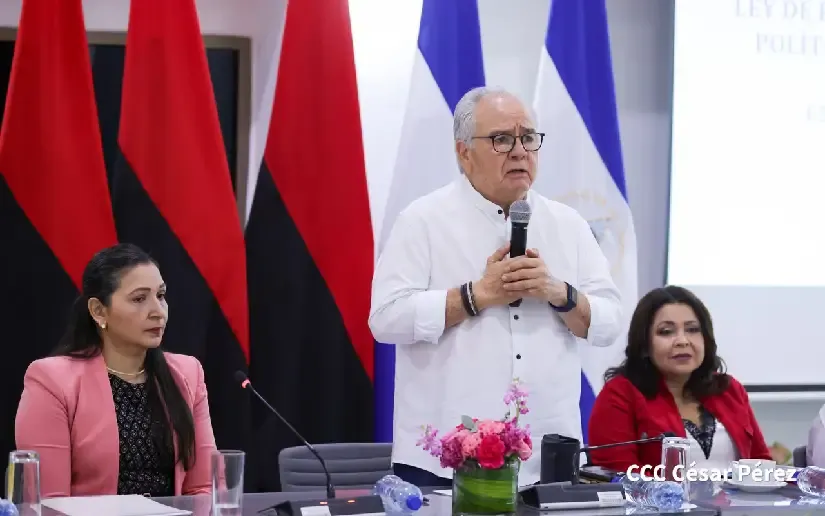
Presentation by Dr. Gustavo Porras
President of the National Assembly of Nicaragua
during the Consultation Process of the Constitutional Reforms to the Municipalities of the People President
Thursday, August 6th 2026
Good morning, Compañeros and Compañeras. We would like, on this occasion, to welcome our Compañera Wendy Morales Urbina, the Attorney General. Welcome, Wendy, to the National Assembly. She is accompanied by our brother Denis José Sánchez, who is the joint Attorney General, and Doctor Marlon Moreira, Superintendent of Property. Welcome, Marlon, and welcome, Doctor Denis.
There is also Compañero Denis Emilio Lacayo, who is the Procurator for the Municipalities, and the team of the Procurator's Office for the Municipalities who are present here. Everyone is welcome to this National Assembly. Today we have an interaction in person with you, with all the Members of the central working team of the Procurator's Office for the Municipalities, and also the virtual connection with all the Municipalities of the People President, in order to establish that communication and be able present the Consultation to you all.
We are also joined by the Members of the Population and Municipalities Commission of the National Assembly and I would like to introduce our brothers and sisters, who have been working on this Consultation Process and on the elaboration of this proposal for Constitutional Reform.
We have Dr. Arling Alonso, who is the First Vice-President of the Assembly. We have our Heroine, Amadita Pineda, who is the Second Vice President of the Assembly. We have our friend Maria Haydee Osuna, who has accompanied us. She is the President of the PLC and, in addition, the Third Vice-President of the Assembly, and she is someone who has adopted a position of permanent Unity since we started working together, and we have now been working together here since 2017.
We have Compañera Loria Dixon, who is the First Secretary of the Assembly, and too our friend and Compañero Wilfredo Navarro, who is the Second Secretary. As Members of the Special Constitutional Commission, there are also the Heads of the Political Groupings. We have Doctor Edwin Castro, who is the Head of the Sandinista Front grouping, our friend Lester Flores, who is the Head of the PLC grouping; and our friend Mario Asensio, who is the Head of the IDB grouping, the Independent Democratic grouping; which is composed of several parties.
And we have presidents of Committees that are integrated in this Commission, of the two main Committees of the National Assembly: Dr. Wálmaro Gutiérrez, who is president of the Production, Economy and Budget Committee, and Dr. María Auxiliadora Martínez, who is president of the Justice Committee. This has been the team that we have formed, in what is called the Special Constitutional Commission, which is mandated by Law to coordinate a Constitutional Reform.
A Special Constitutional Commission had to be formed so as to analyze the Reforms, to consult about them, to offer, at the appropriate time, its opinion and to follow up on approval, both in the First Legislature, which we intend to do at the beginning of the month of September, saluting the Month of the Patriotic Nation, and in the Second Legislature, which we intend to do in January next year.
After greeting everyone here once more, I thank them and also greet all the compañeros and compañeras who are connected on line... Here it is important to know that this whole Process which is guiding us, my colleagues from the Commission are starting to laugh, because by now they are already in their sleep dreaming of Stability, because we have been repeating this so often, which is important. In addition, we have to keep doing so, keeping it present.
Awake or asleep, the three elements we have to guarantee are Stability, Unity and Peace. Now, we have to guarantee and link these three elements to achieve the common goal that Nicaraguans have, all Nicaraguans, which is the fight against poverty. The common goal is to defeat poverty; so, we have to achieve the goal of combating poverty.
These are the concepts that guide the Constitutional Reform: Stability, Security and Peace in order to guarantee the fight against Poverty. Of course, these concepts, which one views as benign, are universal concepts. However in Nicaragua they become actually subversive against those who want to dominate the world. That is to say, anyone can talk about Stability, Security and Peace, but it’s somewhat different when spoken of by Nicaraguans, by Sandinistas, in this era and in any era, it has always been that way.
When Nicaraguans talk about Stability, Security and Peace, that is an approach which is not accepted by the established order in the world, which is one of domination. That is to say, Security, Stability and Peace are something that, in the mouth of the imperialists, means: “I'll give you Stability, I'll give you Security and I'll give you Peace.” That is to say, in case you don't understand, what they give you is the peace of the cemetery, as we can see in all those terrible situations around the world.
But for us, we have to fight for these concepts day by day and we have been fighting for them for centuries, that's the truth. Why? Because our own development as a People and as a country, and I say as a People because we started as a People, nothing more; we still didn't have, or we weren't called Nicaragua. That is, it was started by someone who called it Nicaragua to defend this territory and to defend the human beings who lived in this territory.
Confronting whom? Nicaragua fought against Spanish colonialism and, from there on, we have been fighting against those who came to impose Peace, Security and Stability on us from outside, with the sword in one hand and with other things in the other hand, on the other side: the Bible or beads and mirrors. But they came with that goal. These concepts, truly accepted by the People of Nicaraguan, are basic in the entire Nicaraguan Historical Process and in the Nicaraguan Revolution. We mention all this since you can see how the empire's puppets are constantly watching and observing.
Comandante Daniel came on July 19th and made a proposal to all Nicaraguans. The central proposal was: "There are not going to be elections so that those who are trying to destroy the country and the Nation can take over the government again, seize power and change all that we have been achieving by way of combating poverty." That's what the Comandante said and they're not going to prevail... They Won't Be Able To, They Won't Be Able To, They Won't Be Able To!
This is a Process, a result of historical struggle. I recalled our first Indigenous Anti-Imperialist Heroes, but then 300 years passed and we managed to achieve independence from Spanish colonialism. After three hundred years, in 1821, as Central America. And then we continued and we were then constituted as a Republic, and we barely had a short time to call ourselves Nicaragua when the force that was expanding at that time came, it had its own internal struggles, but it was based on the contradictions inherent to imperialist expansion.
So the Yankee filibusters appeared in Nicaragua. 1854, 1855 and 1856 indicate what Darío told us about twenty years later, writing: The enemy is from the North, because William Walker came here. He made war on us, took possession, received the approval of some three or four countries and became President of this country and that was thought to be democratic and supposedly under the banner of seeking Peace. They claimed they were peacemakers but the first thing he did was to decree slavery again on our soil.
And here came the struggle of us Nicaraguans and that lasted until the end of the nineteenth century and the beginning of the twentieth century. Ruben Darío appeared with all his enormity, majesty and his prophetic vision of everything that was going to happen. The Liberal Revolution came, which was composed of new forces at that time. They destroyed the foundations of the Conservative system, which really was a system absolutely linked to the commands of the Catholic Church at that time, in terms of structuring and of the Conservative hacienda system and that was the reality.
Then everything changed and civil rights appeared, the State appeared, as we are familiar with it and as we know it now, and the secular state appeared. Everything we now know about how the Liberal Revolution brought benefits. But it entered into the central contradiction. How so? Because when it was decided to seek to make the canal through Nicaragua and Zelaya proposed that there should be elements from other countries participating, the Yankees said no, since they were finishing the Panama Canal, and so they removed Zelaya, sent him the Knox note, sent some gunboats to frighten him and so they removed Zelaya.
But Zeledón appeared, and Zeledón raised the banner of struggle against the intervention of 1912. And Sandino saw how Zeledón’s body was dragged through the streets, and he did not cower; rather, he was indignant. And here again comes the history of the struggle of the Nicaraguan people. So that's how we got to 1927. The Espino Negro Pact, Stimson meets with Moncada, they make the pact and Moncada is promised that he will be elected President, that was in 1927. Sandino does not accept that and takes up his anti-imperialist flag.
But even before then, in 1923, when Adolfo Díaz was President, they were already preparing the conditions for their scheme to prepare the country and its Republic in the image and likeness of the metropolis, in the image and likeness of the Yankees. Then, in 1923, they brought out this thing that we see here, the electoral law known as Dodd’s Law, Dodd being a Yankee academic whom the President of the United States and the State Department hired as an Adviser and, furthermore, sent him to Nicaragua.
And the Nicaraguan President hired him as an Advisor to write this law, where they, in their heads, what they wanted to impose, and what they did imposed for fifty years, from 1928 when Moncada took office, until 1978, after the Sandinista Revolution came, was to impose bipartisanship. So, that was the Dodd’s Act, which was the two-party framework, the Yankee, Anglo-Saxon framework.
You can see these were the ballot papers in 1932: the candidate for the Presidency was Adolfo Díaz, for the Conservatives, and the candidate for the Liberal Nationalist Party was Juan Bautista Sacasa. Both of them we can regard with apprehension. Since one of them called for the US intervention and, moreover, was the President in 1923, when the electoral law was created. And the other one is the one who invited Sandino to his last supper. Those were the two candidates, both to be regarded with concern, that was the reality.
But even that was not enough, while this law lasted from 1923 to 1928, there were several situations. Among them, in that period, there was the coup attempt, when Emilio Chamorro staged a coup that the Yankees did not accept. Back then everything was being run by the Yankees until the Espino Negro Pact was reached, in 1927. And they had to guarantee that the elections of 1928 handed the government to Moncada, that was the agreement.
So, to guarantee that, and that's what we must never forget, that's our starting point. That’s what we have to exclude constitutionally, because it is excluded in our laws, for example, in the electoral law and in the other laws. But we have to make sure we leave behind that terrible period via the Constitution, we have already been doing so, and now we are doing so for good. They keep trying to create opportunities so as to return to the past. They did so in 2018 in a criminal coup attempt.
We are clear that they will continue trying. They wanted to stir controversy via the OAS, but, since they swallowed the lie that there were not going to be elections, really now they are just trying to justify the money they are paid, since it did not work out for them, and also, since they are in other countries, they have to lie absolutely shamelessly.
In any case, back then, in January 1928, the US Marines arrived. They controlled the electoral districts. That is to say, a Marine was the head of each polling station, in what we now call the electoral districts. And they appointed as president of the National Council of Elections General Frank Rose McCoy, a gringo sent by the Yankee President to take charge of the National Council of Elections and ensure that Moncada would become President of the country, all so as to fulfill the pact they had agreed.
That has been the political reality in our country and that has been our permanent struggle. There, in the middle of all that, then comes the murder. There were elections in 1928; then again, in 1930 and 1932; and, later, in 1934, came the betrayal and assassination of Sandino, seeking to eliminate the person in that period was fighting against the Yankee intervention. In 1934, Sandino came to seek peace, which is, as we said, after all, the greatest aspiration of all Nicaraguans. That is why we must take care of it, even if we make the mistake of overdoing it, but we must take care of it, because it is much more serious for our Peace to be broken than any subsequent correction. That is the truth, Peace is the aspiration of all Nicaraguans.
Here, an example of how things were, in this issue of the Official Gazette. You might say all this is one's imagination, but no, it is a reality. This is the Gazette of Tuesday, April 3, 1923. There is the Dodds Act, where the basis of that democracy of 1923 was expressed. One can say: that was a hundred years ago. Yes, a hundred years ago, and really in those hundred years there have been even more changes in this country, most of all, in the forty-seven years of July 19th that we have had, that is the truth.
So, you might ask: And what was the problem? If there were votes cast, then the problem came from the definitions, as we can see here. Were they free and democratic? No, not at all. Look what it said here: the right to vote was only for Nicaraguan men. Woman did not have the vote, they did not exist, were not citizens, had no political rights, we are talking about 1923. The only people who had rights were Nicaraguan males, but, in addition, only if they were 21 years old or older.
And there's the problem... If you have a hundred Nicaraguans, fifty-two are women, that means that there are only forty-eight who are able to vote. And, at that time, you see, the over sixty percent population was twenty years and under. Suppose sixty percent of the population were under twenty years old. The population over the age of twenty-one could be forty or thirty-five percent. Let’s say it was forty percent, that is, of those hundred Nicaraguans, only twenty could vote, which is forty percent of the forty-eight percent of existing males. So, there's the problem.
Now, of those, how many were employers? If they were five percent of a hundred Nicaraguans, then five were employers, maybe, or maybe four, the rest were employees. That's what was recorded in the headlines, in the history, and there's the photograph. The employers appear there, those gentlemen in suits and bowler hats, and their workers with their canvas shirts, whom they took to vote, and that was the basis on which this profile of voters was supported. So, everything was fixed and it was clear how the system worked, but that is the Democracy they keep telling us about. Of course, that has evolved, but it remains much the same even now in all these countries.
So, that was the Dodds Act, but even that wasn't enough. That's the electoral law of 1923. Then in 1928 the administration comes along and issues a decree to modify the law and to suspend it, that is the reality. The decree suspended the law that had been prepared while leaving everything the law mandates in terms of electoral districts, the framework, the electoral structure, but it suspended the part we can see here. This is called the McCoy Act, which says:
“In view of the fact that the Supreme Court, by agreement of the seventeenth day of the current month, accepted the resignation of Joaquín Gómez and appointed General McCoy President of the National Elections Council, and that this high official, in that capacity and having been appointed by the President of the United States, shall direct the 1928 elections of the Supreme Authorities, in accordance with the agreement to put an end to the Civil War ravaging Nicaragua.”
That is, according to the Espino Negro Pact, the President of the United States directs that General McCoy be appointed president of the Elections Council, which is the body that has to comply with Moncada being the President, that is the interpretation as we can see today.
Today, this morning, I was watching an analysis and some criticism of a Central American President, because all this brings up a debate about why some Central American countries did not speak out at the OAS, and they issued the same statement, when they were speaking: What happens is that in the other countries - referring to those who did attack us - the Yankee is really in charge. And this is reflected in the our country’s historical documents.
Then, and later comes the history we have come to know with great familiarity ourselves, which is the story of Sandino's assassination, of the compañeros who stood fast and kept Sandino's struggle alive, of how that murder permeated and endured in the consciousness and in the heart of the Nicaraguan People, of how the struggle was organized, how the Sandinista Front was born, of how Santos López became the vital link between Sandino’s forces and the new forces of Sandino with the Sandinista Front and of how the enforcers the Yankees left behind, which was first the Constabulary, that turned into the National Guard and, in that way, they left behind them creole marines, born here, but with Yankee thinking, from West Point, they left them behind to take care of what they call their backyard. So, that made sure they lost nothing...
In other words, that was the embodiment of the enemy and against it the Sandinista Front led an insurrection. The People took up that struggle and we arrive at 1979. That is why this bipartisan system ended in 1978 and then 1979 is the year of the Revolution. That is what we know and, for that reason, we now understand how much meaning the Nicaraguan Revolution has and how much of a thorn it represents for Yankee imperialism, that the Sandinista Revolution has been going on for forty-seven years, and they have thought constantly about how to defeat us, first by waging a ten-year war, using the Contra, investing money, playing crooked games with drug trafficking and everything we now know.
However, in that struggle, and later on against neoliberalism, Comandante Daniel showed us clearly, and demonstrated democratic commitment by handing over the government in the 1990s, after an electoral fraud mounted on a perfectly clean electoral mechanism. The clean electoral mechanism was ours and the fraud was that of the Yankees, who created an image in white and said: "If you don't vote for this image and instead vote for the Sandinista Front, the war continues."
Our people are smart, and that was a vote with a gun to their head. The people voted for the Yankees and we, as part of the People, Comandante Daniel, as part of the People, understood that the right thing to do was to hand over the government and prepare to fight on, as he himself told us, from below so as to return to government, as he himself told us, by way of votes, which was what we did in January 2007.
We know that history and with that history we arrive at 2025. In the Constitutional Reform of 2025, now with the experience of the attempted coup d'état, we developed this Article One of our Constitution, which has been reformed several times, the last time in 2025, and it reads:
“Article 1: Independence, Sovereignty, National Self-Determination, Security and Peace are inalienable rights of the People and the foundation of the Nicaraguan nation. Any interference in the internal affairs of Nicaragua or any attempt to undermine those rights threatens the life of the People. It is the duty of all Nicaraguans to preserve and defend that right.
Consequently, all those who violate these sacred rights of the Nicaraguan people will be considered traitors to the Nation.”
That is to say, all those who act against this article lose their political rights. No one who acts against this article can be a candidate, nor belong to the Executive Board of a political party nor be part of an electoral authority, that is clear. That's what the Constitution says right now, but this needs to be supplemented.
And so we come, we arrive to the point. As you can see, I have seven minutes left and you may say that I have not talked about the Concepts at all, but in fact it’s because those are the easiest part and the most important part is that we understand the historical step that we are taking. How so? Because I can summarize the concepts to you in six words or in six sentences:
They will not prevail, Stability, Security, Electoral democracy guaranteed by the Supreme Council, PAX, Coherence.
These are the six concepts. These six concepts are the ones making up this Constitutional Reform that we are consulting on with you.
One, “They won't be able to prevail.” What does that mean? That the coup plotters, those who commit and undermine the Independence, Sovereignty and Self-Determination of Nicaragua, traitors to the Nation and those who violate or have violated the Fundamental Principles contemplated in this Political Constitution cannot participate in the elections, they will not be able to.
Now, if you want more of an idea of what that means, that is to say: all those who commit or have committed acts that undermine the Independence, Sovereignty and Self-Determination of Nicaragua, incite or promote foreign interference by any means... record a TikTok and start calling for the US military to come, saying: “the aircraft carrier is on the move" what do I lose if it moves?... ask for military intervention, organize with financing from abroad, propose actions or support economic, commercial or financial blockades and sanctions against the State of Nicaragua, its institutions and its citizens.
How is someone who writes that it is all right for these bandits to impose sanctions and, moreover, that government institutions should be sanctioned, to be able to participate in a Nicaraguan election? They can't and they won't be able to.
The other concept is "Stability”, the period of office has to give us a sense of Stability. It has to be a long enough period to fulfill projects beyond the medium term or close to the medium term. It has to be a period that allows us to make sure that people can perceive the changes that take place in seven years.
We are 19 years into this second stage of the Revolution and no one can have any doubt, if they remember and were alive nineteen years ago, about what has changed here. In other words, there is no doubt, you only have to look at the lights; look at the streets, the roads, the lighting in our country, we have progressed. Look, you can go to the Atlantic... it stuck with me when they taught us that at school, because they called our coasts the Pacific and the Atlantic. The Caribbean is now a new concept from a Revolution of Unity.
You can go to the Velez Paiz hospital and they don't charge you a cent, you can go to the HEODRA hospital in León and they don't charge you anything. In Bilwi the inhabitants there now have a regional hospital. They are going to have a regional hospital in Bluefields and here, in the eastern part of Managua, we are going to build another hospital, and so we can go on, the hospital in Las Segovias, the Choir of Angels pediatric hospital in Esteli. But what does that really mean? That we need time, a hospital is built with our own funds over four years; with loans from banks, it can take six years. Why? Because approvals have to come and go.
But you have an acceptable period: seven years, that's what is being proposed here in Nicaragua. There are other countries, in Europe, such as Italy and Ireland, that have periods of seven years. In Africa, most are seven years. There are seven-year periods everywhere, just as there are countries which have grown in economic terms since they have ten-year periods. In Latin America, most have periods of five and six years. And those who most wave the flag of Democracy have periods of four years, because no no matter what kind of person the president may be, the ones who are in charge are the others. You know who I mean, the same as with General McCoy and all that.
Third concept: "Cohesion and Security" What does this mean? It means that, if those who are elected and those who are appointed by the President are for seven years, then the Military Forces, the Commander-in-Chief of the National Army and the Heads of the Police Forces must also be for seven years. So, this Reform mandates reforming the laws related to these two Institutions.
Let's go with concept number four: “The Guarantee of our Electoral Democracy” which is the Supreme Electoral Council and here it is given the power to organize elections every seven years, not to grant legal personality to political parties which receive foreign financing or which are formed with foreign financing. And also the power to cancel the legal personality of a party when its directors or candidates receive foreign funding or have violated the Fundamental Principles of the Constitution. That's understandable.
Since those prohibitions were not yet made clear in the Constitution, now they will be. So, you have to give the power to the entity concerned, to the political instrument, to enforce those laws, the power not to grant legal personality or to cancel it. Because while before it said that the Supreme Electoral Council could grant or deny, here it is expressly stated that in the cases mentioned it will not grant legal personality and that it will cancel in these other cases.
And, then, in order to verify and impose the corresponding sanctions on any candidate, official of the Electoral Body or member of a party’s Executive Board who incurs or has incurred in undermining Independence, Sovereignty and Self-Determination. That is to say, in all that list, no one will be allowed to pass as a member of a party’s Executive Board who is making calls for military intervention or someone who is applauding the sanctions. That cannot be, and that's just the way it is.
The fifth concept is "PAX". Peace, in honor of Ruben Darío, and that is a really lovely poem by Dario. I always think we should include a verse from it, since it is very powerful. But Darío was born on January 18th; that's why we are proposing that we approve the reform on January 18th next year, in the Second Legislature. So the inauguration of the Co-Presidents of the Republic will take place on January 18th, in honor of Darío. This is a change, since it was a Constitutional precept that the date was January 10th, now it's going to be the 18th. We were in fact committing a historic lack of recognition to Darío. This affects two Articles, because also in Article 130, it states that the National Assembly is installed the day before; that is, it is to be installed on January 17th, because the National Assembly is the one that facilitates, in a solemn session, the inauguration.
Finally, what we call "Coherence”, which I mentioned among the six concepts. Coherence, is that we are going to make these modifications as we are proposing. But this has to be consistent with reality so as to adapt what is current, to the Constitutional reforms. So, in order to achieve this Coherence, what we need is for all of us who are here, popularly elected, to move from six to seven years, both the current posts and the recently elected posts.
This is what it says here referring to the periods of the authorities elected by popular vote in the last elections. So, everyone watching us here, who are all Mayors, Vice Mayors and Councilors. The reform states your terms have been extended to seven years from the date of your election.
That is to say, the national elections last until 2028, because the election would be in 2028, if the Reform is approved, and the inauguration would be in January 2029. The same happens in the case of municipalities, mayors and mayoresses, that will be an election in 2029 and those elected will then take possession after that election. So, everything is moved and the period, from the date of the previous election, becomes seven years.
The positions appointed by the Presidency of the Republic or that are elected by the Assembly, or those appointed by the Presidency and ratified by the Assembly, are all seven years from their last appointment. And, in all legislation, the period changes to seven years. These are the six concepts.
Then, since that change has been set out, so as to make clear all the positions that pass to seven years, here are the ones we are talking about: the Chiefs of the Army and the National Police, the Supreme Court Judges, the Supreme Electoral Council Judges, the Procurators, the Attorney General of Justice, the Superior Councils of the Comptroller's Office, the Central Bank, the Monetary Financial Council, the Superintendents of banks, the Presidents and Members of the Board of Directors, the Microfinance Council, the TATA, the Administration and Judicial Career, the INE Board of Directors, the Water Authority and the Civil Service.
These are the appointed or ratified, elected by the Assembly. We have already mentioned all the positions of popular election, which applies to the Compañeros and Compañeras who are Mayors, Vice Mayors and Councilors, every post that is elected by popular election. That is, everything comes together and there is consistency over the period of seven years.
Such that, these are the principles; this is the historical basis, this is the need to advance in these processes and to make them increasingly irreversible, being the central principles to achieve Stability, Security, Tranquility and Peace, which is absolutely necessary in order to emerge victorious in the fight against Poverty.
I will stop there and give the floor to you. I don’t know if comments can also be made, but I leave matters to Compañera Dr. Wendy Morales, who directs this part of the presentation.
Thank you.