







Meeting with Indigenous and Afro-Descendant Peoples
during the Consultation Process on the Constitutional Reforms
Friday, August 7th 2026
Introductory remarks of Comandante Lumberto Campbell,
Coordinator of the Secretariat for Caribbean Coast Affairs
Good afternoon, Compañeros and Compañeras; beloved Doctor Porras, President of the National Assembly; beloved Members of the Executive Board of the National Assembly, Members of the Constitutional Commission; Compañeros and Compañeras, everyone.
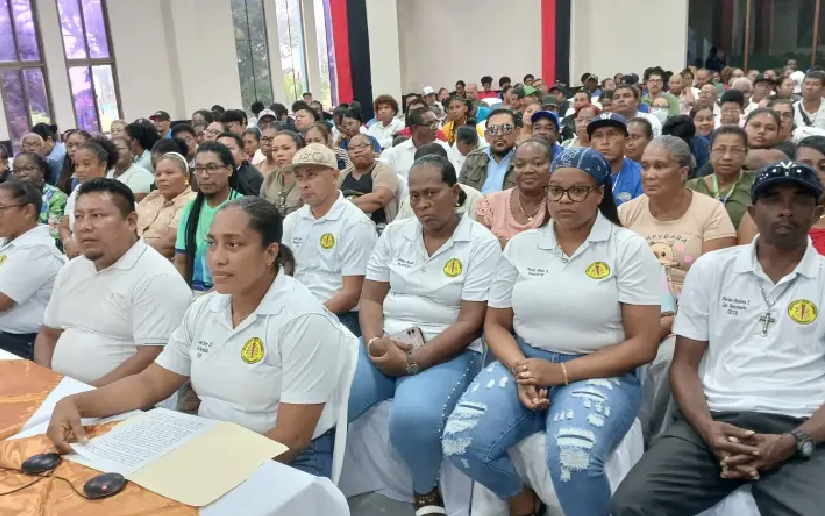
Yesterday we had the meeting with the Municipal Authorities and the Regional Governments. Today we are meeting with the Territorial Governments, 23 Territorial Governments, we are talking about 23 territories where our Indigenous and Afro-descendant Peoples live.
In 2007, when we returned to the Government, there were zero territories titled in the name of Indigenous Peoples. Today, there are 23 territories in the name of Indigenous Peoples. The Comandante said“ "We are not giving away anything. We are recognizing the Right of the Peoples of the Nicaraguan Caribbean Coast who existed before the Republic of Nicaragua existed.”
As regards the recognition of these territories, we are talking about the recognition of more than 37,000km2 of these Peoples. By way of reference, that's like talking about 1.7 times the size of the Republic of El Salvador. So when we talk about securing our Constitution, establishing a barrier so there is no regression in all that we have advanced, as we said yesterday, on the Caribbean Coast we think this makes sense and resonates with us because we know how disastrous those previous years were.
In that sense, all the Compañeros and Compañeras, both in the Upper Wangki, in the Northern Caribbean, as well as in the Southern Caribbean, there they all are, the Compañeros and Compañeras of these Territorial Governments waiting to get this good news which guarantees moving onward in our process of self-determination and development on Nicaragua’s Caribbean Coast.
Address by Dr. Gustavo Porras:
Thank you Comandante.
Good afternoon, Compañeros and Compañeras. greetings to all the Compañeros and Compañeras who are taking part, both those present here and the Brothers and Sisters who are connected virtually on line. Comandante Campbell was telling me we have connections in Bilwi, in Bluefields, in Alto Wangki and in Laguna de Perlas. In other words, there are more than 400 Compañeros and Compañeras connected, Blessed be God that we have this possibility.
I'm going to introduce you to all the Compañeros and Compañeras. Here are the Compañeros and Compañeras who work in the Secretariat of the Caribbean Coast. Here too are the Compañeros and Compañeras who are members of the legislative Committee on Indigenous and Afro-Descendant Affairs, and members of the Special Constitutional Commission.
The Special Constitutional Commission is composed of the members of the National Assembly’s Executive Board who are gathered here. Dr. Arling Alonso, who is the First Vice President, Compañera Amadita Pineda, who is the Second Vice President, Compañera María Haydee Osuna, who is the Third Vice President.
Here too we have Compañera Loria Dixon, who is the First Secretary and our friend Alejandro Mejía Ferretti, who is the Third Secretary. So these are Members of the Executive Board.
But here we have as well, in addition to the president of the Committee for Indigenous and Afro-Descendant Affairs, who is Compañera Shayra Downs, we also have Dr. Edwin Castro, who is president of the Sandinista Front Political Grouping. Also our friend Lester Flores, who is president of the Liberal Constitutionalist Party Political Grouping and our friend Mario Asensio, who is president of the Independent Democratic Political Grouping, the IDB.
We have with us as well president of the Justice Committee, Compañera Auxiliadora Martínez and Dr. Wálmaro Gutiérrez, president of the Economic Committee. That’s everyone who is here with us, along with the welcome presence of Comandante Campbell. Greetings to all.
We are going to present to you the Proposal for Constitutional Reform Proposal that we are making, and this presentation is by way of consultation. Today we will be culminating the first week of work, during which we have practically completed nine consultations. And we want to convey the following to you: our Constitutional Reform Law aspires to and follows along the lines of three concepts: Stability, Security and Peace. All Nicaraguans, both from the Pacific, the Central region, and the Caribbean, all Nicaraguans want Peace.
And that is a general concept of everyone: we need Peace, and Peace does not come by itself; it comes articulated, it comes jointly with Stability and with Justice. If we want there to be Peace, there has to be Stability, and there must be Justice and Security. Security does not come by itself, it has to be accompanied by Peace. For there to be Security, there has to be Peace. If there is no Peace, there is no Security, and there must be Stability too. In the same way, Stability is determined by Security and Peace.
I mentioned Justice, because it is an important concept. Because in order for there to be true Justice, the Nicaraguan people must overcome Poverty. Poverty itself is an injustice, the fact that some have more possibilities and others less, is injustice. So we seek Justice in order for us all to have the same chances.
By focusing on these concepts of Stability, Security and Peace, we can defeat Poverty. That is the central objective that has been permanently defined by Comandante Daniel, by Compañera Rosario, by the Sandinista Front, it is what guides all of us.
Now, following that guide, let's move on to Article One. We have embodied that guide and those elements in the 2025 Constitutional Reform. Last year, we approved an Electoral Reform in the Second Legislature that focused on Article One, which has to do with Fundamental Principles.
Article One is somewhat broad but it delineates the Fundamental Principles. Let’s take a good look at what it says:
“Independence, Sovereignty, National Self-determination, Security and Peace are inalienable rights of the People and foundations of the Nicaraguan Nation. Any foreign interference in the internal affairs of Nicaragua or any attempt to undermine those rights, threatens the life of the People. It is the duty of all Nicaraguans to preserve and defend these rights.”
It's very clear there. We must preserve, as Nicaraguans, Independence, Sovereignty, Self-determination, Security and Peace. That is the obligation we Nicaraguans have. And anyone who tries to undermine these rights, these foundations, attacks the life of the People. That's certain.
"Consequently, all those who violate these sacred rights of the People will be considered traitors to the Nation.”
This is the central guiding principle. Now, we accompany this central guiding principal with the great objective all Nicaraguans have, which is to defeat Poverty. Because as long as there is Poverty, there will not be full Security. As long as there is Poverty, there will be no Peace. As long as there is Poverty, there will be no Stability. As long as there is Poverty, we are not going to be really free. That is the path we have to follow.
I present this Article One, because it is the result of a historical struggle that we have lived through. Because in order to translate this Article One into the Constitution, which is the Fundamental Law of our country, we had to arrive at it via a centuries-old history of struggle. Because in order to have this Freedom to reject foreign interference, and to be able to embody that freedom in Article One of the Constitution, signifies all that we have been fighting for against foreign interference throughout our history.
So now we have clarified in the Constitution of our Republic, that we are against all foreign interference. Why? So as to have Independence, to have Self-determination, to have Security, Justice too, Peace and Sovereignty, which is what we have.
We can refer to the struggles we have been going through and the situations we have confronted. That is to say, we were not yet Nicaragua when our Indigenous Anti-Imperialist Heroes were fighting against Spanish colonialism. That is the history of our People.
Subsequently, Spanish colonialism, on this side, the Pacific, and on the Caribbean side, English colonialism, these are the realities that obliged us to fight during all those years of permanent struggle.
Then came the Independence of Nicaragua which was in 1821, 300 years after the struggle of our Anti-Imperialist Indigenous Heroes began, in 1821. That is why, on September 15th 1821, we commemorate the proclamation of Independence, and that is part of what we have named as our National Holiday.
And there is also another date that is September 14th 1856, which is the date of the Battle of San Jacinto, and we commemorate the victory of the Nicaraguans over a Yankee filibuster contingent. That is to say, several years after 1821, already in 1854, 1855 and 1856, another actor appears in the history of Nicaragua’s struggle, which is the expansionism of the Yankee empire.
A Yankee filibuster from the south of the United States came here, declared himself President of the Republic of Nicaragua and reactivated and decreed slavery. That's part of our history and that's where our struggle comes from. Then came the Liberal Revolution; then comes the Yankee intervention in 1912 and Benjamin Zeledón appeared, another National Hero.
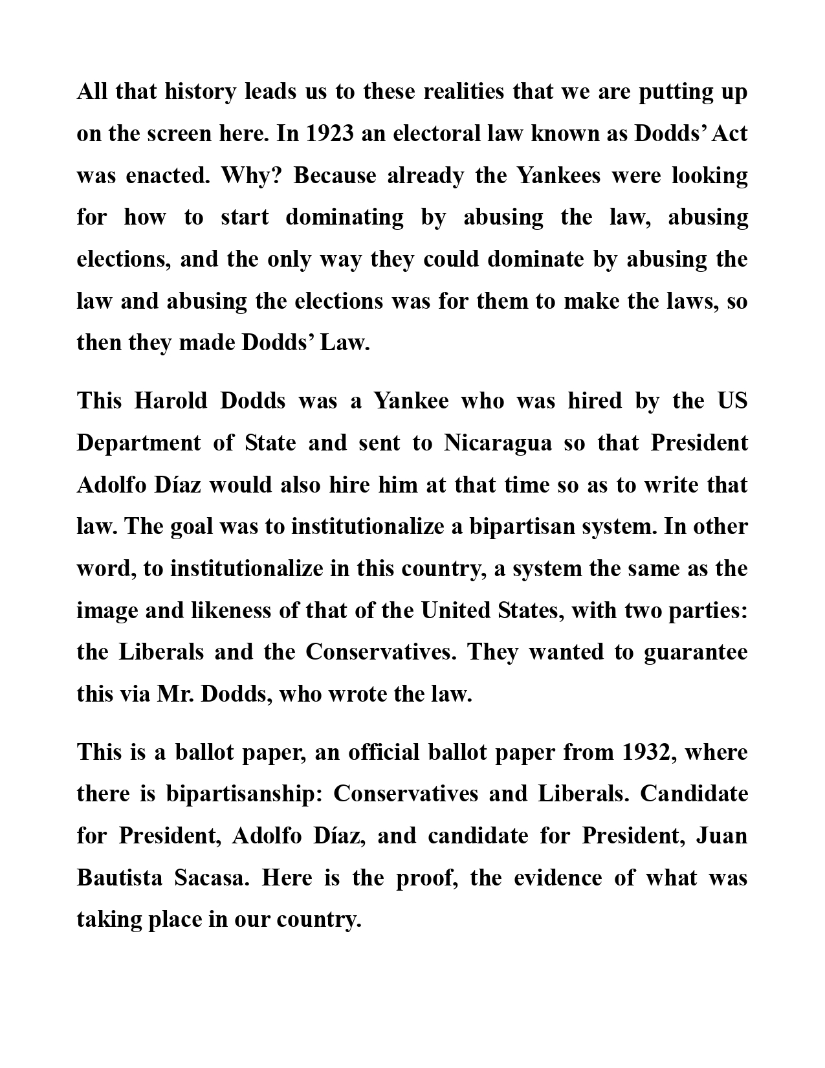
Then, those struggles gave rise to Sandino. Sandino, fighting against the Yankee intervention, when on May 4th 1927 he rejected surrender to the Yankees and went into the mountains. All that history leads us to these realities that we are putting up on the screen here. In 1923 an electoral law known as Dodds’ Act was enacted. Why? Because already the Yankees were looking for how to start dominating by abusing the law, abusing elections, and the only way they could dominate by abusing the law and abusing the elections was for them to make the laws, so then they made Dodds’ Law.
This Harold Dodds was a Yankee who was hired by the US Department of State and sent to Nicaragua so that President Adolfo Díaz would also hire him at that time so as to write that law. The goal was to institutionalize a bipartisan system. In other word, to institutionalize in this country, a system the same as the image and likeness of that of the United States, with two parties: the Liberals and the Conservatives. They wanted to guarantee this via Mr. Dodds, who wrote the law.
This is a ballot paper, an official ballot paper from 1932, where there is bipartisanship: Conservatives and Liberals. Candidate for President, Adolfo Díaz, and candidate for President, Juan Bautista Sacasa. Here is the proof, the evidence of what was taking place in our country.
I was referring to the fact that on May 4th 1927, the Espino Negro Pact was made, and it is the Day of National Dignity because Sandino did not accept this surrender. Sandino that day made clear and expressed his decision to fight against the Yankee intervention, calling those who accepted that pact, traitors and sell-outs, and he went on to fight.
On May 4th 1927, in that pact the Yankees committed themselves to agreeing that, once Moncada surrendered the Liberal forces and handed over the rifles with which they fought in their Liberal Army, Moncada was going to be made President. So, to fulfill that commitment, they did the following: in 1928 they bring in US marines, and they control the electoral districts.
That is to say, what we all know now as the voting constituency, the polling stations, the electoral districts, and what we now call the voting centers, which cover a certain area, there they put a Yankee marine to head each one as its president. But even that was not enough, so they appointed a Yankee Brigadier General, Frank Ross McCoy, as president of the National Council of Elections, what is now the Supreme Electoral Council. Such that he would be in charge of ensuring that Moncada became President; that is to say, they wanted to guarantee the deal that was agreed in the Espino Negro Pact. And that has been the history of our country.
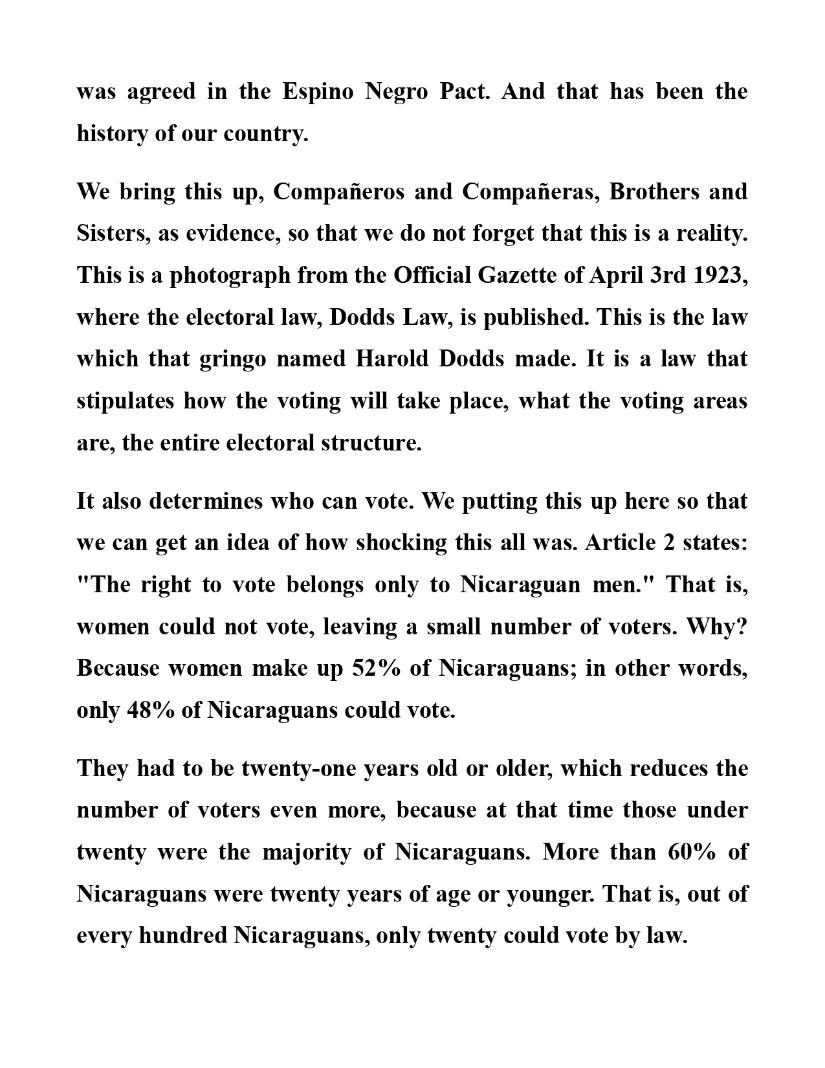
We bring this up, Compañeros and Compañeras, Brothers and Sisters, as evidence, so that we do not forget that this is a reality. This is a photograph from the Official Gazette of April 3rd 1923, where the electoral law, Dodds Law, is published. This is the law which that gringo named Harold Dodds made. It is a law that stipulates how the voting will take place, what the voting areas are, the entire electoral structure.
It also determines who can vote. We putting this up here so that we can get an idea of how shocking this all was. Article 2 states: "The right to vote belongs only to Nicaraguan men." That is, women could not vote, leaving a small number of voters. Why? Because women make up 52% of Nicaraguans; in other words, only 48% of Nicaraguans could vote.
They had to be twenty-one years old or older, which reduces the number of voters even more, because at that time those under twenty were the majority of Nicaraguans. More than 60% of Nicaraguans were twenty years of age or younger. That is, out of every hundred Nicaraguans, only twenty could vote by law.
In addition, those who were eighteen years old could also vote if they were married or could read and write. Imagine, at that time, when it was the Revolution that managed to bring down the levels of illiteracy. Back then it was to ensure that the children of the bosses, teenagers, and eighteen-year-old young men, could vote, because those were the only ones who could read and write at that time or were married, when being married at that time is not like now; there was no civil marriage by a lawyer, only marriage by the Church.
So, with all this what we want to do is to see the concepts of democracy that were sold to us. In other words, what democracy? After all, those who voted here were the bosses, who, being bosses, were accompanied by their employees, whom they forced to vote. Because they complain that this democracy is what the Revolution destroyed. The Revolution destroyed that model, that scheme of domination. This is what we have fought against.
So in order to guarantee that elections would be held in 1928 and to guarantee that Moncada would assume the Presidency, a decree was issued which is known as the McCoy Law. Why? Because it was in fact a decree whereby a Marine General McCoy was made President of the Supreme Electoral Council at that time, the National Electoral Council, which was already established. And, as you see, we can read here that this decree was transformed into law, because it is a decree that ordered the suspension of the part of Dodds Law about running the elections; not the part to do with the electoral structure, but of who was going to direct the elections.
This decree began by clearly stating that:
“Upon the resignation of Señor Joaquín Gómez, General Frank Ross McCoy is appointed President of the National Elections Council, and this high official, in that capacity, and because he has been appointed by the President of the United States, should direct the 1928 election of the supreme authorities.”
That is to say, the Yankee President said: "He must be appointed President of the Supreme Electoral Council and he must direct that vote." And why to direct it? Look how they shamelessly add: "He must direct the electoral act according to what was agreed so as to put an end to the civil war ravaging Nicaragua." That means: he must direct the elections to ensure Moncada becomes President, which was what was agreed in the Espino Negro pact.
This was the reality of our country. That's why we say: this is what we have been struggling and fighting against. It is now clear that the reality in our country was that the great majority of the Nicaraguan population living in the countryside were not included. Everything was for a small group of Nicaraguans; while all the campesinos and campesinas, the Nicaraguans who lived in the countryside, could not take part.
Now let's ask ourselves, Brothers and Sisters, what about the Nicaraguans of the Caribbean Coast? And what about the Nicaraguans on the northern border of our country, from territories like the Alto Wangki? The Nicaraguans of the Caribbean Coast? They were not even taken into account back then. That is a reality.
It is the Revolution that has come and made possible this whole Process of Unity and Recognition, and also giving Autonomy and making the territorial laws and their demarcation, respecting the original concept that the land belongs to those who were originally on these lands.
And when I talk about the Indigenous Anti-Imperialist Heroes, I am referring to Diriangén, to Nicarao, Nicaragua did not exist as a country. The Nicaragua that existed was the cacique whom we were taught to call Nicarao. It was the cacique Nicaragua along with Diriangén, who resisted that first onslaught of Spanish colonialism. And this is the reality Nicaraguans have been confronting since then.
That is how we came to arrive at Article One of the current Constitution. That's why this Article One makes absolute sense, because it summarizes the whole Process of historic struggle. Now, everyone who is against the struggle of all those hundreds of thousands of pure Nicaraguan souls who gave up their lives fighting, all those who are against and who put Independence, Sovereignty, Self-determination, Security and Peace at risk, who put all those rights at risk, we must consider them traitors to the Nation.
Because the Nation is not just its territory, nor simply the citizens who live within it, but also its values, history, strength and culture, in other words, the Nation is very much more. So, all of these are traitors to the Nation. Why? Because they don't want us to be independent, because they don't want us to have Sovereignty, because they don't want us have Self-determination, because they don't want us to have Peace, to have Security, to have Stability. So, that's why we are proposing to you an Electoral Constitutional Reform that leads us to supplement that Article One with 6 ideas.
The first idea, which Comandante Daniel made clear in his speech on July 19th is that “They will not prevail.” They will not be able to participate, they will not be able to be candidates, they will not be able to have political parties, they will not be able to exercise the vote; they lose their political rights. Who are they? Coup plotters, traitors to the Nation, those who violate or have violated Constitutional Principles, and all those who commit or have committed acts that undermine Independence, Sovereignty, National Self-determination, Security and Peace. Those people won't be able to take part.
That's why we have been insisting:
"Are there going to be elections?". Yes, there are going to be elections.
“And who are going to participate?"All honest Nicaraguans, good-hearted patriots, regardless of their ethnicity, regardless of their religious creed, regardless of their political opinion. Here we are the PLC, the Sandinista Front, the ALN, the PLI; here we are different parties. But we are united in support of the Nation.
So then who won't be able to take part? All those who have carried out actions against the Nation. All those who commit or have committed acts undermining Independence, Sovereignty, Self-Determination, Security and Peace, or promoting foreign interference. That is, we have been fighting against all that, and yet someone is going to be allowed to come and promote a return to that past, to foreign interference? Those people are not going to be able to participate.
Those who ask for military intervention... imagine someone who invokes war, who organizes with financing from abroad, proposes acts of and support for economic, commercial or financial blockades. And, in addition, people who propose measures or support sanctions against the State of Nicaragua, its Institutions and its citizens; none of those will be able to take part.
That is to say, no one is going to participate who makes a name for themselves on TikTok or some other platform, declaring that they call for intervention, that it is good that Lumberto Campbell and Gustavo Porras have been sanctioned, that our Institutions have been sanctioned... and then they expect to come along to Comandante Campbell and tell him, "I'd like to register as a candidate." Self-evidently such a person cannot be allowed to do so. That's what we're talking about.
The other thing we want to make clear is the concept of “Stability”. We want Stability, Tranquility so that there is no instability. But also periods of time period that offer stability. That is to say, very short periods are unstable. Why? Because doing an electoral campaign, carrying out the election and then three years later, begin preparing for another election, that's unstable.
So, we took a look as what is done in rest of the world. The countries that grow the most economically are those that have the longest electoral periods and ratification periods for their authorities. China has a period of 10 years. Then there are a number of countries, in Europe, in Africa and elsewhere, that have a period of seven years: Italy, Ireland. There are others that have periods of six years, we have six years at the moment and there are others who have been evolving towards periods of six years. Recently, some countries in Central America changed from five years to six.
So, the proposal we want to make to the People of Nicaragua is that we have a period of seven years, which is a relatively stable period, which gives us time to carry projects well over half-way, so that we can assess the path we are on and our People can assess and approve the results of that period, all this is what suggests to us a period of seven years. And then there is the part whereby the period established in the Constitution for all the positions of popular election or those of ratification by the Assembly is going to be seven years.
After that, since we must ensure "Cohesion and Security”, we say: if the positions of popular election and those elected by the Assembly are for seven years, then straightaway the Constitutional Reform implies reform of the laws of the Army and the Police, so that the Commander-in-Chief of the Military Forces of the Army and the Chiefs of the Police Forces also have a period of seven years. This is how we ensure cohesion and guarantee security.
Then, we have to "Guarantee Electoral Democracy." Democracy, for us, goes beyond elections. Democracy, for us, is to democratize the possibility of access for Nicaraguans from the Caribbean, in terms of road communications. For example, the highway to Bilwi, or having that bridge at Wawa Boom, or the road to Bluefields, that's Democracy.
We are democratizing and you know this, Brothers and Sisters who are watching us, and you, Compañeros and Compañeras, Brothers and Sisters, who are here with us. It is not the same to be in the Caribbean without a highway, when it took three days to travel overland or to wait to see if you could get a flight, in other words, travel was very expensive. And how did people manage in order to have access to other economic and social aspects?...
For us, that's part of democracy. The hospital in Bilwi, that's part of democracy for us. We say that the People deserve the right to free and quality health care and that is what we are doing. Also electricity coverage ensuring 99.5 percent electricity coverage is to democratize access to electricity, and so on with each of the things. The hospital, whose studies are already under way as part of the construction in Bluefields, is going to have 300 beds.
The fact of fulfilling that historic Right of the Peoples of the Caribbean: The demarcation of the Original Peoples’ territories, that is part of Democracy. All these aspects are democracy, but democracy also has a small part called Electoral Democracy, and electoral Democracy is the one that the Supreme Electoral Council should guarantee us.
Why? Because this Council is going to respond to the interests of the Nicaraguan people, because the People are the People President. So then the Council responds to the interests of the People President. But this is the Supreme Electoral Council of the Republic of Nicaragua. It is not the National Electoral Council that I showed you, where the Yankee President's envoy was installed so as to protect to the interests the Yankees had, which was to make Moncada President in order to dominate us.
There's a totally substantial difference there. The Supreme Electoral Council must be given the powers to be able to comply with what we are now proposing. The Supreme Electoral Council has to comply with organizing the General, Municipal and Regional Elections. That is to say, the three elections are maintained: first the national ones; the following year, the municipal ones; and, the corresponding year, the regional ones. I mean, they're going to be the same three, but the Council will now hold them every seven years.
That is what is being proposed, so the Council has to have that power to hold elections every seven years, as well as in other paragraphs of the law, the proposed reform modifies some numerals of Article 152 so as to give the Council the power: " to deny legal personality to a political party constituted with foreign financing, from wherever it may be; with gringo resources, with resources from wherever. If it is not Nicaraguan financing...".
In addition, of any executive in that party violates the Constitution, the Council has the power to deny legal personality. And not only that: suppose that the party already has legal personality, but receives resources from abroad, or its leaders violate the Constitution, then the legal personality of that party is canceled.
That is, we have already put this into practice, but now it remains part of the Constitution as a mandate. That is, in relation to a political party when that party receives a lot of resources from abroad in exchange for which it is going to start attacking other candidates, or doing whatever else. Merely by receiving resources from abroad, the Council has the Constitutional obligation to cancel the party’s legal personality.
It also puts checks and imposes sanctions not only on candidates but on officials of the Electoral Bodies or on members of the political parties’ Executive Boards, when they have committed acts undermining Independence, Sovereignty and Self-Determination, or against Peace and everything we have already noted.
After that we invoke "PAX”, as an idea to remind ourselves, because PAX is a poem by Darío. What we are telling you with PAX is that the inauguration in Nicaragua, once you, Brothers and Sisters, give us your support for this proposal and once we approve it in the National Assembly, the inauguration in Nicaragua will be on January 18th because that is the birthday of Rubén Darío, our National Hero and Universal Poet.
That means another reform too, since the inauguration will be on January 18th in tribute to Rubén Darío, additionally, another Reform, corresponding to Article 130 of the Constitution, will be that the National Assembly will be installed the day before, on January 17th.
Finally, the concept of "Coherence". So that all the Compañeros and Compañeras who are connected on line, and the Compañeros and Compañeras present here, understand what is to happen. We can be expected to ask ourselves: "Well, suppose the Constitution is approved, the seven years are included, all the six ideas that we have formulated as Articles are approved: What's going to happen to those who are elected right now? What will happen to the members of the Assembly? Because there can't be a vacuum, Deputies are elected for six years. What's going to happen? What will happen to the positions the President has appointed? Or with those positions ratified, appointed or elected the Assembly?”
In that regard there are these three points:
The authorities elected by popular vote in the last General, Municipal and Regional Elections have their periods extended to seven years from the date of their last election.
In other words, this Constitutional Reform law is going to have this transitional article. Why? To give it Conherence. That is why it is called Coherence, to give Coherence between what is now current and what will be new, therefore, it is mandated that the periods of all those who were elected by any of the elections will be extended to seven years.
All positions appointed by the Presidency of the Republic will have their periods extended to seven years.
We have already seen that there is a specific point for the Chiefs, the Commander-in-Chief of the Army and the Heads of the Police Forces, but also the other positions that are appointed by the Presidency or that are ratified by the Assembly, or are elected by the Assembly, which are quite a few, about 16.
In addition, in order to avoid any doubt in all national legislation on the civil service, where the period of duties is stipulated or regulated, it will be considered as fully reformed and will read that the period will be for seven years. For example, if there were a law that says that such a position is for four years, it immediately becomes seven years. Now, from when? In the first case, we already know that it is from the last election. In the other cases, it is from the date of appointment.
The most recent example we have is that recently the Assembly, with the due proposal and guidance of Comandante Daniel and Compañera Rosario, elected Compañera Sara Amelia as Superintendent of Banks and Other Financial Institutions. So, her term will extend to seven years from that last appointment. That is, she is going to serve through the 2028 elections and the inauguration on January 18th 2029, but she is going to serve her seven years according to the date of her appointment.
Every position that is elected must be included here, but these are the appointed positions: the Commanders-in-Chief of the Military and Police Forces; the Members of the Supreme Court, the Magistrates of the Supreme Electoral Council; the Attorney General of Justice; the Office of the Comptroller General of the Republic; the Central Bank; the Monetary and Financial Council; the Superintendents, as the example I was giving them; the President and the Members of the Executive Board of the Development Bank; the National Microfinance Commission; the Customs Court and the Tax Court; the Members of the National Judicial Career Council; the Executive Board of the National Energy Institute; the National Water Authority; and the Members of the Civil Service Appeal Commission. Those are the ones who would be named.
Well, so far this is what we wanted to present to you Brothers and Sisters, thank you and I give you the floor. It remains only to remind you that all this is to unite us all in the fight against poverty with Dignity, with Sovereignty, with Independence, with Self-determination, with Stability, Security and Peace, as Nicaraguans, as befits us.
Thank you Compañeros and Compañeras.
Comandante Lumberto Campbell:
We are going to ask someone from the Compañeros and Compañeras of the Northern Caribbean, Compañero Taylor.
Compañero Taylor,
North Caribbean Coast:
Beloved Comandante Lumberto Campbell, Doctor Gustavo Porras, Members of the Special Commission for the Reform of the Political Constitution of Nicaragua; Brothers and Sisters of the Executive Board of the National Assembly.
On behalf of the 16 Indigenous, Miskito, Mayangna and Creole Territorial Governments of the municipalities of Puerto Cabezas, Prinzapolka, Waspam, Rosita, Bonanza and Siuna, of the Autonomous Region of the Northern Caribbean Coast, we express our firm support for the Reform of the Political Constitution promoted by the Government of Reconciliation and National Unity, led by our Co-Presidents, Comandante Daniel, and Compañera Rosario Murillo, as part of strengthening our country’s National Sovereignty and Peace.
From the ancestral territories of the Nicaraguan Caribbean, cradle of Cultural, Linguistic and Multiethnic Diversity, we reaffirm our commitment to continue deepening the Revolutionary Project of Autonomy, the development programs of our Good Government so as to continue transforming our Caribbean Coast and thus achieve a Good Life for our People.
Thank you very much!
Comandante Lumberto Campbell:
Let's hear from Compañero Roggie Humphreys.
Compañero Roggie Humphreys,
South Caribbean Coast:
Good afternoon, Brother, Compañero Dr. Gustavo Porras, President of the National Assembly; Executive Board of the National Assembly; Special Commission of the National Assembly; Deputies; beloved Comandante Lumberto Campbell; Brothers and Sisters; territorial authorities of Ramaquí, Bluefields River, Awastara, Pearl Lagoon, and delegates of our communities.
With the permission of Almighty God, with respect to the spirits of our ancestors, to our senior leaders, to Mother Earth who has given us identity and life, receive a fraternal revolutionary greeting on behalf of the territories, of the Native and Afro-descendant Peoples who inhabit this land of diversity and pride.
I speak from our communities, from the memory of our ancestors and from the living strength of those of us who continue to defend our identity and our autonomy. And since today we are meeting in this Consultation Process of the Constitutional Reform, a space that reflects the essence of our Sandinista Popular Revolution: listening to the voice of the Peoples and building together the future of Nicaragua from our roots and from the strength of our communities.
The Revolution opened paths of dignity for our Peoples, who for centuries were subjected to colonialism and slavery.
Today, in this month of August, when we remember the abolition of slavery, we raise our voice with memory and pride. The Revolution recognized our autonomy, our languages, our cultures and our spiritualities, and allowed us to declare firmly that we are here. We are part of Nicaragua with our own identity and with rights no one can deny to us.
We reaffirm that the Constitution must continue to be the instrument that guarantees Peace, Stability and Sovereignty, but also equality and justice for our communities, so that the voice of our Peoples is never silenced again.
We would like to express with steadfast conviction our appreciation for the leadership of Comandante Daniel and Compañera Rosario Murillo. Under their leadership, the Sandinista Popular Revolution has been a project of Peace and Justice that has transformed our Southern Caribbean Coast.
One of the achievements for which we are deeply grateful is the demarcation and titling of our communal lands. The recovery of our ancestral territories returns us Security, Identity and future as a People. This Historic Act ensures that our communities live with dignity and that our rights are respected.
For this reason, we offer them our total, absolute support, because we know that with their leadership irreversible conquests have been consolidated and new routes of prosperity for our communities have been opened up.
The Indigenous and Afro-descendant Peoples of the Southern Caribbean Coast say that we are present in this Consultation Process. We firmly support the Constitutional Reforms that strengthen the Peace, Unity and Sovereignty of our Nation.
We declare ourselves Present! with our history of resistance, with our living cultures, with our women and young people who lead and with our communities which defend Well-being and Dignity every day, with Political Clarity and with a Spirit of Peace.
We affirm that Regional Autonomy and the rights we have conquered are irrevocable and that, united, we will continue to advance towards new Victories for our families and territories.
We Are Going Onward, Always Further On!
Long live our Co-Presidents,
Comandante Daniel and Compañera Rosario!
Long live the Sandinista Popular Revolution!