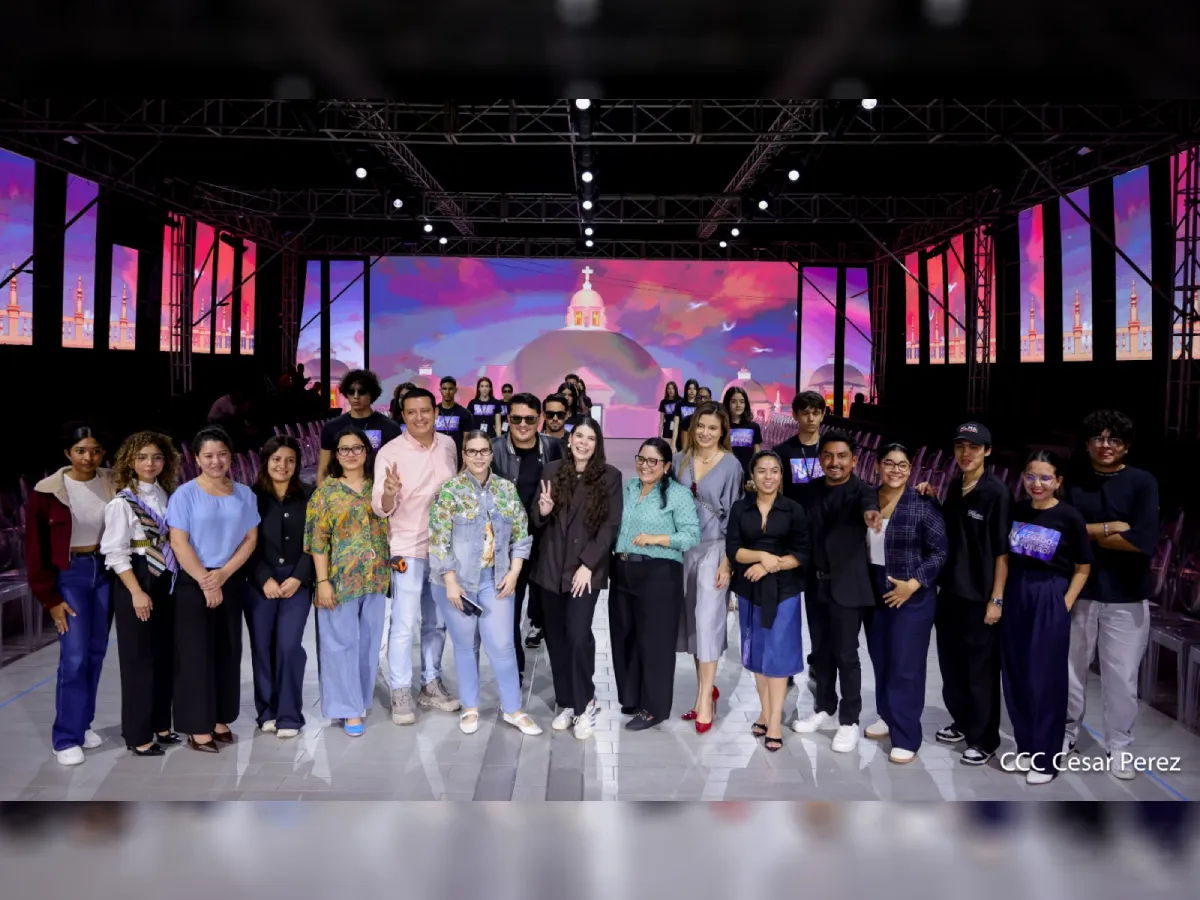








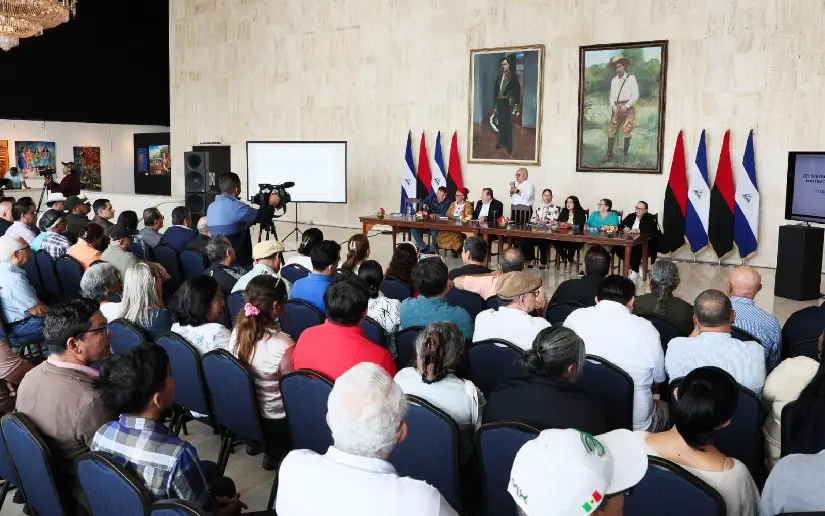
Meeting with Artists, Writers, Artisans and Cultural Promoters
during the Consultation Process of the Constitutional Reforms
Wednesday, August 12th 2026
Presentation by Dr. Gustavo Porras:
Good afternoon, Compañeros and Compañeras. Let's get started.
First of all, I would like to thank you all for your presence. To greet and thank Compañero Ramón Rodríguez, Co-Director of the Institute of Culture of Peoples and Youth and Director of the Rubén Darío National Theater, our host, with the rank of Minister. Also to the Compañera Blanca Rosa Arauz Castillo, Co-Director of the Institute of Culture of Peoples and Youth.
Greetings to everyone, here with us: Plastic Artists, Painters, Sculptors, Draftspeople, Traditionalists, Artisans, Musicians, Writers, Poets, Novelists, Historians, Theater Artists, Playwrights, Actors, Dancers, Photographers and Filmmakers. Here with us also is the Compañero Wilmor López. A greeting and an embrace to everyone
To begin with, I would like to introduce you to the fellow Members of the Special Constitutional Commission. Compañeros and Compañeras, we have been working together to create and advance in the formulation of this Constitutional Reform.
As part of that Commission there are Members of the Executive Board of the National Assembly. I would like to introduce you to Dr. Arling Alonso, who is the First Vice-President of the Assembly. Our National Hero, Compañera Amada Pineda, she is the Second Vice-President and our friend Maria Haydee Osuna, President of the PLC and Third Vice-President of the Assembly.
Here we have Compañera Loria Raquel Dixon Brautigam, she is the First Secretary of the Assembly and here Dr. Wilfredo Navarro, Second Secretary of the Assembly. He told me to mention also that he is President of the Academy of Geography and History of Nicaragua and we have too Compañero Alejandro Mejía Ferretti. The other Members of the commission are present here, they are the three Heads of the Political Grouping. Dr. Edwin Castro, who is the Head of the Sandinista Front Political Grouping. Friend Lester Flores, who is the Head of the PLC Political Grouping and friend Mario Asensio, who is the Head of the Democratic Independent Political Grouping, a Political Grouping where there are several liberal parties, including the ALN, the PLI, and APRE.
These members, along with two presidents of important legislative commissions, Dr. María Auxiliadora Martínez, who is president of the Justice Commission and Dr. Wálmaro Gutiérrez, who is president of the Economic Commission. We are a dozen Compañeros and Compañeras in charge of this work, of this task entrusted to us: to present, and to have the Constitutional Reform Law read, if possible, I think it will be on September 1st in greeting to the month of the Patriotic Nation,.
That is why we are working on this series of consultations. There are 30 meetings, each of which multiplies, because each sector follows up the discussion and we need everyone to be clear about what we are approving and why, above all, why we are approving it. So, the twelve of us have been working on this because we were given that task.
You remember, on July 19th Comandante Ortega gave us a direction, he said: there are not going to be elections here again allowing those who are lying in wait to return to Government, take power and roll back the rights of the People. The exaggerated controversy began, that there are going to be no elections. Far from it, for it was very clear: There are going to be no elections for them to return to the government, take power and change the order of things. Because there was a revolution in this country and it cannot be subjected to foreign pressure.
So, given that mandate, which he also stated clearly: We are going to work with the National Assembly so that the necessary laws are made to guarantee that they will not be able to, they will not be able to, they will not be able to. That's what he said.
We set to work looking for elements giving us the argumentation and the idea of what we should do in Constitutional terms in relation to the elections. So, we felt that really they have indicated a central route to us namely the fight against poverty, because I think we are all clear that this central concern unites us, we are all interested in combating Poverty. As long as this country maintains certain levels of Poverty, it will be susceptible to instability, insecurity and a lack of Peace.
Poverty is the main enemy and, once we have that defined, the other three words I mentioned, which are Stability, Security and Peace, become indispensable for this fight against Poverty. So, that's where we started, we need, to be successful in the fight against poverty, we need Stability, we need Security and we need Peace.
Then someone said to me: I would put Peace first. Yes, we all agree, because in all the polls the greatest, the most frequent, practically the total aspiration of Nicaraguans comes out: we aspire to Peace. But without Security there is no Peace and without Stability there is no Peace, without Stability there is no Security and there is no Peace, and without Peace we have no Security and we have no Stability.
In other words, they are three concepts that are totally united, integrated, implicit in each other, they cannot be separated. Whatever order we put, we, in the discussion, come to the consensus that these three elements are the main elements as argumentation. We have to work on a proposal that will give us Stability, Security and Peace. Why? So as to escape from Poverty, to keep on working, to make progress in this process of national development.
We started from there, but then we said: let's look at the History of Nicaragua for sufficient explanation to insist that the electoral processes belong to Nicaraguans for Nicaraguans and to explain why they should not be otherwise. How so? Because that is one of the central elements, even, of the Comandante's speech and one of the central elements of what we have lived through.
Foreign interference and external financing so as to create instability. Elections are coming, so they have already started making up dolls to form an image, as they have done before in the history of Nicaragua, in a country subjected to a war. They put together an image, a doll, an idea, I don't mean the person, I mean the image they installed in our mind: an image dressed in white to establish the concept of Peace and then get to the 1990 elections which were very well organized, but the people of Nicaragua had a gun held to their head and they were told: “If you vote for the Sandinista Front, the war will continue.”
The people are intelligent and said: We don't want war, that was their feeling. And the Sandinista Front and Comandante Daniel, Compañera Rosario, the entire Sandinista Front was absolutely part of the People because it was as intelligent as the People and said: if you voted for Peace, we're going to hand over the government. And that's what happened in 1990.
Moreover, I remember well, you too may remember that the Comandante said: if we are going to return to the government, we are going to return by way of votes. It was the absolute commitment that this was the way and no other, even having the strength to do things differently, but there was no other way because the People want Peace. This is what we have here and this is what we need.
Then we went on to review the history of Nicaragua for what might give us arguments and that was far from difficult, one only has to review matters a little so as to be able to analyze what they taught us. So, the first thing we find is the struggle of our anti-imperialist Indigenous Heroes from Diriangén, Nicarao and so on. And who were we Nicaraguans fighting against? That is to say, they have us labeled and you know they even make jokes to us that we are “an unbearable little people”, but in fact they have never left us alone.
Hence, our Indigenous Heroes, when Nicaragua was not yet the country, when Nicaragua was the name of one of our chieftains, Nicaragua and Diriangén, Spanish colonialism had already arrived and we had to confront it. Reading about this, we find that there are places, there are points, there are very clear dates when Diriangén, together with Nicaragua, managed to expel Gil González. We find the reference of the battle of the Quebrada del Perro, we find a whole amount of evidence exlaining why we are like that, because we are Dignified and they cannot colonize us or, at least, we resist any interference and colonization.
So we endured that struggle for 300 years, until Independence came in Central America from that Spanish empire, signed, formal, not real, but formal, 1821, September 15th one of the dates which explains why we call September the Patriotic Month, and we managed to participate in that moment, in the Independence of Central America.
Central America and ourselves were federated states, each of the countries. Historians know this best, and what I note is after having read thanks to you. There we started reading the books of Brother Rafael Casanova, of all the historians who are here, all the writers, to see what happened. And I'm searching and we set out to see such that we came to a conclusion which requires us to ask, why did we get there? That is, we are independent in a formal way, but still the empires were eyeing us, seeking how to divide us and they divided us into small republics. So it was easier to "swallow" us, speaking in good Nicaraguan. And just there, like everything from a social point of view, we say: well, just as in the laws of physics and the laws of matter, that is, everything is matter that occupies a place in space, and if you take it away, it is replaced by something the same.
In history and in social aspects, Spanish colonialism was on its way out, shrinking, losing its political power, in order to sustain themselves the empires have to maintain the metropolis and sustain their economy via the exploitation of the colonies and, to the extent that the empires start failing, they lose the ability to exploit their colonies and they start to shrink. All of a sudden, those things that we read and see clearly, like now the renewal of Monroism appears, when the empire has to fall back to Latin America, and it was our turn to maintain our position of Dignity.
So then we say: we arrived in 1821, we went through the whole process of the appearance of the Central American Republics, only for there to appear to us 1854, 1855, 1856, in those three years William Walker now appears to us, expansionism appears to us, Yankee filibustering and the development of a new imperial phenomenon appears to us. And besides, not only that: it appears to us and they put the discussion of the Canal for Nicaragua back on the table, as the colonizers themselves had already put it, because it was not by chance that they came to Nicaragua, since they went along the River San Juan and they had already seen the places which Brother Casanova noted, and they had foreseen that they would be transit points, and that has been the struggle.
Now others came, Vanderbilt and the merchant traders of that time came, looking for a passage less perilous than the one through the east to the west in the United States. Then they found Nicaragua and sent their emissaries to take charge of the operational situation in Nicaragua, we talked about: William Walker, Byron Cole and all those people came. Soon they find what they always find here: a majority of Nicaraguans resisting, and four or five who are direct descendants of the oligarchy and the Creole class who immediately welcomed him. There are the writings and letters of thanks to Walker, along with the ecclesial power, praising the fact that he became President of our country.
He became the president of our country and we was not talking about made up stories. He simply decreed slavery, and set about doing what he wanted. But each of his actions faces Nicaragua’s children and heroes. Just as the Spanish led Nicaragua to produce Diriangén and Nicarao, and just as the struggle for Independence also Nicaragua produced Heroes and brought indigenous people to the forefront of the struggle for the first time, which is why we remember Tomás Ruiz.
Likewise, Nicaragua, when the Yankee filibusters came, produced José Dolores Estrada, Andrés Castro, and all those Heroes who fought and managed to unite Central America in that struggle in order to defeat Walker. So, that's the reality, that's our story, the story of all of us who are here. It may be with some inaccuracies, it might be more accurate, we can enter into discussion about whether or not each detail was so, but when you follow the general line of the story and the analysis, that is the truth of the matter.
Our country, our people, has emerged from struggle after struggle against colonizers, against imperialists, against foreigners who want to impose themselves on us, and we always come out ahead. Such that while Nicaragua was struggling with its own internal contradictions and for its own development, that is not a free and natural struggle, but also one intervened and influenced by foreign powers.
We had the Liberal Revolution here. And really, if we go back to review it was a real revolution, without a doubt. That's why we have José Santos Zelaya as the National Hero of that group of people influenced by the revolutionary ideas of that time. We have our National and Universal Hero, Rubén Darío, the same person who wrote to us From the North, the same one who wrote us an Ode to Roosevelt, the same Rubén, who gave us clear guidelines, in fact, the person who prophesied to us what was going to happen, not only in Nicaragua, but in Hispanic America as he called it.
That's where Zelaya's Revolution came from and it broke with a terribly archaic structure of the conservative hacienda system and all that we are well familiar with and the leadership of the Church, which was very powerful. When we were discussing and we started to review: Yes, I remember that in order to register, they didn't ask us for birth certificates at that time, they asked us for proof of baptismal faith, because that was the State at that time. There was no birth certificate, not even a certificate, it was by baptismalfaith. Then you had to go and seek proof of baptismal faith, go to the Archdiocese and the diocese, that was the reality. So you see, that's how times evolve.
So, José Santos Zelaya came along and for the first time established civil rights, for the first time developed a secular state, for the first time opened public education, these are realities. But also, for the first time, he wanted to develop the country by looking to the Germans, Japanese and others to develop his idea of a Canal through Nicaragua. Then came those who were developing their power at that time, expanding, and they came alongand said: no, you can play any other little game, but not that one. Then came the Knox Memo in 1909, and Zelaya was forced out of government.
Of course, one can say: How outrageous that this Zelaya gave up just because they wrote him a little note. No, the Knox Note was accompanied by gunboats that they sent to the Caribbean. That is, these kinds of behaviors tare repeated through the centuries. They went so far as to send gunboats to the Caribbean and then they sent the Knox Note, Philander Knox, who was, as you know, the US Secretary of State, in these times it would be like the Rubio Note, from the head of the US State Department. So now it would be the Rubio Notes, but back then it was the Knox Note.
We return to the other element that we mentioned: that every aggression against our country Nicaragua produces a Hero. Then came the intervention of 1912 and Benjamin Zeledón appeared, the Conservatives sold out the Nation and the Yankees murdered Zeledón. Zeledón fought, those are realities and we know them very well.
It is our history, there in writing, there is that beautiful letter written by Zeledón to his family, I think it was just moments before the fight in Coyotepe, La Barranca. But well, Zeledón was murdered and the Yankees acted as usual trying to frighten people. The same behavior they used in 2018: you have to make people fearful, you have to frighten people, you have to dominate them. So they took Zeledón and dragged his body through the White Towns, dragged him through Catarina, where Sandino was growing up. I know everyone knows all this, but I want to go through this as a guide helping us to establish why we are engaged in this Reform.
So, that's where Sandino came out. He saw what they did to Zeledón and reacted just as the vast majority of Nicaraguans would have: instead of being afraid, he was indignant, as we say in Nicaraguan "he boiled over” How are could they have believed? How could they drag around a dead man? Furthermore, we are respectful of the dead and of our dead even more so. So then Sandino there swore to fight the Yankees, we are talking about 1912.
Sandino had that experience, he had that will to fight and he made it clear. So then he tells us by writing as he did about this episode and in that way he observed a series of internal struggles. The Yankee intervention continued, until we arrive at 1923 and this thing that's here on the screen.
What's so special about this? In 1923, what the Yankees had in place was an intervention, they already had Adolfo Díaz as President, and then in 1923 they sought how to dominate via the country’s laws and they planned to establish a bipartisan electoral system in Nicaragua, in the image and likeness of the Yankee model and so they enacted an electoral law.
Not the Yankees directly, because they did what they always do: they find some unscrupulous type, and they used an academic named harold Dodds, the US State Department hired him, and sent him to President Adolfo Diaz. Adolfo Díaz made him his Advisor and they told him to create the Electoral Law of 1923, known as Dodds Law. You put in your search engines: “Dodds Law”, and all the information will appear.
This law established the National Council of Elections, for the first time and tried to institutionalize the bipartisan system. Bipartisan, we have been hearing that word until the Revolution clarified things for us, but it was what we were taught as the historical parallels. These are the historical parallels: the Conservatives and the Liberals, that's what the law established. There were mechanisms in Dodds Law that only allowed you, those options so as to apply the bipartisan system.
Here in this image you have an official ballot paper, because we think it is interesting to offer evidence of what we are talking about, this is real. Here is the official ballot paper for 1932, on November 6th. Now we have to investigate why elections are always in November, it might possibly be seasonal. But on November 6th 1932, here are the elections. The Conservative Party, the candidate for President was Adolfo Díaz; the Nationalist Liberal Party was Juan Bautista Sacasa. And both of them can be regarded with apprehension: Adolfo Díaz, the one who invited the US intervention, the one who served as justification in calling for the intervention, the Gringos were to intervene and that was it. Juan Bautista Sacasa, the one who hosted General Sandino's last supper, who was President when Sandino came to seek Peace. That is, both of them can be regarded as to be feared. That's what we came to know as: the historical parallels.
But what was this all for? They are preparing their plan such that four years after this law, they manage as an empire, to sit down with the leader of the Liberal Constitutionalist Army. So, they sit him down and agree the Espino Negro Pact on May 4th 1927. In the Espino Negro Pact we all know very well: the Yankees tell him: "You hand over your weapons, the war is over. You’ll be president next year, we promise you." That was it, put colloquially.
But now we call May 4th the Day of National Dignity, because everyone accepted the deal except Sandino. And Sandino, with 30 men, left and a month and a few days later on the following 1st of July he declared his manifesto in San Albino. So, that's why May 4th is the Day of National Dignity. And this is what happened.
To comply with the deal with Moncada, in January 1928 a contingent of US officers and marines came to control the electoral districts so as to guarantee the 1928 election result. In addition, the electoral district presidents and the presidents of the polling stations, were not going to pay any heed to Nicaraguans, because they were Yankee Marines, and then too they appointed Brigadier General Frank Ross McCoy as President of the National Elections Council.
This is our story and this is what we Nicaraguans cannot allow to happen again. That's why, my liberal friends, all my Sandinista Brothers and Sisters, all those who have conservative opinions, regardless of any differences, all Nicaraguans must say: why are they going to interfere in our business? That is why that story must not be repeated.
And some may say to me, "Where did you get all that from? Let’s see the evidence." Yes, I'll give you evidence. We researched there in the Assembly and there is digital image of the Gazette of April 3rd 1923, which is the Gazette where the Dodds Law was published. The electoral law that prepared the conditions they were creating for four years later, so as to reach the Espino Negro Pact and, then, five years later, to elect Moncada.
But look how interesting: this is absolutely a problem of political opinion, ideological, they would say, but it is a matter of how they see things, and from where they see things. We say now "All Nicaraguans have the right to choose and be elected, with the exception of those…" No, they didn't say that, on the contrary, they said: "No citizen will have the right to vote."
That is to say, you can then realize what the thought was there: "No citizen has the right to vote if they do not meet the conditions and qualifications required by the Constitution and by this law." It is absolutely exclusive, that is, it specifies “no one”. In other words, if it were inclusive, it would say "All Nicaraguans have the right, except for... or lose the right such...”
Now look at the democracy that was prescribed for us here. More or less, you can see that the ratio is 50-50, men and women: "The right to vote belongs only to Nicaraguan men." In other words, women cannot vote here.
But if you look beyond the ideology of domination, out of every 100 voters, only 48 can vote, because in this country the population is 52% women and 48% men. So, out of every 100, only 48 will vote. In addition to what it implies from that ideological point of view, not only do voters have to be male, but they have to be over 21 years old. So clearly up until 20 years ago almost 50% of our population was aged 16 and under, until that changed with the Revolution. But at that time, 100 years ago or so, the calculation is that probably more than 60% of the population was under the age of 20, so those who could vote, really, to be that age, it reduces you from 100 to 22 people, that was Democracy.
So, they were winning the election from the start: women out, because if women vote it's absolutely subversive, because they carry inside a desire to free themselves. So, woman cannot and nor can young people. They have to be 21 years old, so that they are already grown and tame.
But we don't stop there, they had to guarantee... it's the way the oligarchs thought, the employers of that time, they had to guarantee their correlation of forces. So those who are between 18 and 21 years old can vote, which was quite a lot of the population, but only on two conditions: One, if they were married by the Church, because there was no other valid marriage and to get married by the Church you had to have dowries, you had to be able to make real financial contributions.
So, they were determining the electorate, but not only that, it was also to guarantee that they are the children of the oligarchy, we are talking about 1928, we are 40 years, 30 years after leaving the conservative period behind. So, besides being able to read and write, the illiteracy rate at that time was over 70%. So, then, who were the ones who could read and write among men aged 18 years old to 21?: the sons of the oligarchs, the sons of the employers. Given that, all the voting population of men between 18 and 21 was a population aimed at supporting that option. But this was democracy we were told.
They didn't stop there. Despite having made that law, they saw the operational conditions, they saw that they could use what the law determined. But, in addition, because they needed to control the elections completely, they issued this decree from the Executive Branch. This decree was dated March 26th 1928 and what it does is suspend Dodds Law, it uses all the electoral structure of Dodds Law, and it gives force of law to the appointment of the Yankee supervisors and to all the administrative arrangements. But then this decree says:
"The President of the Republic, in view of the Supreme Court of Justice…"
Remember that we have seen that in 1928 the Gringo officers who were going to be polling station presidents had come. And this General Frank Ross McCoy had come. Then:
In view of the fact that the Supreme Court of Justice, by Agreement of the 17th of the current month, has appointed, in place of Doctor Don Joaquín Gómez, who submitted his resignation, General Frank Ross McCoy, President of the National Elections Council, and that this high official, in that capacity, and having been appointed by the President of the United States, must direct the 1928 electoral act of supreme authorities, as agreed to put an end to the civil war.
That means, that he is going to be President of the Council he must direct that electoral process and, according to the agreement: that Moncada has to turn out to be the President, that's what this decree says. And in that regard here with us is Dr. Aniuska Abea, whom I forgot to introduce. She is always at hand, she is the soul of all these things, she is the Legislative Secretary of the National Assembly.
So we looked at the historical records and the photos and everything that constitutes evidence. Here are the candidates for President and Vice-president: General Moncada and Doctor Enoc Aguado, on November 4, 1928. Here, you have a polling station, here is the line at the polling station and look who is there: a marine, the electoral police and probably the head of the electoral district. There it is, they are realities.
That is to say, if we dig into our history, we will know why, little by little we are coming to understand how we have been and how we should be. Here's another photograph: the US Marine Corps Admiral, controlling a voting booth in Managua, November 4, 1928, the marine, the electoral police official.
It is not necessary to put the word obliged. It says: Nicaraguans line up before 7.00am, on November 4th at a compound in Managua. But according to them, the elections were free and these are lining up. Note the National Guard keeping a close watch, in the foreground, so that the people lining up do not leave.
Now when we get into the structure of the McCoy Law, it says that the heads of the Departmental Electoral Councils are appointed by McCoy. And here is Major Joseph Pate, from the United States, at the center, president of the Electoral Committee in Estelí and its Departmental Board. So, here the Gringo General was saying, who could vote... because it's logical, in a structure that had to obey him. Here we can see all the evidence Nicaraguans need of how things were.
That was the struggle and more struggle was coming. Sandino managed to expel them in 1933. Yesterday with the Vietnamese friends who came to visit, we recalled that there are two defeats the Yankees have had to accept: the one that Sandino gave them in '33 and the one of '75 of the Vietnamese People.
But we are continuing the struggle and we are continuing to fight against that enemy, either directly, as Sandino did, and indirectly or directly, as we did in the fight against Somoza, who was the last marine, or through their instruments of attack, as the Contras were, or their political instruments.
We continue to fight on, even confronting failed coups d'etat, as we did confront it. After all, we are not mistaken, it is the same design: some quisling sell-out, whom they use; with their financing, and them behind directing, and so the Nicaraguan people have to be prepared.
Until we arrived to last year to address the Constitution of 1987, that of the Revolution, and here too there was a struggle, since they already wanted to change it after 1990. And then we returned to power and last year we approved this Article One in our Constitution, we reviewed it and we think it is important to remember it if we talk about Stability, Security, Peace. If we talk about the fight against Poverty, if we talk about Dignity.
Article One of our Constitution says:
"Independence, Sovereignty, National Self-determination, Security and Peace are inalienable Rights of the People and Foundations of the Nicaraguan Nation. Any foreign interference in the internal affairs of Nicaragua or any attempt to manifest these rights threatens the life of the People. It is the duty of all Nicaraguans to preserve and defend these rights.”
Therefore, we had already incorporated the terrible experience of 2018 into it, but that we have to reinforce it, so that it does not happen to us again. "Consequently, all those who attempt against these sacred rights of the Nicaraguan people will be considered traitors to the Nation."
This is Article One of the Constitution, the Fundamental Law of our country, which we must disseminate and make known so that everyone is aware of that thought. So, on the basis of this whole historical account, on the basis of all this evidence, on the basis of this need to develop elections only among Nicaraguans, forNicaraguans, and so that we do not see reversed the rights that we are achieving, that they cannot come at us abusing the law, or via wars and other ways, this is what we have come to propose to you.
We have worked on six ideas for Electoral Reform. These six ideas are very simple, but what we want is to translate them into articles of the Reform Law so that, in turn, they have Constitutional force. What are the ideas? And we put them like this so that we don't forget, because what we want is for everyone to be clear.
The first is what the Comandante said: "They won't be able to.” That they are lying in wait and want to return, btut they will not be able to. So hen, we put: "They will not be able to”: Citizens have the right to choose and be elected and to opt for public office, except for the limitations contemplated in the Constitution.
Certain people may not be candidates for positions of popular election, nor may they hold public office by appointment of the President of the Republic or election of the Assembly. Who are they? The coup plotters, those who commit or have committed acts that undermine Independence, Sovereignty, National Self-determination and Security and Peace. In other words, Article One. The traitors to the Nation and those who violate or have violated the Fundamental Principles contemplated in this Constitution. They won't be able to do that, that's the first idea.
So, there is a paragraph that perhaps gives us a better idea of who “Will not be able to”: Those who commit or have committed acts that undermine Independence, Sovereignty, National Self-Determination, Security and Peace; who insist on or promote foreign interference; who call for military intervention; who organize with financing from abroad; who propose and manage or support economic, commercial or financial blockades and sanctions.
That is, if they propose, manage or support sanctions against the Nicaraguan State, its institutions and its citizens, they will not be able to. I mean, we have to tell the truth. "It's not that what I did was a Tik Tok saying I wish the planes would come and attack and that the Yankees would intervene."
The Constitution is respected and this is what the Constitution is going to say, and this is what it says: They will not be able to and if I go to Article One, it is treason to the Nation. Everyone who speaks, it says, defending foreign military intervention: It is treason to the Nation. So there it is, there is no need to say much, so that everyone is aware: They will not be able to.
The second concept or idea, is "Stability". Every country needs Stability to develop, and Stability is also determined by election periods. Thank God, we’ve never had, I think, four years. We had five, we had six and we are proposing seven. But imagine if it were four years: one, in the national election; the second year, the municipal election; the third or fourth year, the regional one; and to return again to the national one, then you would be going to live in that kind of instability.
So we looked around and we saw that for our country, for our reality, seven years is a good period. And without going into examples, but just to say: we are not the only ones with this idea. There are a lot of people in the world with this idea. Most of the people, like us, opting for even years, are in Africa. African countries have seen the need to have more stable periods.
There are other countries that have ten, China has ten. What a coincidence that they are the ones who have developed the most and have developed the fastest, it is thanks to stability, stability is vital for development. And if we're combating Poverty, that's important. Italy has seven years, Ireland has seven years. There are some others who are on this path. Recently, in Central America, there was a reform that passed, I think in El Salvador, to six years, and so they go on. But well, that doesn't matter to us.
We see what we need. That is to say, Stability of seven years and so then there what it is going to say is that the period established in the Constitution for the positions of popular election and for those of ratification of the Assembly are going to be seven years. So, we carry two concepts: "They will not be able” and "Stability".
The third idea is "Cohesion and Security". The positions of popular election have seven years and the positions of ratification of the Assembly or election of the Assembly have seven years. These seven years should also be valid for the Commander-in-Chief of the Military Forces of the Army and for the Heads of the Police Forces.
That gives us Cohesion, that is, this is a single, Cohesive Government. We are obliged, after looking at our history, that it is via the divisions among Nicaraguans that they dominate us. We are committed to this Cohesion. After the burn that we suffered in 2018, we are have to be careful, because the same thing is not going to happen to us again. So, we have to make it clear: Cohesion and Security.
Then someone has to run these processes in operational terms. So here comes this idea that we call: "Guarantee of our Electoral Democracy". It is our Electoral Democracy, the elections of Nicaraguans, for Nicaraguans. We have our Nicaraguan Supreme Electoral Council, it is chaired by a Heroine and Compañera of ours, Compañera Brenda Rocha.
But we have do things correctly. We have to give the Council the Constitutional powers to enforce the law. Then we have to change several numerals of Article 152 to make it clear that they are going to organize and direct the general, municipal and regional elections every seven years; that they have the power not to grant legal personality to political parties constituted with foreign financing, or when one of their directors has violated the Principles of the Constitution; that they have the power to cancel the legal personality of this party or of the party when it, its director or candidate, receives foreign financing.
And, in addition, they have to verify and impose any corresponding sanctions on the candidates, on the officials of the Electoral Body and on the Executive Board, on the members of the Executive Board of the political parties. What we are doing here is to give Constitutional force to the Supreme Electoral Council.
I want to take a minute here to tell you why we put Electoral Democracy, because for the concept of us, Democracy is much broader. Electoral democracy is a small part of it. It is true that it is important, it is true that the People of Nicaragua must say every electoral period, which now we propose that it be every seven years, to say: "Yes, we agree, yes, we have to go in that direction, yes, in these seven years it has been enough time to realize that so many hospitals have been made, that so many roads have been made, that we are on the right path, that we are fighting poverty." We have to express ourselves in a vote, but that's a just a small part of democracy.
Democracy is much more than that. Democracy is that they don't divide people up at the door of a hospital into A, B or C, or that they don't divide you into whether you can pay or you can't pay. Rather people arrive and rightly say: “The People is President, so take good care of me." Or people can say “They tell me every day, in speeches, everywhere, that I have the right to free health care, so they can't charge me.”
Democracy goes beyond the elections so I send a child to school and I know they cannot refuse to let her in if I don't pay, and that they cannot refuse to let her in, let’s say, if she’s not wearing a uniform, and I know she's not going to faint because he hasn't eaten.
They are going to guarantee that for me, and for that we have to fight, so things can never regress, that they guarantee children their school meal, that they guarantee families the possibility of buying academic inputs and that they are never going to charge anyone to go to school, that is Democracy.
The Democracy of the Caribbean People, who can now travel to Puerto Cabezas, or who can travel to Bluefields by land on a good road. That's Democracy: We have democratized with good roads for overland communication. In other words, not only is the road to El Crucero in good shape, but the route to the Caribbean Coast is in good shape.
Now you have a bridge so that it won't take more than a few hours, six, eight hours, so that you're not waiting for a boat or a barge to cross. So, the concept of Democracy goes much further, and that is what we are fighting for. The election is just a part of that.
Democracy means having 99.5% electricity coverage in the country. We democratized the energy coverage, of electric energy, that is Democracy. The 79 Hospitals, having a Hospital Oscar Danilo Rosales or a Vélez Paiz Hospital, or having the Heroes of the Segovias hospital in Ocotal, or the Choir of Angels Hospital in Estelí, or having the New Dawn Hospital in Bilwi, or the Afrodescendants and Original Peoples Hospital being built in Bluefields, or the Lesbia Carrasquilla Hospital in eastern Managua, there by Ciudad Belén, for which the contract has already been signed. All of that is Democracy.
That is, to the extent that we are achieving that, or ensuring everyone’s right to vaccinations, that is, you have to comply with a great number of rights, for example ensuring decent buses. At some point we had buses that were pitiful, now we have buses to be proud of and, moreover, with fares of just C$2.50.
I mean, Democracy goes further, to have nice parks, to have an Internet connection in a park, or whatever we need to build. That is why it is important that our focus is the fight against poverty. Because as we emerge from poverty we can move onward, because now we do have a guarantee that we are going in the direction we have already mentioned.
So elections are a little part, but it's an important little part. Why? Because it gives a renewal of will and of commitments. But, in addition, if we do not take care of this part, it is where historically they have got in among us to divide us against each other, to separate us, and then, there is already that process whereby the intervention forces come to posing as peacemakers. That's how the letter was, let's remember the letter from the priests, the oligarchs and the high society ladies to William Walker: "The Peacemaker." But the peacemaker set the place on fire, that was the contradiction. We must stop dividing ourselves. So, here we have four concepts now.
We named the fifth idea PAX after Dario's Poem. Because we want to tidy up the oversight we made. We were making the changes... But the most important date in most countries, in political terms, are the inaugurations. And the inauguration here used to be on January 10th when on January 18th we had the birth of Darío.
In other words, let us give history its due: January 18th, the inauguration date of the Co-Presidents will be January 18th, in tribute to our National Hero and Universal Poet Rubén Darío. There are two articles that have to do with this, because there another article deals with the installation of the Assembly the day before. So it will say: the Assembly will be on the 17th and the 18th, the inauguration. So, that is the fifth idea.
One: “They won't be able to.”
Two: Stability.
Three: Cohesion and Security.
Four: The Guarantee of Electoral Democracy in the Supreme Council.
And Five: the inauguration, PAX in honor of Darius.
And the sixth idea is called "Coherence". That is to say, we changed the Constitution, but that Constitution must also be in accordance with reality and the Constitution must be consistent. So, if you say in the Constitution, from the day it is approved in the second legislature, we will propose that it be January 18th next year. Proposing it now in September in the first legislature and the second on January 18 next year, that day, approving that law will also mean that everything moves correctly in that direction.
So, we need Coherence: By mandate and strict observance of Constitutional Supremacy, the terms of the authorities elected by popular vote in the last General, Municipal and Regional Elections are extended to seven years from the last election.
Thus, the next national elections are going to be in 2028. So, those of us who were elected, we will stay on for seven years, until 2028 and the new election. But not only the elected ones, the positions appointed by the Presidency of the Republic are also extended to seven years. And then, those positions have to be consistent with their election or ratification in Assembly. In the first place, from their election; in the second, from their appointment.
And thirdly, in the case of all national legislation where it talks about a period, and it is clear that we are talking about public institutions. We are talking about public service. Then, all the national legislation on civil service that establishes a set period, will change to seven years.
You might tell me: Look, I'm the President of an association of writers and artists. The statute says two years. Are we going to move to seven? No, it remains two because the association is private. I take that example, because we already had that question from a the president of a cooperative.
I mean, if my term was due to end this year, because I was serving for two years, which is what my statute says, is it going to be seven now?, no, it's two. One thing is what is private, but in this case it is public. Those are the six ideas.
So what we ask of you is to tell us, give us your opinion, today, tomorrow, whenever you want. But, in addition, we ask you to disseminate what no one can refute, that we have good historical reason to guarantee that our Constitutional dispositions around the elections guarantee there is no foreign interference, guarantee that there is Stability, Security and Peace, guarantee the capacity we need to defeat poverty. On that, all Nicaraguans agree.
But here I think that no one thinks that those times are going to come back, that is, neither where women did not vote, nor where it was a Yankee marine who was at the head of the electoral district and the polling station, that is not going to bring us Peace.
This is what will bring us Peace: The unity of all Nicaraguans. This is as far as we have worked with my Compañeros and Compañeras and we have come to present these ideas to you so you can hear them.
Thank you!
Compañero Ramón Rodríguez,
Co-Director of the Institute of Culture of Peoples and Youth
and Director of the Rubén Darío National Theater:
Thank you, Doctor!
First of all, I would like to thank the Compañeros and Compañeras, Doctor Porras, the Executive Board of the Assembly, our friends the Compañeros and Compañeras Deputies who are with us, for coming to give us this magnificent illustration about the new electoral mechanisms that our People demand.
Coincidentally, the history of our country is also reflected in our National Anthem, which is the oldest in Latin America and the one that speaks of Work and Peace. There we have a great Hero too, Salomón Ibarra Mayorga, who when the Anthem was called for in a competition, the judges were Gringos and maybe they didn't know Spanish or knew very little, but our Anthem reflects much of what Doctor Porras has told us.
For example, the Hymn says: "May Peace shine beautiful in your heaven”, which Salomón Ibarra Mayorga did, he went to the subjunctive mode and put “may shine", because it did not shine. “May nothing tarnish your immortal glory”, instead of "Nothing tarnishes your immortal glory", because it was indeed tarnished by the US intervention and that National Anthem of ours is the reflection of the struggles of our People.
And today we want to tell and thank all those we have invited, on behalf of all the cultural workers, that we have been working hand in hand with our Government and we have also suffered and are suffering the insults in art and culture.
Many years in oblivion and, logically, our government had to give priority to aspects that were more complicated, such as health and education. But we have been observing for a while now, we are full of art and culture.
All of us who go to the municipalities, like Blanquita, like other Compañeros we visit every week, realize how far the power of Democracy really reaches.
As the Doctor said, democracy is very broad and Democracy also means that our People have the right to culture, to art. There are hundreds and hundreds of young protagonists, houses of culture built with much love, also communities that receive all these projects with the National Cinemateca Mobile Cinema, everything done around our heritage, and what the different Municipalities do through their Municipal Authorities.
How do we synchronize our efforts? We are institutions that have been working hand in hand, precisely because there is a visible example, which is that of our Co-Presidents.
And so we have been establishing cultural routes with all the Creative Cities, Entrepreneurship, all our traditions, gastronomic fairs, because also defending our gastronomy, our culture is to defend the identity of our People. The very access to our cultural institutions, such as this theater.
I also want to mention something that has to do with January 18th. Here, when the construction of this theaterwas conceived by Nicaraguan intellectuals, with the support of different people, it was almost proposed to open it on January 18th as part of the celebration of the birth of Rubén Darío, but here it was inaugurated on December 6th because it coincidentally coincided with Somoza's birthday.
On the 5th two important buildings were inaugurated in Managua in 1969, which was the Airport and the Intercontinental Hotel and already on the 6th they gave it in combination. And we, since we took office here, have arranged that the date which is going to be celebrated as the creation of the National Theater is January 18th. That's also part of what we heard from the Doctor.
We have been living under the invader’s boot since our ancestors centuries ago.
And today we have restored our culture through all our cultural activities, our resources and, above all, all those protagonists who attend our cultural houses free of charge every day, with changing rooms, with musical instruments, with tools, precisely, the vocational classes and everything that INATEC and other cultural institutions offer.
So we want to give our support, on behalf of all of you, to this Reform, because we know that we cannot go back to the past. We can't go back to that dark night too when our artists were going through such problems.
And I'm not saying that some people are not still experiencing difficulties or going through them, but we are aiming to solve them through decrees and laws that can also favor artists. But there is the political will and, above all, as we always say, two leaders who care about art.
Just look at how Managua is changing, just look at all the many things that make our People more enlightened. As Marti said, a cultured people is a Free People.
Thank you very much and we are glad that you can also express your comments.
Compañero Javier Díaz Lacayo:
Good afternoon, I’m Javier Díaz Lacayo, I want to thank you for the invitation as a bookseller and publisher and also as a member of the cultural spaces represented here, commenting and analyzing this proposal which is extraordinary and which deserves support, I think we must also consider something that has already been seen, which is the types of interference are not always violent.
In 2018 we were able to overcome the soft coup attempt with ideological and spiritual preparation. The soft coup is a subtle maneuver that seeks to alienate the psyche and conscience of Nicaraguans to provoke negative feelings against hope, against trust, sowing anger, hatred, fear and guilt. That is a subtle way that is also patented in the United States Manual for more than 100 years and not only of the United States, but of all the enemies of Peoples like ours.
I consider that it would be worthwhile to look for links that incorporate the defense of Sovereignty, the search for Stability, the Security of Peace, by preventing these types of factors, also inhibiting those people or groups that continue to provoke, that continue to undermine the mental and emotional instability of Nicaraguans andputting in doubt or endangering the free elections that we Nicaraguans deserve.
On the other hand, all the people who are here next to me are even older people, my older brothers, whom I love, respect and admire. All of them through their forms of expression in art, they are vehicles of National Identity and Dignity and through all the efforts that we make from the history of culture, from literature, we try to promote exalting the Identity and Dignity of Nicaraguans.
I think those who attack the kinds of dynamics that strengthen Identity and Dignity should also be punished, and also those who seek to disrupt them, those who intend to sell, either by way of similarity or by subtle way, other forms of transculturation that alienate our intellectual property, as Nicaraguans we have the right to strengthen ourselves with such attributes.
Thank you very much!
Compañero Marcio Vargas:
Good afternoon, the dogs are barking and they are going to bark even more, because we are Dignified.
The Gringos can tell us absolutely nothing, when their electoral system has not been changed in 200 years and favors the supremacists. The Europeans cannot tell us anything since they have kings and they have false elections. The States subjugated by the Monroe Doctrine cannot tell us anything, as one can see in recent days, in recent months, that the supposed elections in the sister countries of our America are intervened via obvious frauds and that can never happen again here.
Because as we have seen for more than 100 years, we were intervened, our electoral system was a joke during the 16 years of neoliberal rule, there was a fraud in 96, everything was arranged to satisfy the Gringos, so that the candidate put by the Gringos would be the winner. But today is the time of the President People.
They Could Not Prevail, Nor Will They!
We will overcome!
Intervention: 3:
I just want to reinforce Marcio's idea, by saying that there is no greater pride and honor than not only to be present, but to be able to express something that my father wished for and expressed in 2012, that he said we should eliminate the petty-bourgeois style of elections that we had maintained in this country, including since our Constitution of 1987 and that now we are already defining a path that is on the way to development and not to delay, because what we had was an advance and then a setback.
On several occasions we had setbacks and during the advance we had North American intervention, we can no longer accept that and I believe that artists also have the responsibility to make this clear, to disseminate, through the art of painting, the art of sculpture, the theater or in the cinema itself.
And I am enormously grateful to our National Assembly, to our Co-Presidency, that we are seeing this Reform and they are taking us on a path that will guarantee a true Nicaragua, Dignified, Blessed, Sovereign, Free, for those who dreamed of this but who fell on way, like our parents, at least from another plane of life, to see that their dream came true.
Thank you very much!
Compañero Ofilio Picón:
Good afternoon, my name is un Ofilio Picón, a Nicaraguan musician. I listened very carefully to the speech of Compañero Gustavo, President of the National Assembly, his speech seemed quite coherent to me, but I kept thinking about something, and that is that they are always talking in this speech about the political preponderance, of the political imposition of imperialism, of the political power of the great metropolis over impoverished peoples, in our case in Nicaragua that of the Spanish empire, at the time too, as today it was a political decision that divided the country under a Viceroyalty and its system of administering power.
So it occurs to me that in our case of Nicaragua that power, and in all cases really, but to talk about us, let's say the pursuit of power, is accompanied by something that is inherent, which is rapine. All this succession of dominating power politically entails the fact of taking possession of its natural resources.
Since the interventions in Nicaragua began, the intention has been to plunder Nicaragua and plunder all the Peoples and we can go perhaps in some way, it is a suggestion, Compañero Gustavo Porras, that one could incorporate, even succinctly in the speech, some mention, that in concrete stages, that imperial aspiration or ambition is another very concrete issue in Nicaragua. For example, if we talk about the Spanish conquest, gold, for example, played a fundamental role, it was to take over gold, silver, mineral wealth and all the wealth that could be, which later, when it became colonization, was also the labor force, the wealth of the land, in short, all the wealth.
But if we look at each of the stages of intervention, the objective is that and the scheme is simple, it is a great military and political power along with a small group, which he did mention, a small group of local allies in the countries. Let's say that they are the target to facilitate looting, that they lend themselves to that, to open the door, to take over local power and be lackeys, to be those who serve as intermediaries to facilitate the looting of our country.
For example, at the time of Sandino, I remember something incredible like thousands and thousands of pine trunks were coming down the Wangki River, down the Coco River. The great pine forests that were in that area were razed and went down by the current of the river, and they were waiting for them in the Caribbean to take all that wood, all that wealth that good thing that to date we have suffered, let's say, that loss, that damage we continue to suffer.
Just to mention as a precise fact, a target, for example, the fruit factory in Nicaragua, United Company did a terrible thing as they came to take over the land, the peasant's labor force and poison our environment. The famous "Nemagon”, we already know that a lot of people were affected by the Nemagon and there were thousands of cases of kidney failure and I still remember seeing the champas of those affected who were outside the Assembly.
Three governments passed and no one paid attention to them, until Comandante Daniel arrived and they were given a solution, they made little houses, they accommodated them. But all this is the product of that insatiable desire to seize the wealth and maintain good living standards in the imperialist power at the expense of the sweat and wealth of the poor peoples.
That's what I wanted to say. Thank you.
Compañera Ninfa Farach:
Good afternoon, my name is Ninfa Farach, I am a painter, poet and also an entrepreneur. It has been very agreeable to hear what the Partial Reform of the Constitution will be. 2018 left us with a very painful lesson, here all or most of us were threatened with death. They even threatened to burn down our businesses and in the end my business, a winery was burned down. So, what does this mean? That if we do not take care of our Revolution, we may become more damaged one way or another.
These reforms must be locked in place. Why should they have padlocks since we are always under the gaze of the United States. Because as Compañero Ofilio said, they are after our natural riches and above all about our geographical position.
Now, if we don't protect this Revolution, this Revolution can be taken away from us. Unfortunately, there are countries where there have been left-wing governments and they have not been prepared in their Constitution and these governments were defeated by the right wing. Why? Simply and straightforwardly because the United States uses its organisms to subvert. We can't ignore that and everyone here knows it. So far we have been much smarter than them because we managed to overthrow a soft coup, as one Compañero said.
So the only thing I ask is that these Reforms have locks so that they are not somehow eroded neither by the right wing, nor by imperialism.
Thank you very much!
Compañero Gustavo Leytón:
Good afternoon, honorable Members, thank you very much for the invitation, national artists. Brothers and Sisters, Gustavo Leytón, your humble servant, greets you. Grateful for the invitation to come today to this participation, to support this Reform to the Law of the Constitution, because it is to support our Sovereignty and the search for Peace.
And we are the artists who go from municipality to municipality, from event to event, all over the national territory. We are a sign of Democracy that there is support for national art from our Good Government. I want to urge my fellow song creators, musicians, artisans, to keep pushing, creating songs since as one Compañero said, it's bad to remember how bad we lived, but in 2018 those who made the songs before the Triumph of the Revolution said that they were forbidden to listen, to play the songs.
So, I was one of those who set out to make songs about current events that would reach the People, that would carry messages of Progress, that would carry messages of Brother and Sisterhood, that would carry the message that we would not leave out anyone and the songs began to emerge, to free us, from Skapados and other artists of the Chocoyanos and Alfonsina, that girl appeared with that angelic voice.
I asked for the favor of being given the space to speak on behalf of my colleagues, musicians, singers, composers, let's continue making songs to support our Good Government, our Constitution, our Deputies, National Sovereignty. Here we are a sample of the Democracy that exists, there goes the Lord, the Eminence, the King of the Maypole singing on the platforms all over Nicaragua and can you give him a round of applause, please.
A sample of the union of the culture of the Atlantic with the Pacific. The King of Chinamo salutes the King of the Maypole. We are a sign of democracy, we are old people singing to Youth, but telling them that: yes, it is possible to become a Patriotic Nation. Yes, music can be made the artistic weapon of the Revolution.
Thank you very much, Compañeros and Compañeras
Compañera Marta Toribio :
Good afternoon, I come from Monimbó, Masaya, my name is Marta Toribio, traditionalist from a nice family heritage, which is known as the traditional Toro Venado, The Malinche. On behalf of my family and my own, we come to thank all the unconditional support that has been provided by this Good Government, Comandante Daniel and Compañera Rosario Murillo, so that today our Culture, our Tradition, thrives.
And we are here thanks to that support in this hall, because it would not have been possible before, because our traditions were seen as nothing and only this Government and this constitution that we come to support today, because it always comes to favor our customs, our traditions, to our Nicaraguan people, to tell Comandante Daniel, Compañera Rosario Murillo, that we always support them, even though we were vilely singled out, our house, our family heritage was destroyed in 2018 in Monimbó, simply for bringing joy to the people.
Today we are grateful for this Peace that the Good Government gives us, because we continue dancing and we continue to bring this joy, joining the great effort made by many of the popular artists, traditionalists and living legends that we are from this People of Nicaragua. Congratulations to everyone, to Doctor Porras, to all our Compañeros and Compañeras in the National Assembly, to everyone, because thanks to all your work we are going to continue fighting and sovereignty will continue to prevail for our People of Nicaragua.
Long live Nicaragua and long live our Nicaraguan customs and traditions!
Caribbean Coast Intervention:
On behalf of all the People of the Caribbean Coast, we want to support the Initiative of Partial Reform, to greet all of you. I am a Nicaraguan poet, Miskita, proud to be Miskita and something that I might have missed, but maybe I didn't read it: The inclusion of the Caribbean Coast in the document.
What else to say? Those who came before me have already said everything. I think that this is the moment that every Nicaraguan should support, stand by the People, be always vigilant, because each of us are men and women who make up a Patriotic Nation.
Thank you very much.
Intervention:
A very good afternoon, Compañeros, I want to congratulate Dr. Gustavo Porras, the Compañeros and Compañeras of the Assembly. I have been in Nicaragua for four years and before the war I was also young and I have seen and perhaps those who have not traveled outside this beautiful country, do not know the importance of being in this Dignified People, this Free People, demos, means People and kratos means power.
So when they say People President, our Comandante, our Compañera Rosario, who invited me to be here with you and be a Nicaraguan like you and tell this very important story that the world has to know and knows above and beyond the false lies, the Dignity, the bonhomie that exists in this country that has taken me all over the country 50 municipalities or more every day, every year and I have not seen a single soldier in all of Nicaragua.
I have seen people, and even beggars are dignified in this country. So it is very important that we are here in this room with our colleagues, our brothers, sisters, with Maestro Ramón, with Maestro Picado, with all of you creating and doing despite difficulties, another point of the five that Doctor Porras has, I would add this one of culture, that despite the economic difficulties and having the priority of creating 79 hospitals. I want you to know that these numbers are outside, external numbers. The economic growth of Nicaragua, the strategic plans, the new vehicle plant, in short.
There are obviously concrete data that demonstrate to the world the Dignity of this country and the way forward that we are creating together with the artists, creating culture also in all these fields that Don Ramón already mentioned, many more also in the houses of Culture, more than 214.
Anyway, we are offering at the Cinemateca Nacional, every Sunday mobile cinema to the populations, but also our films that tell and narrate the heroic story of this Nicaraguan people.
So many congratulations and keep going.
Compañero Clemente Guido:
Good afternoon Compañeros and Compañeras Members of the Commission, Members of the National Assembly and intellectual artists gathered here. As you already know, my name is Clemente Guido and I am acting as Vice President of the Executive Board of the Academy of Geography, History of Nicaragua. Historians are also present here.
This position that I have was occupied before by Aldo Díaz Lacayo, who proposed that the history of Nicaragua should be studied and analyzed from the perspective of the struggle between the empire and our nation and that every Nicaraguan should assume a militant position committed to the nation, not to the empire and in constant struggle against that empire.
That was the teaching of our well-remembered Compañero and our former Vice President Aldo Díaz, as far as we have known from your side, honorable Deputies. That is what this reform is about, to make a decision to support and be part of the nation's project in defense of national Sovereignty and Peace and to be an integral part of the struggle of the People who over centuries of imperialist domination have been impoverished by the norms, laws and structures imposed by imperialism.
It is time for structural and permanent liberation, as Comandante Carlos Fonseca said, there is no room for timid or, even worse, hesitant positions. The academics who have a high sense of Civic, Patriotic and Nationalist Responsibility, and who also rely on our current founding statutes, can, without a doubt, say to you: There is a yes to the Proposed Reforms and we support this initiative of our Co-President Daniel and Co-President Rosario and also that you are promoting brother and sister Deputies of the Nation of Sandino.
Thank you very much.
Compañero Ramiro García Vázquez:
Good afternoon, everyone. First of all I would like to congratulate the authorities of the Assembly, the Members and all the people who are here, very wonderful, very nice. My name is Ramiro García Vázquez, I am a researcher and I have been working on cultural matters for more than 40 years, I have written about paleontology, archaeology, anthropology, physics.
I am a Member of the Academy, but that is not the point, since I want to make a little contribution there to what Doctor Porras was saying that they were going to look for that letter to Walker, there are two volumes one of 1856 and 1858, from New Paper. The complete letter appears there where it says that Agustín Vigil, who was the representative of the Church in Granada, called William Walker “Guardian of Peace and Northern Star” and offered all the wealth of the Church to Walker so that he could buy weapons and consolidate his power. And after all that, William Walker burned Granada, that was his thank you. So that's the role the church played at that time.
But there are other things, there are other notes that must be made known as part of that Dignity for which Sandino, Zeledón, all the Heroes of the Revolution, gave their lives in that lawsuit between Vanderbilt and William Walker and all that clique of criminals who invaded. Their pretension, along with President Rafael Mora, was to divide Nicaragua, to make Nicaragua disappear from the map of Central America, because they had everything planned.
Chontales for the Hondurans, all that great vast territory, the southern part for the Costa Ricans, including the San Juan River and the Great Lake and the whole West for El Salvador. That is to say, to fragment Nicaragua, to make Nicaragua disappear from the map of Central America for the pretensions of the Empire. That's perhaps a contribution that maybe you'll take it into account.
Let's talk a little bit about invasions. The genesis of the invasions in Nicaragua was born with the Spanish Empire that has been called “conquest”, which is not conquest, they are invasions, starting from the establishment of that colonialist system, that's where all the invasions come from. In such a way, this role, this initiative to consolidate this project of the Revolution, that's why I call it an anthropological, cultural project, the Revolution is that, because as Doctor Porras said, democracy is not only elections, but it is a universe to get people out of Poverty. And in the study of the Battle of San Jacinto, for me it is like the most emblematic thing, what it represents for the defense of Sovereignty, Dignity, apart from the role that Sandino played in this project of the Revolution.
And about this assembly, if we can call it that, I think it is more, there is no need to argue. I propose that the authorities put it to a vote, we put them on their feet and we consider it approved and to multiply it. As Dr. Porras said.
Thank you very much.
Compañero Solomon Alarcon:
I want to congratulate the organizers for the success of having brought together so much art, so much writing represented by all the colleagues who are here. It reminds me of the old days of the headquarters of the Sandinista Association of Culture, when we watched the big assemblies and I just want to appreciate that in each of us we are also as a group, amenable and this gives us strength, because don't think that only human capital, scientists are susceptible to the enemy, the artist is also tempted and we all know that here.
So this participation comes as an injection of strength for national artists, so as to stay at the side of the Revolution permanently, I think everyone's participation has been very productive and we feel represented and the term is not that we are “taken into account”, that's very cheap: We feel part of this Reform and we believe that as a group, I have no doubt that everyone agrees, that we are going to assume it as part of our initiative and long live the Revolution.
Literary Circle of Elders of the Clan Managua:
Good afternoon Compañeras and Compañeros, a fraternal greeting to the table presiding at this Central Event the Literary Circle of the Elder Clan Managua, proclaims every day that our law is reformed and that on July 27th we made a proposal at the National Palace and almost 65 poets signed to support the Reform and the Literary Circle of the Elders will write from tomorrow onward some phrases on the six proposals that are there for Stability mainly, for the Security that we must all have and the Peace that we must embrace with strength.
Thank you very much.
Jimmy Arias:
Good afternoon, my name is Jimmy Arias and I come on behalf of the Hugo Hernández Oviedo Theater Company. I want to be brief, I want to be concise, I want to deeply thank Compañero Ramón Rodríguez and for the invitation, by which he was the channel for this invitation to reach us.
Thank you for the presentation, we are clear, it has been a presentation that makes the situation of our country clear to us, but it is not only the part that they present to us, but the commitment that we as Nicaraguans must have in support of these Partial Reforms, because that also depends on us taking them to heart, because here the dignity of Nicaraguans is reflected, the commitment of the Co-Presidents, Comandante Daniel Ortega and Compañera Rosario Murillo on behalf of all Nicaraguans.
That is the commitment that we as Nicaraguans must also assume, to be dignified Nicaraguans and get ahead first of all of the exaggerated controversy on social networks and among some brothers and sisters from neighboring countries. I want to close with this, to bring it up, because it was the thought of a child who was ten years old, today I am now 50 and I see it palpably.
Oh beloved Nation, you were suffering when at one time the National Guard beat you and made you shed tears, but you knew one day you would be free in your thoughts, you had men and women who would come to defend you and make you happy, the sons of General Sandino. And today that I look at you free and smiling, I feel proud to be Nicaraguan.
Thank you very much.
Compañera Blanca Rosa Arauz Castillo,
Co-Director of the Institute of Culture of Peoples and Youth:
Well, we appreciate the participation of each of you and I think we have demonstrated as a culture that we fully support these Reforms and we are ready to say that yes we agree and yes we believe that our Government is on the right path to achieve, to maintain our Sovereignty, to maintain our Dignity as a People and a Culture we help and support always.
I think we have all declared that, so let's stand up to thank the Doctor, to thank the Compañeros and Compañeras of the National Assembly and say: Everyone here, Present!
Thank you all very much and we will continue, asking each of you also to share everything that we have learned today.
Thank you very much!