







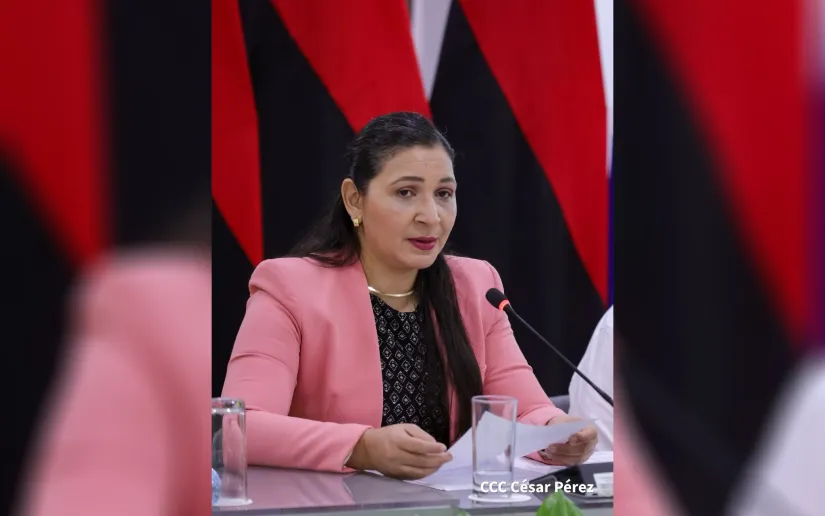
Address by Dr. Wendy Morales, Attorney General,
during the Consultation Process of the Constitutional Reforms
with the Municipalities of the People President
Thursday, August 6, 2026
Good morning to everyone here. Good morning to all the Compañeros ans Compañeras Mayors, Mayoresses and Members of the Municipal Councils. More than 3,000 people who comprise these Municipal Councils are connected to this meeting, 153 Municipalities from all over the country are also connected at this session, in order to comply with these consultations and with this historical reflection that Dr. Porras, President of the National Assembly, has shared with us.
I also want to thank the entire team of this National Assembly, the honorable Deputies, all the Compañeros and Compañeras who are with us today from the Office of the Attorney for Municipalities, the Special Procurator for Municipalities, Compañero Nestor Lacayo, who is in constant communication with all the municipalities, in order to guarantee all the programs that are being held throughout the country, regardless of circumstances.
It is an honor for us to address this honorable National Assembly, this Plenary, to share a little, from the institutional work of the Attorney General's Office, by way of reflection on the strategic role played by municipalities in the construction of national development and in the permanent strengthening of our State and, obviously, the direct link that these municipalities have with this Constitutional Reform proposal, which is the subject of this consultation with all the municipalities of the country.
This Constitution, we are well aware, represents much more than a set of supreme norms; we consider that it is the legal expression of a collective project of coexistence, the framework distributes the competences of public power, recognizing rights, establishing responsibilities and defining the Fundamental Principles that guide the institutional life of the country.
That is why we believe that each Constitutional Reform Process constitutes an opportunity to reflect, which is what Dr. Porras has done here today, with great serenity and with a vision for the future, on the capacity of our Institutions, how we have been acting throughout all these years, how all the projects have been implemented, and this is very important to emphasize, always with the obligation to respond to those social, economic and institutional transformations that our nation is experiencing.
In this exercise, constitutional law offers a widely accepted premise. The Constitutions, we are completely clear, do not remain immutable; they are constantly evolving and evolve according to the societies they serve, in this case, the People of Nicaragua. The duration of constitutional periods, the distribution of competences between the different levels of Government, the territorial organization of the State, the mechanisms of institutional control and the forms of political representation, as we are all aware, have been undergoing modifications in many countries, always obeying their own historical processes and, obviously, the needs of each society.
In that sense, Nicaragua is not unique; we also have our own realities, our own needs and we have been fulfilling them throughout all these years, always managing them with the Unity and synergy that has characterized our Government. So, Compañeros and Compañeras, from that perspective, this Attorney General's Office considers it appropriate to share some reflections on the role played by municipalities within the State, on the importance of administrative continuity and on the elements which comparative constitutional law contributes to the analysis of the different models of institutional organization that exist in the world.
Thus, the Constitution constitutes the legal architecture of the State and the municipalities, we believe, are the closest representation to the daily life of Nicaraguan families. The municipality is the space where the nation's public action is transformed into tangible results for families. Consequently, the strengthening of the municipal system is an essential element for the consolidation of the State and for the effectiveness of public management.
It is in the municipalities where public policies cease to be normative provisions so as to become roads, bridges, drinking water, sanitation, housing, markets, parks, schools, sports centers, environmental protection, land management and multiple services that directly affect the quality of life of the population.
And it is for that reason that a basic idea, which most certainly all of us who are present here share, is to recognize that strengthening this municipal regime means strengthening the State as a whole. The transformations that our municipalities are experiencing today, we are sure, require increasingly solid institutions, with greater technical, legal and administrative capacity to respond to the growing demands of the population.
The experience over the years and the experience throughout the creation of the Office of the Attorney for Municipalities has shown us that territorial development is not built through isolated actions, but through processes of continuous planning, execution, monitoring and evaluation.
We have been constant, as the Attorney General's Office for the Municipalities and the Attorney General's Office of Justice, in this coordination and synergy which we have successfully carried out with the Municipalities over the past two years. Strategic planning is the essential basis of correct municipal administration and, in that sense, all the municipalities have been united to improve, to make concrete each of the projects with that clear, defined, strategic and safe planning, which includes the execution of said projects.
And, as Doctor Porras mentioned, making possible visits to these hospitals and carrying out these projects throughout the country can only be executed with that synergy and with that planning. That is why municipal plans, we consider, as well as development and public investment programs, infrastructure works, drinking water and sanitation projects, urban modernization, environmental protection and territorial planning, require a medium- and long-term vision which guarantees their completion and sustainability.
Institutional continuity will allow these projects to be executed efficiently, avoiding unnecessary interruptions and allowing public resources to produce the greatest possible benefit for Nicaraguan families. Precisely for this reason, institutional continuity constitutes one of the essential principles of all modern public administration, as Doctor Porras also referred to, when addressing the modern legislation, the terms and the periods of execution of the functions of each public servant in other countries.
Therefore, we also believe that any modern public administration seeking to guarantee that these projects and other development plans are executed will have that vision and purpose, as Dr. Porras has already shared with us. We believe that there is no sustainable development without planning and there is no effective planning without institutional stability. Nor is there institutional stability without strong institutions capable of guaranteeing the continuity of public policies.
Comparative constitutional experience has shown that there is no single model for the duration of the mandates of national and local authorities. It has also shown that there is nothing established which defines that these should correspond to a particular period. For this reason, various countries have adopted periods of four, five, six and even more years, precisely taking into account, as referred to at the beginning, their political reality, their historical reality and their administrative reality.
The common element in all these systems is not only the duration of a mandate, but the existence of Institutions capable of ensuring administrative continuity, permanent accountability, transparency, public control and the effective protection of the general interest, as we have been implementing in our Government of Reconciliation and National Unity. The best international practices show that institutional stability favors strategic planning, facilitates the implementation of multi-year projects, improves inter-institutional coordination and strengthens the State's capacity to meet the needs of the population.
Honorable Compañeros and Compañeras Deputies, Compañeros and Compañeras Members of the Attorney General's Office for Municipalities and Compañeros and Compañeras Members who are connected at this meeting, as well as all the Municipal Offices of the People President in our country, we believe that constitutions do not constitute static instruments, but living expressions of the political and legal agreement that organizes the State and guides its evolution. Their strength lies precisely in the ability to respond and in the ability to move forward through the democratic mechanisms provided for in them, in the face of the new realities, challenges and needs of the country.
From this perspective, any proposal aimed at improving the constitutional design must be analyzed, as has already been presented here, with institutional responsibility, with a State vision and with strict adherence to the principles that guarantee the Stability, Governance and Well-being of the nation.
It is thus, Compañeros and Compañeras Mayors, Mayoresses, Compañeros and Comapñeras who accompany us, that every Constitution responds to historical needs. Very good the thoughtful presentation that Doctor Porras has made about the history of our country, how it has been changing over the years, according to the interests of some, a very few petty people who only want to see our country develop for them, and not for the thousands and thousands of Nicaraguans.
And that is why we believe that, as I said, every Constitution has to respond to these historical needs, it has to respond to the social and institutional needs of each State, including those modifications that are deemed necessary to strengthen the organization of the State and guarantee a more efficient public administration.
One of the greatest challenges facing a public administration is to harmonize the immediate demands of society with the obligation to build public policies capable of producing sustainable results over time, and that is why modern public management cannot be conceived solely as the administration of everyday life. The real purpose is to create the necessary conditions such that decisions taken today do produce lasting benefits for present and future generations.
Consequently, the possible extension of the constitutional period of the national and local authorities, from the Attorney General's Office, is seen and understood as a mechanism aimed at strengthening institutional stability, the continuity of public policies and long-term strategic planning.
In practice, many national and municipal programs, particularly in the areas of infrastructure, economic development, health, education, housing, territorial planning, energy, the environment and administrative modernization, exceed the time horizon of a short governmental period.
As Dr. Porras already mentioned, with our own resources the time for a project is determined in approximately four or five years; with external resources, due to the conditions that are required for this type of financing, more time is needed. Therefore, it is important to have our Primary Law, our Constitution, in conjunction with the execution and completion of the main projects that are being developed throughout the country.
A longer time frame can certainly favor a more complete implementation of these projects. We believe that the costs associated with institutional transitions will be reduced and greater predictability will be provided to the public administration. Now, from the legal point of view and as the legal representative of the State of Nicaragua, it is important to clarify that comparative constitutional law shows that there is no universal standard on the duration of popular election mandates.
Different democratic States contemplate periods of different duration, defined according to their own institutional realities, without the temporary extension of the mandate constituting, in itself, a parameter to determine the democratic character of a constitutional system. The decisive thing is that the duration of the mandate is provided for in the Constitution, which is what the Compañeros and Compañeras Deputies of the Assembly are working on today and who have presented themselves to all of us, so that we are clear and well informed about what these structural changes comprise.
And it in relation to the term of office that is being provided for in this Constitution, the new Constitution, the most important thing is that it should be approved in accordance with the Reform procedures established by our laws and that the essential principles of the constitutional order are respected, as has been the case over the last few days in this Assembly.
In this sense, we believe that institutional stability, without a doubt, contributes to strengthening legal certainty, to favoring the continuity of the policies of the Nicaraguan State, to consolidating multi-year planning, to improving coordination among public institutions and to allowing results-oriented management in the medium and long term.
For the municipalities and for all the Compañeros and Compañeras connected here today, this acquires a very special relevance. Municipal development plans, investments in infrastructure, drinking water and sanitation projects, territorial planning and local economic development strategies require administrative continuity to fully achieve their objectives.
That is why a broader institutional horizon will facilitate better budgetary programming and a more efficient execution of public investments, whose institutional strengthening finds an important complement in the creation of the Office of the Attorney for Municipalities, whose specialized function contributes to providing legal certainty, protecting municipal heritage, unifying legal criteria, technically accompanying local governments and strengthening coordination between the Central Government and municipalities.
Therefore, from the perspective of strengthening the State and the municipal regime, a Constitutional Reform extending the duration of mandates constitutes an option aimed at consolidating the continuity of public policies, planning, efficiency and territorial governance.
Compañeros and Compañeras, everyone, within the Process of strengthening the State, one of the most relevant constitutional and institutional advances has been the creation of the Office of the Attorney for Municipalities, whose incorporation represents a transcendental step in the consolidation of the Nicaraguan municipal regime. It is the first time that municipalities have a specialized body dedicated exclusively to providing legal support, protecting their institutional interests and strengthening the legal security of municipal management.
The creation of this Prosecutor's Office has represented a strategic decision aimed at strengthening municipal institutions and guaranteeing a specialized technical defense of public interests, its existence being what has allowed to provide permanent legal advice.
Likewise, as an arbiter, it has strengthened the coordination between Central Government and the Local Governments, starting from a Closer, Coherent and Efficient articulation, for the benefit of the entire population. All this has contributed to a more modern public administration and has strengthened all the institutional areas of the municipalities, which do not depend exclusively on the will of the authorities, but on that close coordination.
Compañeros and Compañeras, we believe that national development begins in every municipality, in every local space where the different communities and the different population centers converge, and that development begins in every completed work, in every community served, in every family benefited, in every productive project executed, in every road rehabilitated, in every water system built and in every properly managed public investment. And all this, we believe, constitutes the concrete expression of a State that works for its People.
Strengthening municipalities means strengthening the State's capacity to better serve the population. It means strengthening legal security. It means strengthening planning. It means strengthening institutional coordination. It means strengthening the responsible administration of public resources. It means strengthening territorial governance and, ultimately, strengthening Nicaragua's integral development.
That is the objective, Compañeros and Compañeras, and it remains the common objective of our Government of Reconciliation and National Unity: to build increasingly solid, more efficient, more transparent local governments with a greater capacity to respond to the challenges of the present and the future. With this vision of our Co-Presidents, reinforcing the municipalities transcends any transitory circumstances so as to become a State policy oriented to the welfare of families, the balanced development of the national territory and the consolidation of modern institutions able to guarantee Continuity, Efficiency, Legal Security and Standards of Excellent in Public Service.
Therefore, with very forthrightly, on behalf of all the municipalities of the country and of the more than 3,000 Compañeros and Compañeras who are connected at this meeting today, we firmly support these proposals for Constitutional Reforms, which we know will prosper for the benefit of our People, that People President which is who defines its own paths of Development, Peace and Stability in our country.
Thank you very much!