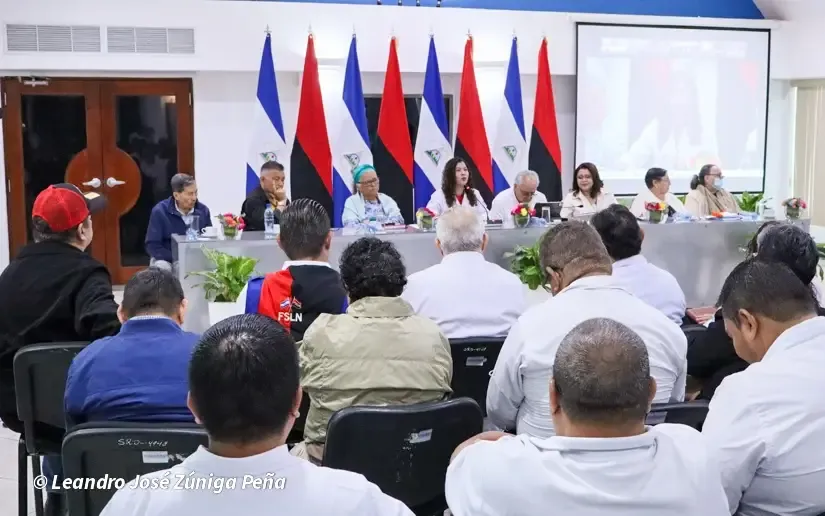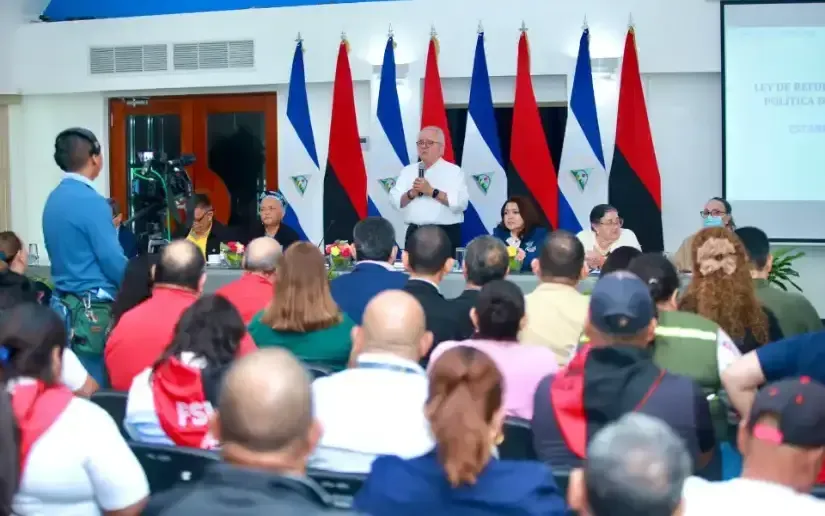








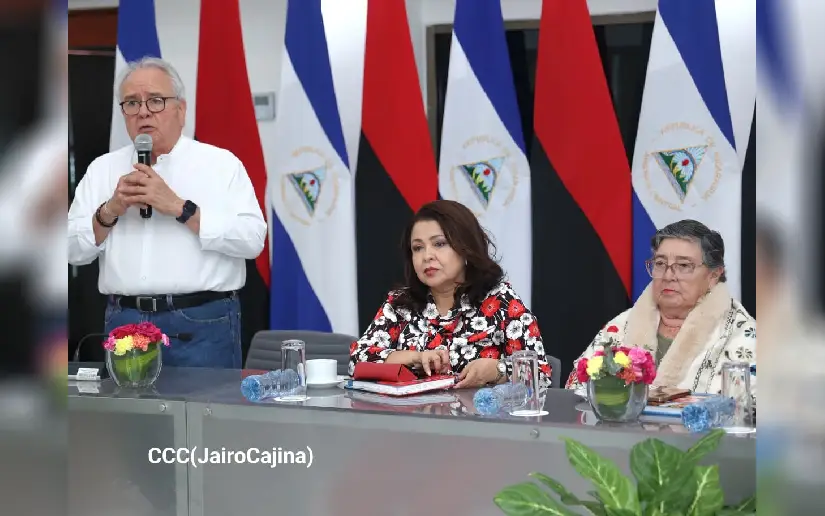
Meeting with Workers in General
during the Consultation Process of the Constitutional Reforms
Friday, August 14th 2026
Presentation by Dr. Gustavo Porras:
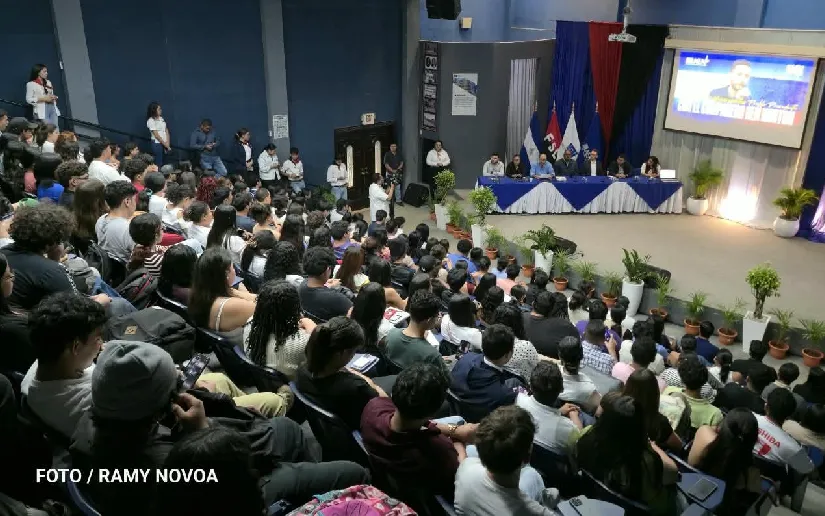
Good afternoon, friends, Compañeros and Compañeras. We have 241 on line connections and at many of these you can see that there are many Brothers and Sisters, Compañeros and Compañeras, workers from all the different sectors.
I want to present to all the Compañeros and Compañeras who are connected the Compañeros and Compañeras who are present here: the Special Constitutional Commission is composed of the Members of the Executive Board. We want to take this opportunity for you to meet Dr. Arling Alonso, she is from Chinandega and is the First Vice President of the Executive Board of the National Assembly.
Here too we have our Heroine, our Beloved Compañera Pineda, who is the Second Vice-President of the National Assembly. Also here we have the Compañera María Haydee Osuna, President of the Liberal Constitutionalist Party and who is the Third Vice President of the National Assembly, who is part of the Special Constitutional Commission.
On this side we have Compañera Loria Dixon Brautigam, a Caribbean woman from Bilwi and she is the First Secretary of the National Assembly. We have our friend Alejandro Mejía Fernández, from Granada, from the Nicaraguan Nationalist Liberal Alliance Party. He is the Third Secretary of the National Assembly.
Also in the Special Constitutional Commission are the three Heads of the existing Political Grouping. We have Dr. Edwin Castro, he is the Head of the Sandinista Front Political Grouping. We have our friend Lester Flores, who is the Head of the PLC Political Grouping. And we have our friend Mario Asencio, who is the Head of the Democratic Independent Political Grouping.
We have two Committee Chairs, two of the most important in the Assembly. We have Compañera Auxiliadora Martínez, who is the president of the Justice Committee, and Compañero Wálmaro Gutiérrez, who is the president of the Economic Committee, and we have with us all the members of the Labor Committee of the National Assembly, who are present here.
Thus, the members of the Executive Board, the Heads of the Political Groupings and the colleagues of the two commissions, the Justice and the Economic Commission, formed the Special Constitutional Commission. To all our Brothers and Sister workers, you should know that this is what the Constitution and the corresponding law mandate, that if there is going to be a Constitutional Reform, a Special Constitutional Commission must formed to review and propose the Reform.
We began this discussion on July 19th following the mandate from Comandante Ortega. I am sure that all of you who are in the different places, municipalities, areas, are informed because you will have seen it, since you were mobilized, when we commemorated July 19th. On that occasion, Comandante Daniel Ortega, very clearly, said: "There are not going to be elections again in this country allowing the enemies of the People to assume the Government, assume power and roll back the conquests of the People." That's what the Comandante said.
Then he added: "We are going to work with the National Assembly to make laws that will put up a wall, put up a barrier so that those enemies of the People who are lying in wait to do so cannot come back to harm us. They will not be able to, even if they want to, they will not be able to, they will not be able, they will not be able." Those were the words of Comandante Daniel Ortega and Compañera Rosario, from whom we received clear instructions to set to work. We all agreed on that.
In addition, Comandante Ortega has always insisted that we have to be clear about the history of our country, namely, that we live permanently fighting against foreign interference, and we all know that. We are going to go through that history, but we also know the most recent one, that took place in two thousand and eighteen, this real intervention, its financing, its objectives and its planning were designed by a foreign power, they were designed by the Yankees, who have historically been enemies of Nicaragua.
We know this, it all came out and what's more, I think that every so often we have to revisit all the amounts of money in regard to which it was possible to identify where it came from to finance all these destabilizing actions.
These are the elements with which we began to work: guaranteeing the laws so that there is no destabilization, guaranteeing the laws so that enemies do not return to try to take over the Government and roll back the conquests of the People. And also, to be clear that there is a permanent foreign interference from which we must defend our People.
With that we started working on the Reform Proposal. The first thing one does is to identify the ideas that later, once agreed with the People of Nicaragua, will be turned into the Articles of the Constitutional Reform Law.
The Reform Proposal, which is based on concepts to which we are constantly alert and which we also internalize. That is to say, this is a Reform Proposal that seeks Stability, that seeks Security and that seeks Peace. This is not in order of importance, this is stated because these three concepts are totally indivisible.
The greatest aspiration that the Nicaraguan people have, that all workers have, is peace. We want to live in peace, to guarantee peace today and for the future of our children, our grandchildren and for future generations. But to ensure peace we need security. We have already realized that if we let down our guard and do not have a guarantee and security, our Peace will be broken.
It's enough to remember eight years ago that that's what happened. But also, to have Security and to have Peace, we need Stability, we need all three concepts. Remember that we had an enviable stability that we had been building, that model of dialogue, alliance and consensus. Ten years of permanent growth to 2018 and that enviable stability was what motivated them to inject money, plans and break Security and Peace. After breaking the Security and Peace, they immediately broke the Stability because there was instability.
So, we are clear that these concepts are totally indivisible. Now, what do we want this for? We can say with pride: we are a stable, safe and peaceful country. Yes, but at the end of the day, we want that to be the case for our People will be happy. To be happy it is not only enough to have these statements, but also to have the possibility of solving the material needs of all our People. This is a gradual process, a process of economic growth. This is a process of combating poverty.
In other words, we want this in order to have enough resources to be able to defeat poverty. That's the general concept. We need to carry out an Electoral Reform whereby we clearly comply with the Comandante's directive of guaranteeing and putting up that wall, that barrier against the enemies of the People, against those who want to disrupt our Stability, Security and Peace. Why is that? Because they don't want this country and the people of Nicaragua to escape from poverty. That's the concept.
From there come the other ideas we have to develop. But on that basis, we have reviewed the history our Comandante constantly refers to, the history of struggle of the Nicaraguan people, where we came from, and we set out to review this. We find that the history we are familiar with began when the Spanish came. We are talking about 1521, when the Spaniards came and started going around here until they decided to impose themselves, because that's what they came here for.
Then the resistance of our anti-imperialist indigenous Heroes began: Nicaragua and Diriangén. At that time Nicaragua did not exist as a country, what existed was the name of the cacique Nicaragua and there was the name of the cacique Diriangén, and of several caciques that existed at that time. The Spaniards came to disturb all that, to fire their arquebuses, with the Bible in one hand, with the sword in the other, to dominate us. But our anti-imperialist indigenous Heroes resisted.
In 1524, that is, three years later, they managed to expel the Spanish colonialists from our country, inflict a defeat on them and get them out. They were defeated in Diriamba, in a place known as the Quebrada del Perro, there they defeated Gil González and he left, because he saw the union of Diriangén and Nicaragua in that confrontation. I understand that he went to Panama, then returned with new strength.
Then Francisco Hernández de Córdoba came and there began a permanent struggle for us, the Nicaraguans, the Diriángens, all of us, fighting against Spanish colonialism. Imagine how it lasted from 1521 to 1821, a 300-year period of permanent struggle.
In those 300 years of struggle, we are obliged to find the main points of that history of resistance which need to be highlighted. Precisely for that reason, back in 1770, about 50 years before Independence, the chieftain of the Boacos and the Ulwas, Yarrince, in the area of Chontales and Boaco, engaged in his resistance. Even the Spanish respected him for his resilience, they had even appointed him Captain.
But when the Spanish began to humiliate his people, he said, "No," he sent back that appointment, vindicated his chieftainship and began to fight the Spanish. He was captured and sent to Guatemala, where he died in a prison, after being tortured there in Guatemala. That is the story of Cacique Yarrince.
So, those 300 years of struggle took us up to 1821, which is when we signed the Act of Independence of Central America. We learned about that at school, about why we have the Patriotic Days like September 15, one of the dates which makes September our Patriotic Month.
The day that Independence was formally signed in writing, did not mean Independence from the reign of Spanish colonialism, which was exercised through a Viceroyalty and from that we achieved Independence. But the colonialists had already put in place the people who were going to continue their domination, these were the oligarchs, the Creoles, who were the only ones who had any rights. Because the others, the poor, the indigenous, had no rights.
We wee also divided as Central America. After 1821 the struggles between the Central Americans began and they were divided into the five Central American republics. Because there, other historical aspects appear, for example the empire of Iturbide, which was in Mexico, wanted to take over. But the fact is that we appear as a republic, as a country, not as a federated republic, but as a unitary republic: Nicaragua appears with its first Constitution, which was in 1838 and by then we were already a republic.
Why did we take all that route? Because we had been following it, because we realize that we need to get rid of the Spanish empire. We are looking for how to be independent, but then here comes another empire, one comes down and another begins to rise, and begins to claim ownership. Why? Because they sought to have colonies, because colonies are what that guarantee their standard of living.
If countries are colonized, according to them it is because they come to bring us peace, development, everything they tell us. No, countries are colonized so as to enslave them, so that once colonized, everything they produce or part of what they produce passes to the empire to sustain the living standards of those who live in the metropolis, in the center of the empire.
That is a fixed law, in such a way that when the Spanish empire began to decline and ceased to be, other empires appeared that were developing. The British sought, around this region, in the Caribbean, to try and get control of this land. They couldn't and although the Spanish were retreating and
Nicaragua was formed, then the new empire came.
At the moment when this new empire was being born, the filibuster William Walker appeared with some mercenaries, with Byron Cole at the head. We are talking about 1854 and they came to Nicaragua as part of the expansion of imperialism, pursuing the same thing that the Spaniards pursued, which was the transit through Nicaragua between the Pacific and the Caribbean, or between the Caribbean and the Pacific.
That much-desired transit belongs to us Nicaraguans, but they wanted to take it because they were expanding, because for them it was a severe trial trying to cross overland from east to west in the United States because of the distance, and also because there was still an indigenous population of American Indians large enough to resist them. But they were totally exterminated.
At that time Cornelius Vanderbilt, was an entrepreneur who began to study this route, began to develop and invest in that route and he financed the expedition of William Walker, with the order to take over so as to ensure that his company controlled the transit in this area.
Then William Walker came, and he also devised a macabre plan for domination and got together with the sell-outs, with the oligarchy, with those that had been left over from the remnants of the Spanish Empire. He got together, did a deal with them, told them he was going to give them all the opportunities, and he got together with the Catholic Church, with the priests, with the priest Vigil.
His soldiers were disciplined, because they were mercenaries but they were terrible criminals and so a Yankee filibuster, William Walker, became President of the Republic of Nicaragua. To do so he had to have cooperation from the sell ours and there are these two hundred and seven letters from ladies in Granada thanking Walker for pacifying the country.
There is a letter too from the priest Agustín Vigil in which he preaches calling William Walker: "The Northern Star which comes to give us light". There are all those letters, and this is a reality, there have always been quislings. And how did Walker repay them? All those people in Granada suffered the fire that burned it down. And there Walker left a sign: "Granada was here." That is to say, these are realities, Compañeros, Compañeras, this is not just words, we have to read this history and these are the realities.
After that, in 1856, came the Battle of San Jacinto, which is the part we know, which was the most famous part, the part that made September the Month of the patriotic Nation, and strengthened our national sense more than simply the month of Independence, not taking into account the difference in the years, one being in 1821 and the other in 1856, where 1856 really did give us the month of the Patriotic Nation, because we Nicaraguans defeated the Yankees in San Jacinto at that time, and then we united all the Central Americans so that three years later, when Walker wanted to invade Honduras, his days were up and I think Walker is buried there.
This has made us a dignified People who have in their soul, in their feelings, in their veins, the sense of Dignity, of anti-Colonialism and anti-Imperialism, in other words, this is not just history, it is reality. So then the struggles continued, life went on, until at the end of that century, a stream of new thinkers appeared, of new people, a stream that rejected the existing power of the Church and which began to say: citizens have civil rights, citizens do not need to ask permission, and they have the right to be buried in a cemetery, they have the right to civil marriage, they have the right to public, secular education, because at that time, at the end of the nineteenth century, in Nicaragua, those in charge of education were the religious orders, those in charge of health were the religious orders, those in charge of civil rights were the religious orders, so that if someone was not baptized, it was as if they did not exist.
Let's see, among the Compañeros and Compañeras who are here, tell me if it's not true, or if you don’t know, go ask your parents. In this country, before the Revolution, they didn't ask for your identity card, they didn't ask for your birth certificate, more often they asked for proof of your baptismal faith. Why? Because the faith of baptism is the one which in those days was used as proof of your existence as a Nicaraguan. These are realities, they are not our inventions.
This is how we arrived at the Liberal Revolution. That group of intellectuals, of people who managed to study, who had new thoughts, who had received new ideas from the revolutions taking place in the world, assumed the fight to make the Liberal Revolution at the forefront of which was the National Hero José Santos Zelaya, and also within that group was our National Hero and Universal Poet Rubén Darío, who with his ideas spread Nicaraguan Dignity all over the world and anit-imperialist thoughts all over the world and thus we had also another series of Compañeros and Compañeras who are Nicaraguan Heroes.
So, we have now reached the Liberal Revolution. What do we find in all those events? To every action of imperialism, to every action of colonialism, Nicaragua responds with its Heroes. Our people are like that, they respond with Heroes. When the Spanish wanted to subjugate the Nicaraguans of Chontales and Boaco, Yarrince appeared. When they wanted to subdue the people of Sutiaba, Adiact appeared. When they wanted to overwhelm us in this whole area, from the very beginning, on the plateau across to Rivas, Nicarao and Diriangén appeared.
Then, when they wanted to stop independence, the Heroes of our Independence came out, Tomás Ruiz, an indigenous man who was the first priest and the first indigenous person to study, appeared. Furthermore, although we are already talking a little after Independence, he was captured and sent to Chiapas and he died in Chiapas. That is to say, there are always heroes, heroines. Nicaragua produces Heroes every time it is attacked.
Later, during Zelaya’s Revolution, Zelaya wanted to build the Canal for Nicaragua, but independently from the influence of the Yankees, so then the Yankees came and intervened. They sent gunboats to Corinto, they sent gunboats to Bluefields and they sent the Knox Note that we are all familiar with
.
They only tell us the story of the Knox Note and people may say: but how come Zelaya stepped down, just because Know sent him that note? No, Knox sent the note, the US created an internal destabilization movement and also sent a gunboat to Corinto and a gunboat to Bluefields so as to force him to leave and go to Mexico, that was the reality of our country in 1909.
That is to say, the Liberal Revolution could not develop, so to speak, national capitalism, which was what might result in such a revolution, but it resulted in neocolonialism and imperialist imposition. Now, this took place with the Knox memorandum, it's called the Knox Note because the US State Department at that time was run by the Secretary of the State who was Philander Knox and he signed it.
It's as if a Rubio Note were to exist now, signed by the US Secretary of the State. That's just for comparison thing. But in Nicaragua there were those who do not accept that, who did not agree. And that led Adolfo Díaz, a conservative who was viscerally against the Liberal Revolution, to invite Yankee intervention, the intervention of 1912, and he invited the Yankees. The US Marines came and intervened, but they found out what I was telling you: Every one of these interventions produces a Nicaraguan Hero, Nicaragua stands fast with a Hero. At that time, General Benjamin Zeledón appeared and died, Sandino called him an Apostle of Freedom.
This General resisted and gave the battle at the Barrance in Coyotepe, that is to say, with a smaller number of men, and the Conservatives and Yankees fell on him. They killed him and dragged his body through the White Towns, they dragged him through Catarina and the towns of the plateau, and when they paraded him through Catarina, a higher force made sure that Sandino was there and when he saw how they abused the body of Zeledón, Sandino, instead of cowering, which is what they intended, so as to instill fear, maybe this reminds some of you of the failed coup, they wanted to put fear into the whole People and so they set fire to our Comrades and filmed it and posted it all in the social networks so that everyone would be terrified.
It was terrorism, they did it and paraded Compañeros and Compañeras, stripped them naked, attached wires to them, painted them, tied them to poles, filmed them and disposed of them. The goal was to terrorize us in the same way the Yankees did back then.
That's the same practice used by the Yankees. They took Zeledon’s body, tied it up in a cart and paraded it around. But that rather makes people angry, it makes people indignant, it arouses that history of struggle people have inside, of Dignity. And so Sandino, instead of being scared, got outraged and promised that he was going to fight to get the Yankees out of this country. Those are realities. Then the Yankees continued, that is, they killed Zeledón, and they had Adolfo Díaz, who was the one who invited them and they made him President.
Then in 1923, the Yankees decided that the way to dominate this country should be by designing some laws, a model, a political system similar to theirs and then they sent a man named Harold Dodds. He was an academic and the Yankee government hired him, sent him to Nicaragua and the Government of Adolfo Díaz made him an Advisor and charged him with making the electoral law known as the Dodds Law.
What was this man's mission? To make an electoral law that would guarantee via the elections that the electoral model in Nicaragua would be in the image and likeness of the Yankee model: a bipartisan system. I mean, Liberals and Conservatives that's the Yankee model. Liberals are what we know as the US Democrats and Conservatives are what we know as the US Republicans.
The truth is, it doesn't matter who might win. The bottom line was to make the empire prevail. Because they can say: "No, it's just that one is better” or “that the other is better", which is irrelevant. The whole debate is over who might make the metropolis better off. In other words, the Democrats are the ones who celebrated the murder of Muamar al Gaddhafi. The Republicans are the ones who celebrate the bombing of Gaza or the bombing of Iran.
Put another way, the bottom line is always that of the empire. Then they developed the laws so that there would be elections between two parties: the Liberals and the Conservatives. And there we all remember, those of us who lived before the Revolution and after, how we were taaught to refer tothis system as that of the historical parallels.
The historical parallels were the Liberals and the Conservatives. And since childhood we were told that they were the historical parallels. As if someone had said, it is always going to be like this: Liberals, Conservatives. Until someone appeared who upset those historical parallels, who was Sandino because the context changed, as we are going to see.
Here is an example that is important for all our Compañeros and Compañeras: This is an official ballot paper from November 6th 1932. We can seeing that elections are always in November and that made sense because that was established, really since the first Constitution, the one of 1838.
Now Compañera Aniuska has passed me data and information that she researched, since that moment the month of November is being talked about. Because there, at that time, they held several elections: One was the election by small constituencies. Another was by department. So, one was in November, the other in December and the other in January. Since
November is in view because, I imagine it has to do because the rains will have passed, that is, it has to do with weather conditions. In November everyone gets kind of quiet and relaxed, December is coming, there are fewer lawsuits.
But it remained that way because there several Constitutions stipulate that the inauguration was on the first of January. So, the elections were made in November to be able to take possession on the first of January. All that is part of the story, but it is the result is that this is why we continue to hold our elections in the month of November.
But here we have: Who were they? Candidate Adolfo Díaz and Juan Bautista Sacasa. Adolfo Díaz, Conservative, and Juan Bautista Sacasa, of the Liberal Nationalist Party. Then, “Regard both of them with fear”: Adolfo Díaz, the one who brought the Yankees and Juan Bautista Sacasa, the one who invited Sandino to the last supper so that later he would be betrayed and murdered. It's all the same to the Yankees, it didn't matter which of them won. They knew that both were at their service.
Then we come to 1927. Between 1923, 1924, 1925, 1926, there was a war, I think they call it Constitutionalist, and there was a Liberal Constitutionalist Army, whose leader was Moncada. In that army, one of its generals who was at the head of a contingent was Sandino. When Moncada was winning, when the Liberals are winning, the Yankees waited for things to mature and then they intervened.
They were not going to let the one who had invited them in be destroyed. So, they stopped the war and made the Espino Negro Pact, the Moncada-Stimson Pact, which is this one here on the screen. This is the Espino Negro, this is in Tipitapa, this is Moncada and these are the Generals of the Espino Negro Pact. There is another photo where the Gringo civilians are already leaving, but this is the Espino Negro Pact.
What does it say? Well, it didn't say anything because it wasn't even written down. It was a verbal pact where they agreed telling Moncada: "Look, you hand over the rifles, we'll give you a dollar for each rifle, but I also promise" the Yankee told him, "that next year you're going to be the President of the Republic," and that was the pact.
So, to guarantee this agreement, they handed over the rifles, and then they had to bring military forces to keep the war from continuing, and to guarantee this, they had to bring in US Marines. But there, in 1927, the history of Nicaragua changes, because there is a General who says: "No, these people are selling out the Nation, I'm neither selling out nor giving up." And he left with his men and didn't accept the deal, and then they start calling Sandino a bandit. Sandino changed history so that he could take that definitive course, which is the one we have to defend today. Sandino left.
May 4th 1927, could have been called the Day of Ignominy, but thanks to Sandino, thanks to his decision, thanks to his Dignified position, it is called the Day of National Dignity. He managed to rescue the National Dignity, the Dignity of Nicaraguans, he left, he waited for May to pass and for June to pass, and on the first of July Sandino declared his Manifesto of San Albino, where he makes clear the position of struggle against the empire. That's the story of all of us, we carry it inside ourselves.
So, the Yankees, to comply with their pact, in 1928 they brought in the US marines who were tasked with controlling the elections, they were told to take charge of the polling stations, the electoral districts and the Electoral Departmental Councils and, since they were US marines, then they had to put a US marine officer at the head of the National Electoral Council, and since they are military, they appointed Brigadier General Frank Ross McCoy as president of the National Elections Council. Those were the elections in our country.
So there was a Yankee president of the National Elections Council, several Yankees for each department, and a bunch of Yankees in each polling station. Now, to do this they had the laws, the Electoral Law already referred to: the Dodds Law, which was published on April 3, 1923. What do I mean by that, brothers and sisters? All this we are saying, we can say forthrightly, that it is true, it is not a deceit, everyone can be certain that this is our history. Here it is, in this Assembly, there are these elements, these documents, this history.
And look at what the first two articles of this law said. The first makes it clear that it is not the right of Nicaraguans to vote, but the other way around, it is put in a language of exclusion: "No citizen will have the right to vote if they do not meet the conditions and qualifications required by the Constitution and by the present Electoral Law." In an inclusive language: all Nicaraguans have the right to vote, except those who do not comply with the law. Under their Law no one has the right to vote, "except" means that there are just a few who have the right to vote.
Look at the second one: the right to vote belongs only to Nicaraguan men. That is to say, here in this Executive Board only two of us could vote, and in this auditorium, only eight out of seventeen would vote, which is more or less the proportion. 48% of Nicaraguans are men, 52% are women. This rule says here that out of every 100 Nicaraguans only 48 can vote.
In addition to that, it says here: those Nicaraguans have to be 21 years of age or older. Imagine, at that time, 100 years ago, how many Nicaraguans were 21 years old or older. Most Nicaraguans, until the Revolution changed that, most of us Nicaraguans were under 20 years old, most, like 60% of Nicaraguans were only 20 years old or younger.
Oh, but then, 18-year-olds could vote, on condition they were married or if they could read and write. Who were the people who married in the Church?: The rich, the landowners, because the Church didn't marry the workers, it didn't marry you hired hands, the people who were married had to be from among those who gave alms. But also, that they were a guarantee of the voted for the oligarchy since they also had to be literate. Now we have a very low illiteracy rate, but at that time among people under 18 and 20 years old, only the children of the oligarchs, could read and write, because they were in private schools run by the religious orders.
Zelaya had made the attempt to create a public school system and then he fell and everything was half finished. They didn't let us develop, the Yankees came and disrupted us. So, this is the truth, this is the democracy that was prescribed for us.
Then things continued to develop, but for the purpose we are explaining, the Yankees came, they used this law, they used all these concepts, and they invented yet another law, by decree, which they called the McCoy Decree. It is a decree that leaves intact the arrangements of Dodds Law, but it imposes who would be in command, who was going to be in charge of each of the electoral instances.
So, from the start you can see it here:
The President of the Republic, in view of the fact that the Supreme Court of Justice, by agreement of the 17th of the current month, has appointed, replacing Doctor Don Joaquín Gómez, who submitted his resignation, Mr. General Frank Ross McCoy, as President of the National Council of Elections.
And here the person who really ruled at that time, at that moment, sticks out their head. Which is what they would like to happen now:
… submitted his resignation and appointed General Frank Ross McCoy, President of the National Council of Elections, and that this high official, in that capacity and because he was appointed by the President of the United States, should direct the 1928 election of supreme authorities, as agreed to put an end to the civil war.
What was agreed upon? The agreement was: you give me the weapons and I make you President. That was the deal, so as to ensure Moncada became President. You might tell me this is just what you write, but let's go to the photo: here is the photographic evidence of what we are talking about. These are the elections of 1928, you can't tell me it's artificial intelligence now, this is the reality, because at that time there was none of that.
Here you can see, look, these are the voters taken to the polling station, waiting to vote before the polls open. And look who's here, with their suit and tie, with the characteristic hat, with their gun: the head of the polling station, the Yankee. Those were the elections, this is the democracy they would like to prescribe for us.
Here are what are may possibly be some voters, here is a National Guard, at that time they were called the Constabulary, here is another and here is the head of the polling station, a Yankee, with his tie, with his characteristic hat, with his sash. There are the voters and here are the ones in charge of running the poll.
This guy that's here, he's Major Joseph Pate, this is from Estelí, and these US Marines are protecting him. He is the President of the Electoral Committee in Estelí and these are the members of the Departmental Board. That's what there was here, that's what they want to prescribe for us, and that's not going to happen again. Our elections are among Nicaraguans, for Nicaraguans so as to develop Nicaragua.
We must remember all these struggles, all this reaction, leading us to this our Article One: Independence, Sovereignty. This is Article One of our Constitution, which we approved last year making it complete, because we incorporated the struggle of 2018, the triumph over the coup attempt, we incorporated that and it reads:
Independence, Sovereignty, National Self-Determination, Security and Peace are inalienable rights of the People and foundations of the Nicaraguan Nation. Any interference in the internal affairs of Nicaragua, or any attempt to undermine those rights, threatens the life of the People. It is the duty of all Nicaraguans to preserve and defend these rights.
And here comes the central thing: "Therefore, we all have to fulfill this, those who act against these sacred rights of the Nicaraguan people will be considered traitors to the Nation.”
That is the center of all the historical explanation and it is what led us to offer six ideas, which are the ones we are submitting. All these ideas fit in with what the Comandante told us, with all this history.
Idea one: ”They won’t be able to", which is what Article One of the Constitution says: that coup plotters, traitors to the Nation, those who violate Article One of the Constitution or those who violate or have violated the Fundamental Principles of our Constitution may not be candidates for popularly elected positions, nor may they hold public office by appointment of the Presidency or election of the National Assembly. Those are the ones not going to be able to take part.
Who are they? To continue and to emphasize, because this is a paragraph that we are drafting with the Compañeros and Compàñeras, so that it reads as follows: in addition to those who violate Article 1, those who incite or promote foreign interference. In other words, no one can go around here using their smart phone to post on TikTok: "We need the forces of the Blue Helmets, the Green Berets, the Yankees to come...". That is inciting or promoting foreign interference, and so they lose their civil rights.
Those who call for military intervention, we Nicaraguans cannot allow that, not even in jest. Those that are organized with funding from abroad, would repeat the history that they wanted to impose on us eight years ago. Those who propose, manage or support economic, commercial or financial blockades, or those who propose, support and manage sanctions against the State of Nicaragua, its institutions and its citizens. We're not going to allow that, so that's the first idea.
Idea two: Stability. We are proposing to you, Brothers and Sisters, to the People of Nicaragua, in accordance with the approach we have taken under the guidance of the Comandante, that our electoral periods be for seven years. We had them once at five, then we had them at six, now let our electoral periods stay definitively, for seven years. Why? Because seven years is enough time to realize the results of the policies that are being carried out, because our Democracy is not merely electoral Democracy.
Our Democracy is the Democracy with elections that guarantee the continued advance with free, quality of education, to continue advancing with free, quality health care, to continue advancing with free, good quality roads, with free, high quality electricity coverage, to continue advancing in all these fields, with school meals, to continue promoting free, high quality People's recreation, in parks, in sports facilities. In other words, democracy is much more than just elections. So, seven years is enough time. Therefore, if the reform says that the positions of election or ratification are going to be seven years, naturally, if these charges are seven years, we have to make everything cohesive.
This is the other idea, it is called: "Cohesion and Security". That is, seven years for elected positions, so also seven years for the position of Commander-in-Chief of the Army and for the positions of the heads of the Police Forces. So, we are creating stability, cohesiveness and ensuring Security with the protections and the seven-year terms.
But, in addition, we have to ensure that all this is carried out correctly. So, we included this idea of "Guaranteeing our Electoral Democracy": That means reforming the attributions of our Supreme Electoral Council. Our President of the Supreme Electoral Council is a Nicaraguan Heroine, Compañera Brenda Rocha. In other word, we know this is our very essence. We don't need to go around saying that the characteristics of our Supreme Council belong to Nicaraguans, that's a given.
Our Council must guarantee that this Electoral Democracy, and we put Electoral Democracy because it is a small part of Democracy. Democracy, as we have already said, is much more integral. And in this Electoral Democracy, this Council must have the mandate to call elections every seven years for the various elections we have, in the three different types of elections that exist: national, municipal and regional. Each election, each one in the period which corresponds to it.
But, in addition, the Council must also have the constitutional mandate to dent legal personality to political parties that receive foreign funding, whose leaders act in violation of Article One of the Constitution or any other constitutional article.
And not only to deny, but also to cancel the party’s legal personality if a leader or a party begins to receive foreign funding or violate constitutional principles. And, furthermore, in the case of candidates, officials of the Electoral Body or members of the Executive Board of the political parties, to verify and impose sanctions corresponding to their violation. That is, this article reform mandates, gives the power and strength to the Supreme Electoral Council to apply the meaning of this Reform.
The fifth idea is that we make the inauguration in our country on January 18th in honor of the birth of Rubén Darío. We put PAX for the poem by Rubén Darío, "Paz", so that we don't forget: January 18th is going to be the date of the inauguration in Nicaragua. That's the proposal.
Finally, there is the idea we call "Coherence”, which means that the new reality established by the Constitution and the current reality have to be coherent. So, once this Reform is approved, if it is approved, the next elections will be in November 2028. So, those in national positions, those elected in the national elections, have to extend their term until the new election and those elected will take office on January 18th, 2029.
This is how this idea about “Coherence" reads: The terms of the authorities elected by popular vote in the last general, municipal and regional elections in force, are extended to seven years from the date of the last election. The terms of the positions appointed by the Presidency of the Republic or their election or ratification by the Assembly, are extended to seven years from the date of their appointment, election or ratification. That is from the last election and that is from when they were appointed and the periods in all current national legislation on civil service where the term of office is stipulated and regulated, will be for seven years.
But to all the Compañeros and Compañeras who are connected, please take note, that these are public positions. A trade union leader is not going to change their period saying: "I’m general secretary of a trade union federation, now I’m elected for seven years, the statute says two, but I’ll stay on for seven." No, that post is private, or the same post in a cooperative, because the questions was asked of us: "The statute of my cooperative says two years, so now will it change to seven?" This reform has nothing to do with that because it applies only to public service positions, just to be clear.
I thank all the colleagues who are connected on line. Thank you, everyone. Let's remember this information is so as to set about promoting it.
Onward, Compañeros and Compañeras !