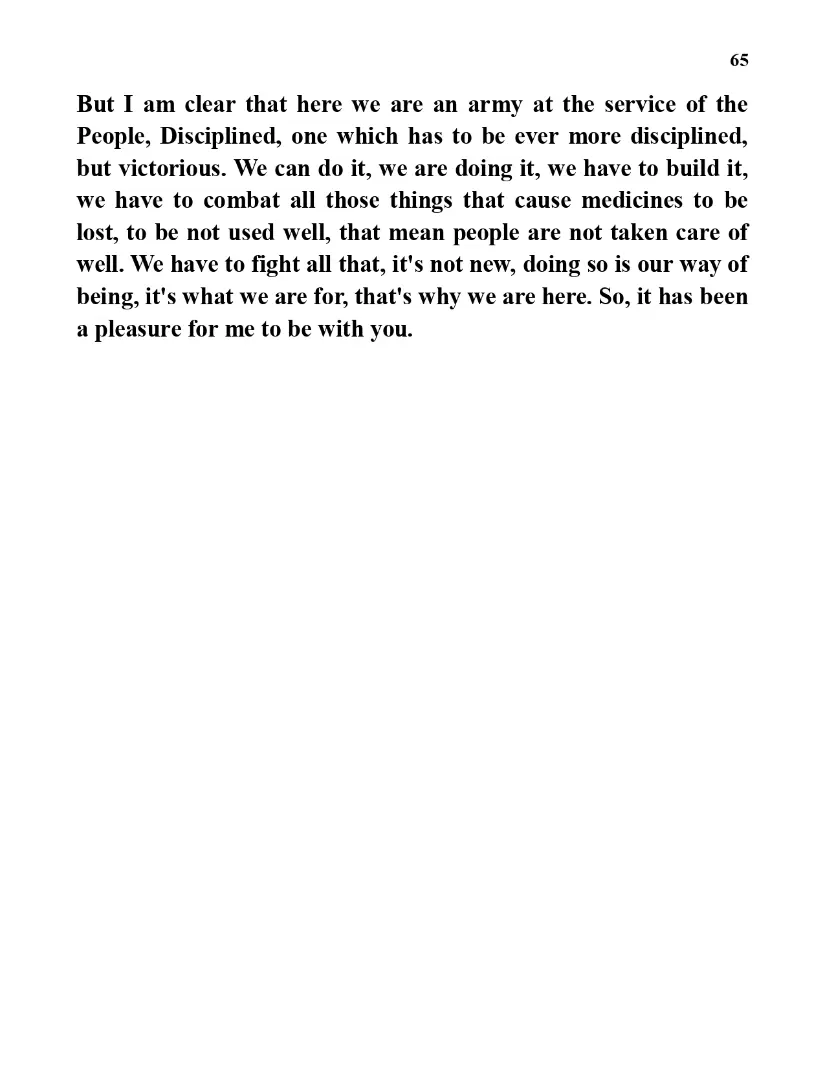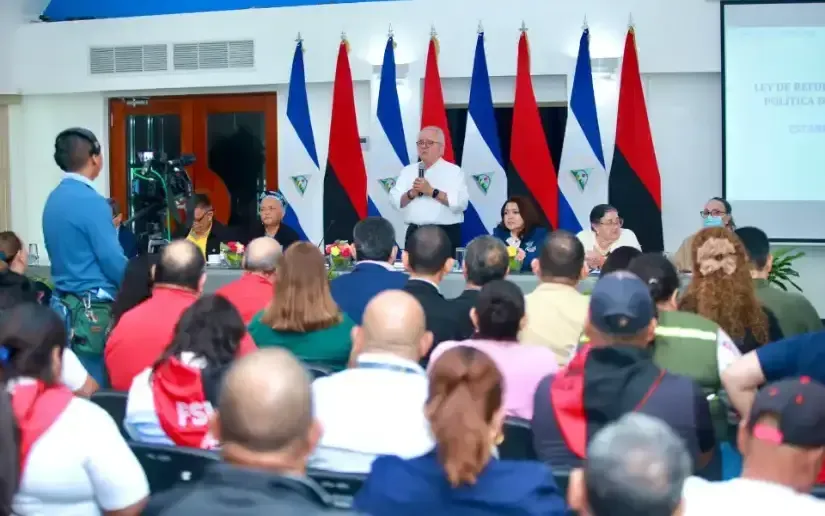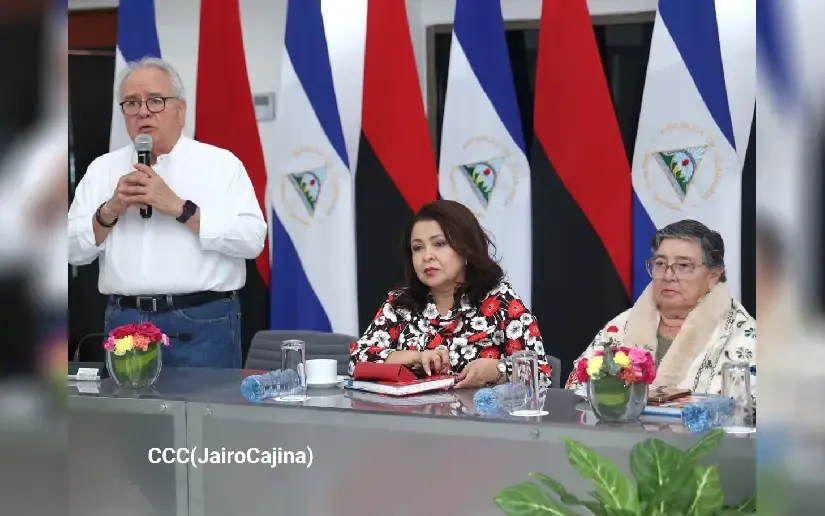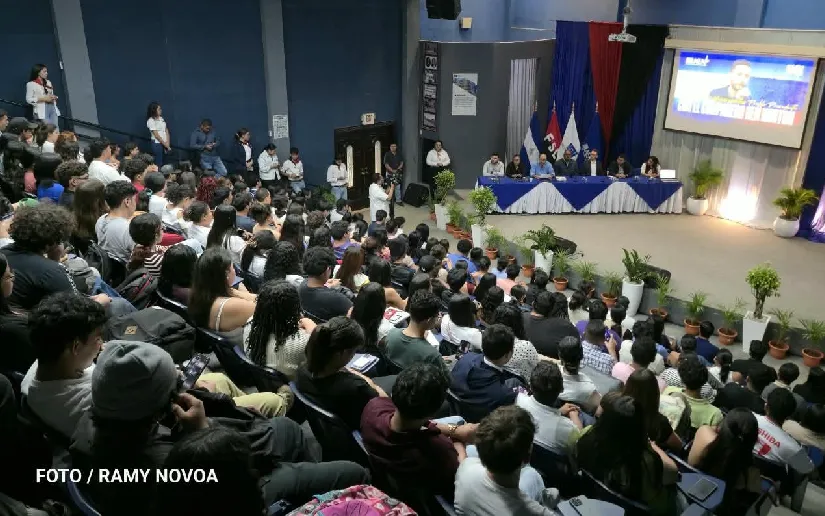








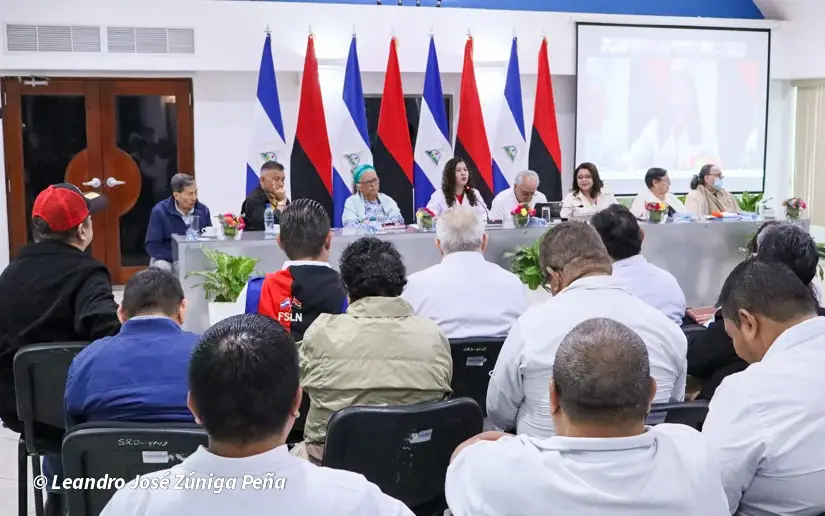
Meeting with Doctors, Specialists and Health Workers
during the Consultation Process of the Constitutional Reforms
Thursday, August 13th 2026
Presentation by Dr. Gustavo Porras:
Good morning, friends. It is significant that we are meeting today, on August 13th. A day when we are commemorating the birth of two giants of the Revolution, the giant of the Latin American and Caribbean Revolution, of the Cuban Revolution and also Guide of the Nicaraguan Revolution, Comandante Fidel Castro, who today would be celebrating 100 years of life, and the 96 years of our Comandante Founder of the Sandinista Front, Comandante Tomás Borge.
That is what is being commemorated today and it is significant that today we are gathered and we are going to work in this Consultation on constitutional changes with a sector that for all of us has been a fundamental pillar of the Revolution, of the construction of the new Nicaragua, and has been a fundamental pillar of all those dreams of our Heroes and Martyrs. This is the idea for which hundreds of thousands of Nicaraguans have given their lives on this plane of existence.
We welcome all of you to the National Assembly, in this place named after Rubén Darío. We welcome Dr. Meyling Brenes, our Minister of Health. There is here also the Minister Advisor of the Presidency for Health, Dr. Sonia Castro. There is Compañero Doctor Carlos Sáenz, who is Deputy Minister and Secretary General of Health and Doctor Enrique Beteta, who is Deputy Minister of Health.
We also have our Brother Denis Centeno, who is the Director of the White Cross and he has been doing a great job, a very good job guaranteeing that we have national coverage of the White Cross, we welcome him too.
Members of the Health Committee of the National Assembly are with us. Here is its president, Dr. Melvin Agurcia and here are the members of the Commission. We have Hospital Directors: Dr. Virginia, Dr. Carmen Cruz, Dr. Grillo, who is also a deputy in the National Assembly. There's Freddy Castillo, from the La Mascota Hospital.
We have the Directors of hospitals, Directors of Health Centers, Area Directors, Directors of the National Health Complex, Directors of the decentralized entities, you know that we have a series of decentralized entities and for all the Brothers and Sisters who are connected, it is necessary that they work together, in unison. We have the SIP, we have the INNS, which is the medical supplies company.
We have the company that has to do with maintenance, the CEMED, or rather the instance, the decentralized entity. We have the mobile clinics that we need to reinforce so as to fulfill the hundred that we have committed to reach the People. And it's not that there will only be a hundred, that is to say, after a hundred we go to the new goal.
We also have the Brother and Sisters of the National Executive of FETSALUD who are here with us. There is Evelyn, who is the founder of FETSALUD, she is a deputy to the National Assembly, there is Doctor Zamora.
There is Humberto Murillo, who is a member of the National Executive of FETSALUD and the Brothers and Sisters of SILAIS Managua. But we also have Compañeras and Compañeros connected on line. How many connections do we have? We have two hundred and seventy-nine connections. We can seeing them here and each of these on line connections has a number of Compañeras and Compañeros.
Let's all greet each other, here we are. That's why they call us, and one can understand the meaning of why they call us an “Army of White Coats”. We have to act as an Army, an Army of Peace, an Army of Love, an Army of Affection, an Army to do good, a Christian Army to take care of our neighbor as we should.
All this that I am saying translates into the words of the Revolution, in the words of the Comandante, in the words of the Compañera: "We are an Army to serve the People President." That is not a simple slogan, it is something very profound, the People President is the model that we are building, the model that determines that we have to attend to that People as if they were, and as they are, our Presidents.
That is what we work for and, in this huge Army of selfless Compañeras and Compañeros in White Coats, we have great specialists, we have sub-specialists, we have people with a great deal of skill, Compañeras and Compañeros with a lot of intelligence, with a lot of preparation. We have dedicated nurses, and we have dedicated laboratory staff, we have dedicated drivers, and we have dedicated directors, and we have dedicated administrators.
We all have to be like that and it is so important as well the battle to prepare and supply those who are at the front so that they do not need ammunition and food and rest periods at the front, also in our Army there are our Quartermaster Compañeras and Compañeros, our kitchen Compañeras and Compañeros our concierges. That is to say, this is a single Army serving the People, and you can have a hospital, the best of the best, technology, but if the brother or sister, for example, in charge of the Security of the hospital entrance, a brother CPF, does not act with the affection and quality that the People President requires, what is inside is useless. While on the contrary, he can take care of people very well and help them pass inside, but if the person who is going to receive people inside the hospital does not take care of them well, all the earlier kindness was of no use. In other words, this is a single Army at the service of the People President. So, we greet you all.
I would like to present the Compañeras and Compañeros who make up the Special Constitutional Commission. Our Constitution mandates that, in order to make Reforms, a Special Constitutional Commission must be formed, appointed by the Executive Board, approved by the Plenary, and that is what we have done. So, here we are the Members of the Special Constitutional Commission, the Members of the Executive Board, the Heads of the Political Groupings and two presidents of the main legislative committees of our National Assembly.
I am going to present Dr. Arling Alonso, a doctor, she is the First Vice President of the Assembly. We have too our Heroine, Compañera Amada Pineda, she is the Second Vice President. We have our sister, and friend, who has been steadfast in working for a united Nicaragua for all. She is María Haydee Osuna, President of the Liberal Constitutionalist Party and Third Vice President of the Assembly.
We have here Compañera Loria Dixon Brautigam, who is the First Secretary of the Assembly, a Caribbean woman, a teacher and a nurse. We have Doctor Wilfredo Navarro, he is the Second Secretary of the Assembly, and our friend Alejandro Mejía Ferretti, who is the Third Secretary of the Assembly. He is from the ALN party and he has been united and working with us.
We also have the three Heads of the Political Groupings in this Commission. Doctor Edwin Castro cannot be present, since he is also the Chairman of the Parliamentary Committee on Friendship with Cuba and there is an activity at UNAN right now, so we told him to go to that activity.
But we also have our friend, Compañero Lester Flores, who is the Head of the Liberal Constitutionalist Party Political Grouping, and our friend Mario Asencio, who is the Head of the IDB Political Grouping, the Independent Democratic Political Grouping, and together with the PLI and ALN Deputies who make up that Political Grouping.
And we have two Compañeros who are presidents of legislative committees: Compañera Auxiliadora Martínez, who is the president of the Justice Commission, and Compañero Wálmaro Gutiérrez, who is the president of the Economic Commission. These Compañeros and Compañeras make up the Special Constitutional Commission.
I am going to present the ideas that we have been working on so that you can get to know them, so that you can give your opinion, and not just for today, that is, do start talking, thinking, sending ideas, manifesting them right here and with all these connections we have.
It is very important in a sector that is very important, imagine, in a hospital, in a Health Center, at a health fair, how many people do we come into contact with? If they are thousands of thousands of people who can leave our care with thanks, blessing the Revolution, or who can leave upset because they received contempt or mistreatment.
That is the importance we place in you: how you serve the People President. And if we say that we are convinced that this is the right model, we must be clear that this People is the President in charge. We must be clear about that and we have to take care of them since they are our superior.
And that's not something recent, I remember that there was a time, in the middle of the war, we drew up a plan that we needed to combine, in the middle of the war, around 1986, or maybe 1987, making savings, because there was the concept of "everything for the war front", but also taking good care of people, and also giving them what workers needed. And I remember that the plan was called or the motto was: "To us our due, to the patients everything". That plan is not forgotten by me and that stands, it must be that way.
I want to tell you, I have told the Minister and I want to tell you, in these times, Comandante Daniel and Compañera Rosario are constantly monitoring the health situation and, in these times, as never before in the history of Nicaragua, not only in the history of our governments, in the history of Nicaragua, there have never been so many resources and so much capacity to solve problems as today and you know that, all of you who are listening to me.
Because gone are the times when we told the population: "Go to the pharmacy to buy gauze", "Go to the pharmacy to buy a suture thread", because there was none. Today there are in each of the storage areas or in the store rooms that there are in each service, in each unit, or in the large warehouse of a territory, of a municipality, of a SILAIS, or in the largest one, in the national one, in the SIP, there are. But we have to be aware that just because we have enough of such things this does not mean that we do not take care of it all or that we do not use it for the well-being of the People.
Let's get started.
We set out to work work so as to be able to identify what we were going to do to fulfill Comandante Daniel's directive of July 19th. On July 19th, Comandante Daniel said, "There are not going to be elections here again," and he also said, "There are not going to be elections again so that those who are lying in wait can return, so that those rogues will return to take over the Government and take over Power, and thus turn back all that we have achieved." At one point he said specifically: "Why do they want to come back to take power? To turn education into a business, to make a business of everything" and that's not coming back. That was the directive, and he told us: "We are going to work with the National Assembly to make the necessary legal modifications to the laws so that these demons do not return. They will not be able to, they will not be able to, they will not be able to."
That's pretty much the summary of Comandante Daniel's orientation. So, when we started looking at it all and started on the text, we said, "We need to make a Partial Reform Law to the Constitution that is based on three important concepts: Stability, Security and Peace."
These three concepts are not abstract, they go hand in hand with the aspiration of the majority of Nicaraguans. The majority of Nicaraguans, if you take a survey, almost unanimously, everyone aspires, everyone expresses that the most precious good is Peace. It is Peace, because without Peace we can do nothing. And if we aim to defeat Poverty, that is the central goal that guides us. In order to achieve that goal we need Peace and that is why they broke our Peace in the 2018 and tried to install a coup d'état, and we defeated it and they could not prevail, and they are not going to be able to.
But they did hurt us and we took a $35 billion hit as a country, affecting all of our assets. Of course, because they wanted to win, and their project was to take away the possibility of overcoming poverty. Thus they broke the Peace we had and, given that, we began to realize that we need these three concepts, to have Peace we need Security; and to have Security we need Peace; and to have Security or to have Peace we need Stability.
These three concepts became our guide us in this Reform. But beyond that, the Comandante spends his life explaining to us, and in our turn we too spend our lives saying it, as are get to know it better little by little: our history is not a history only of Nicaraguans, it is a history of our struggle against foreign interference and that is a reality.
We, as a People, all of us who are connected in this meeting, all of us who are sitting here, regardless of what each of us may think, and some of us may be saying, "What Porras says is not true." But, regardless of what we think, this is a reality, because no one can say that the history of our country does not include the existence of Cacique Nicaragua, of Cacique Diriangén and the struggles of our anti-imperialist indigenous Heroes against Spanish colonialism.
So, it doesn't matter if I say it or whoever says it says it since all Nicaraguans come from that historical experience. That struggle is incorporated in our thinking, in our being, in our behavior, in our social DNA, and we incorporate it. Because the Spanish came here and they sought to dominate us here. If we, at that time, did not speak Spanish, we spoke our original languages, but colonization imposed Spanish us.
But since our peoples are brilliant, brighter than the Nicaraguan people I don't think there is right now, what we speak is Nicaraguan, although they may say they speak Spanish. No, we speak Nicaraguan. That's right, I can stop anywhere and I say: "They just don't understand the fact that we speak Nicaraguan." You understand all right, but they don't understand, because we do speak Nicaraguan.
We incorporated, we created syncretism in the language, in the culture, in our religion, just look at Santo Domingo. There was a syncretism where, under the dominant Spanish imposition, our roots are: the Chinegro dances, the Vacas Culonas, the Cacique Mayor. That's us, that's a summary of centuries of our struggle.
We spent 300 years fighting against the Spaniards and there we committed ourselves, and we are going to make a collection, a compilation, because we have the struggles of Nicaragua and Diriangén. How striking that the cacique was was called Nicaragua; so then it was the territory that assumed that name, but the Cacique Nicaragua and Diriangén, that we knew him as Nicarao, but that's what Nicaragua was called. We weren't even a country, but we were already getting incorporated as a colony.
And I was talking to Wálmaro, who is from Diriamba, and here there are people from Carazo who are connected on line in Diriamba, because we found and read where Diriangén and Nicaragua defeated Gil González. So, we have the date, it was April 14th, we have the year and we have the place: in the Quebrada del Perro.
In the Quebrada del Perro the battle took place where Diriangén and Nicaragua defeated Gil González and expelled him. Now, that's what Walmaro is telling me, it's a street, everyone knows that's where it is. Imagine that it's this historical memory and everyone knows that that's where the Quebrada del Perro is and what we have to say to everyone: "It was here, in the Quebrada del Perro” and that's where I argue that outsiders don't understand us: this is where they “broke” the Spaniards. We Nicaraguans understand that because it is our language. And it keeps accumulating and that makes us who we are. That is the magic of the Revolution, because as I told you yesterday, the Revolution is one of the most beautiful of God’s gifts.
And in the 300 years before 1821, during that time, at every moment, we were producing heroic Nicaraguans who fought against the intervention, we have Caciques like Adiact, Agateyte, Yarrince, Chontales. That is, suddenly you read the chronicles and Diriangén was going over the Maribios, over the Cordillera, to Chinandega, to meet with all the Teyte, which meant the "old ones" and there was Agateyte, who was the chief of everything.
That was a life of permanent defense, 300 years that we were not taught about in our history. Then we reached 1821, where we freed ourselves from the yoke. We formally liberated ourselves from Spanish colonialism, in 1821, but the foreign enemy forces wanted always to keep us dominated. We got to September 15th 1821 the Act of Independence was signed and we say: "September is the Month of the Patriotic Nation”. That is why we are proposing to make this Reform, with the guidance of Comandante Daniel and Compañera Rosario, as a greeting to the Month of the Patriotic Nation; we ought to approve of this since it's only right.
But things didn't stay there. You know that a place in life, in space, in the social or material world, which is left vacant, gets occupied by another. It is a law of matter and it is also a social law. If there is a void left, someone has to fill it. Spanish colonialism was beginning to recede, but there were forces that even if they no longer occupied, they continued the struggles, so as to divide Central America, we were a Federated Central American Republic, and each of our Republics was made independent. So there are struggles between us, the Central Americans, and thus Nicaragua appeared with its first Constitution in 1838, always fighting against imperialism and colonialism.
Imagine, in 1838 Nicaragua appeared and the struggle just continued. There was another impasse, because the Iturbide Empire, based in Mexico, along with everyone else sought to devour this small, beautiful land. But by then it failed to take into account the fact that in the north, there were the beginnings of a new imperialism, US imperialism was beginning to take shape.
US imperialism was beginning to develop and it sent out its advance guard. And among the forces sent out were a group of filibusters headed by William Walker and Byron Cole, financed by a man named Cornelio Vanderbilt, who had a business vision when the most difficult thing was to cross the North American territory from East to West, which was full of the region’s Native Peoples, against whom the US also committed a terrible genocide.
So, to avoid that conflict and war, they looking for a way, the same way that attracted the Spanish, the same way that brought the English to the Caribbean, because it was the British Empire that came to the Caribbean. That is why Creole is spoken in the Caribbean, because it was the same phenomenon, Creole English, they wanted to impose “English” there and so the language that developed in the Caribbean is Creole, the same thing happened in both the Caribbean and the Pacific. Those were the struggles that developed here.
So they discovered the River San Juan, along which the pirates used to sail. Then, those who were on the Spanish side defended the River San Juan River so that the pirates could not reach the Pacific. That's where they built the castle that we are familiar with and everyone kept passing there trying to get their way, and at the end of the day Nicaraguans were here fighting two empires: the British Empire in the Caribbean and the Spanish Empire in the Pacific. That is the reality of our country.
So, as I was telling you, that's how we arrived having Vanderbilt make a millionaire enterprise, managing to make that crossing, and he sent his emissary William Walker, to take Nicaragua and to guarantee safe transit by means of the filibusters, a band mercenaries who came here. But he went further: he learned of the contradictions of Nicaragua’s own society at that time, which were the contradictions between the Creole oligarchy the Spaniards had left behind, who felt threatened because, suddenly, they saw the natives, the poor, the indigenous people gaining strength and beginning to develop, and so then it was the oligarchy confronting Nicaragua’s People.
That was the reality and it is no coincidence that this oligarchy’s surnames included Chamorro, it also included the surname Zavala. That is to say, since this country is small, we are referring to the oligarchic families that were descendants of that oligarchy with which the Spanish monarchs had agreed independence saying "OK, be independent, but these are the people who are going to run things." Those were the big ranchers who created the conservative hacienda system, and it was the sheer economic power of the conservative hacienda owners which allowed them to develop their own system.
And what was the most effective instrument of domination? The Catholic Church was the most effective instrument of domination. We are going to show a copy of the letter which all the ladies of Granada high society and also the men leading that oligarchy signed asked William Walker to, please, protect them from the popular mob.
In other words, we can put the story of the XXI century in the same terms: There were the Yankees on the one hand, and there were the children of all the oligarchs, all those surnames associated with the wealthy elite. On the other hand, there was a group of obedient employees who listened to them, and on the other hand there are the People, like ourselves, who have had to defend ourselves against them.
Heroes appeared there, Heroes emerged after Independence and in that regard we see the need to rescue Cleto Ordóñez who is a National Hero, from Granada, but not the Granada of the élites, but the Granada of the People. Cleto Ordóñez was the first popular Hero of the anti-oligarch struggle. And so they go on emerging.
And that was the case when William Walker came and that's how José Dolores Estrada emerged and Andrés Castro emerged in that struggle as National Heroes. I was even reading how Tomás Martínez, I think it was, prosecuted José Dolores Estrada and declared that National Hero to be a traitor to the Nation because he did not agree and he was proscribed.
But then he came back and they restored his honors and restored his title of National Hero. How so? Because that's the story of division provoked by outsiders. They could not forgive José Dolores Estrada for managing to unite the Nicaraguans, so as to reject William Walker, or for uniting the Central Americans so two or three years later they managed to definitively defeat Walker.
So, what is it that I want to convey to all the Compañeras and Compañeros, to all those who are on line via those 260 connections and those who are with us here? The history of our country, the history of our people, is the history of the struggle of Nicaraguans against foreign interference, against foreign intervention. And every chapter of that intervention, of that interference of colonialism and imperialism, Nicaragua stands fast, and produces Heroes, and that's how the anti-imperialist indigenous Heroes have produced all of you.
Nicaragua produced the Heroes of Independence. This is how Nicaragua produced Tomás Ruiz, who was the first Indian who managed to become a priest, but he did not stop being indigenous of his blood, native indigenous, and he studied, he was among the first to emerge and they did not forgive him for that and imprisoned him and he died in Chiapas after being tortured. He's an indigenous Folk Hero, that's the story. So, every action of intervention by them produces our Heroes.
William Walker came and Dolores Estrada emerged and Andrés Castro emerged. Against the whole process of intervention, the Liberal Revolution emerged and an intellectual lighthouse emerged who transmitted his ideas in Nicaragua and far beyond, who is Rubén Darío. I was reading yesterday a compilation made by the Compañeras and Compañeros here at the National Assembly of the political writings of Darío.
That's when the Liberal Revolution came that broke the existing system, it really was a true Revolution and that's why General José Santos Zelaya is a National Hero, because he broke with all the existing establishment of hacienda conservatism and the Creole oligarchy. Put another way, there were no civil rights here. Education was not secular, education was run by religious orders. Health care, those who are health scholars know that care was dominated by the concept of charity, of charitable health care. The hospitals were available via a convent or a monastery, run by the religious orders.
It is clear that if you were someone who did were not believer, not only would you die you would not even have a place to be buried. So, you might say, "This person is crazy, how could it be true?". But, yes, it is true and we have proof: Go and see where our National Hero Benjamin Zeledón is buried. He is buried outside the cemetery of Catarina, at the door, at the entrance, there he has his mausoleum. And why wasn't he buried inside the cemetery? Because the Catholic Church, which was served the Yankee intervention, did not give permission for him to be buried inside the cemetery so the People buried him outside. And as always happens, they didn't realize that by refusing to bury him in the cemetery, they made Zeledón even closer to the People. That's our history.
Then you have another example of intervention in 1912, after the Knox Memo of 1909, came the intervention of 1912, Nicaragua stood fast with Zeledón, he fought, he was murdered, and after the murdering Zeledón, the Yankees were paraded his body through Catarina so that the people would be afraid, he produced Sandino, because Sandino saw what they did to him and, instead of being afraid, he was outraged.
I keep insisting that this is our history. We have that history inside us and we have it here in front of us. None of us like to have anyone tell us what to do. But to have a foreigner do so, a Yankee, definitely not.
So then we get to 1912 and we have already entered another intervention. Logically, this makes empires, the metropolis think: how do they resolve this intervention? So they move on to a new phase. Since they see that there is an internal struggle in Nicaragua and they already have their subordinates in government as President, such as Adolfo Díaz, who are support US intervention, then they move on to the phase of wanting to dominate us via the law.
Here is an example of this: In 1923 the Yankees enacted a law that is known as Dodds Act. That's very easy to confirm: just enter a search engine on your smart phone, and put "Dodds Law in Nicaragua," and it will show that it was an electoral law, that it was a guy named Harold Dodds, and the history comes out.
This law established the existence of a Supreme Electoral Council; at that time it was called the National Council of Elections. The fundamental thing about this law was to establish a bipartisan system, as the US already had a bipartisan system, with the existence of just two parties, the same thing we heard here: they are Liberals and Conservatives. The Liberals resemble the US Democrats and the conservatives, the US Republicans. So they want to impose that here and they send that gentleman surnamed Dodds, who was hired by the State Department and they sent him to Adolfo Diaz so that he would hire him as an advisor and prepare the electoral law.
This law was in 1923 and it was the one that remained in force. What they did with that law was wait to put it into operation in 1928, but first they needed to create the political conditions, because between the 1923 and the 1926 there was the Constitutional War in which fought the Liberal Army of Moncada, where Sandino was one of the Generals and they were winning the war.
Then the Yankees came along and said, "Now is the time to act." In 1927, remember, the Espino Negro Pact was agreed. The Yankees came and said, “now this is over and we're going to make a pact with Moncada. But here we need you to control the weapons. So we’re going to create a National Guard and impose order and we’re going to elect you as President a year later, in 1928.” That was the pact, that's what they planned.
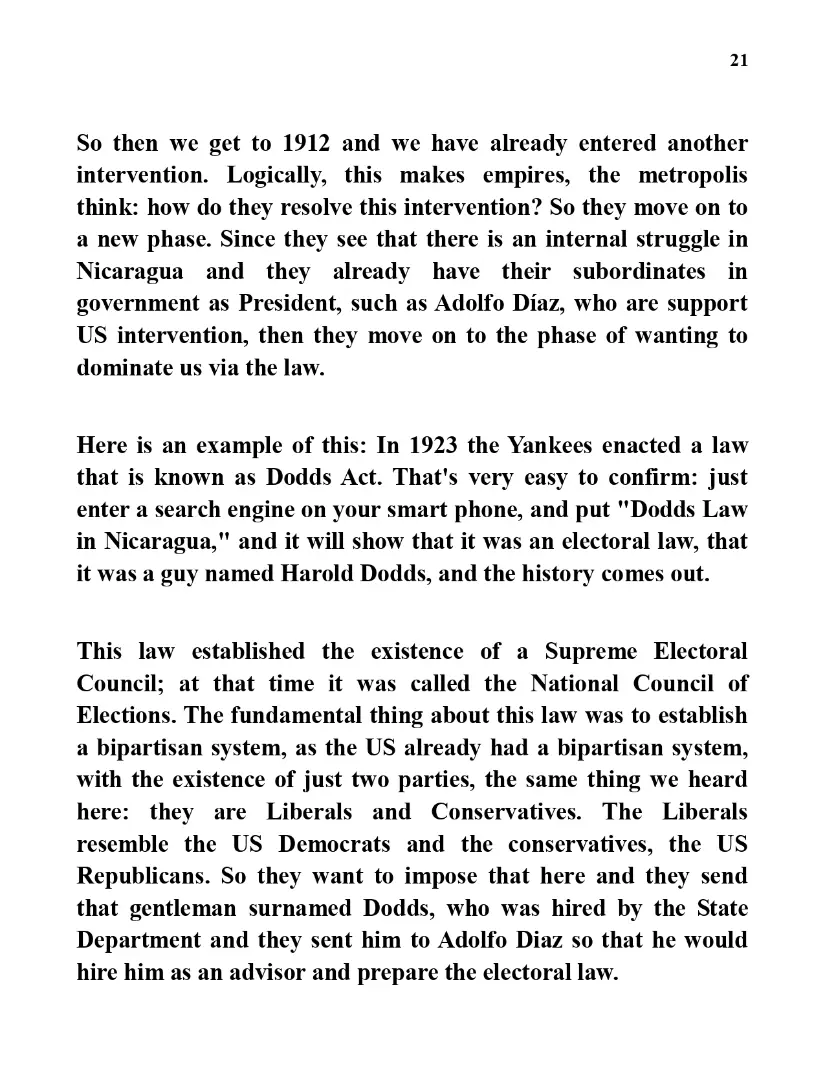
This image shows the design as you can see, here is the ballot paper, this is proof of the official Ballot from 1932. There was the earlier process of 1928, because there were elections in 1928, 1930 and 1932. This was the bipartisan system, which we were taught as the historical parallels. The bipartisan system where Adolfo Díaz was the Conservative candidate for President and Juan Bautista Sacasa was the Liberal candidate for Vice President, both were candidates of the Yankees. Adolfo Díaz, was the one who had invited them to intervene; Juan Bautista Sacasa was the same person who, when he was President, invited Sandino to his last supper for him to be assassinated.
So, the Yankees had that idea of bipartisan system. This gives you an idea of how bipartisanship is designed so that no matter who wins, it gives you the idea that there is a democracy even when both serve the same masters anyway.
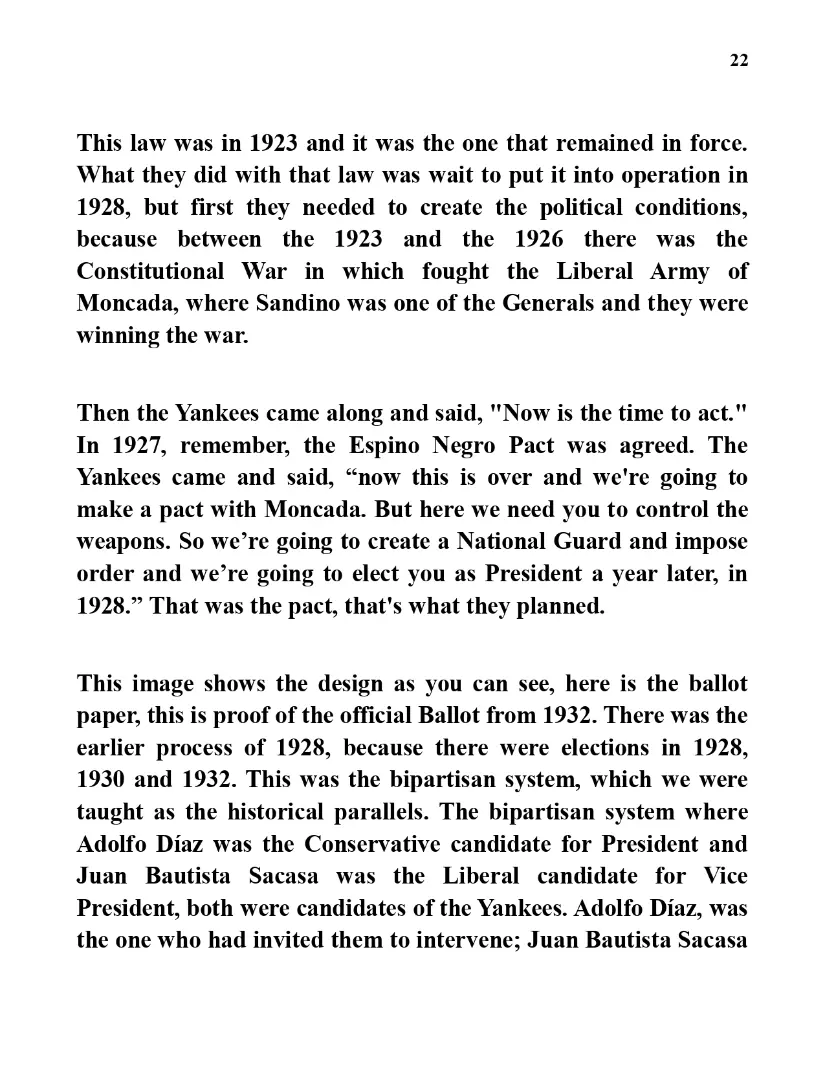
Then 1923, 1924, 1955 go by, with all that happened, until 1927. This is a photo of the Espino Negro Pact, is it invented? No, it's not an invented, there's the photo. Here is Moncada and here are the Gringos and Henry Stimson, the Moncada-Stimson Pact, this is the Espino Negro Pact.
So, in that pact they tell Moncada: "You hand over your weapons and we'll pay you for them”, I think it was a dollar per rifle and that was it. May 4th 1927 would have been a day of ignominy, but no. One of the generals said, "No, I’m not giving up my weapons, I neither sell out or surrender," and he set off with 30 men. As the song says, "It was 30 with him," and he resisted saying, "No, I'm neither selling out nor surrendering."
So, instead of being a day of ignominy, it is our Day of National Dignity. Sandino transformed that ignominy into the expression of National Dignity on May 4th 1927. Sandino, one month and a few days later, declared the Manifesto of San Albino, on the first of July 1927.
Then, in 1928, the Yankees need to keep their deal with Moncada. But, to comply, how could they make sure that Moncada would be elected President? Very easy: they brought in the US marines, and put a US marine officer at the head of every electoral district, departmental electoral body and polling station.
And not only that, since they wanted complete control, they put Brigadier General Frank Ross McCoy as President of the Supreme Electoral Council. This McCoy was a General to whom the President of the United States says: "You are going to go there, we are going to make you President of the Supreme Electoral Council and you are going to ensure that Moncada is elected President" and that was the reality.
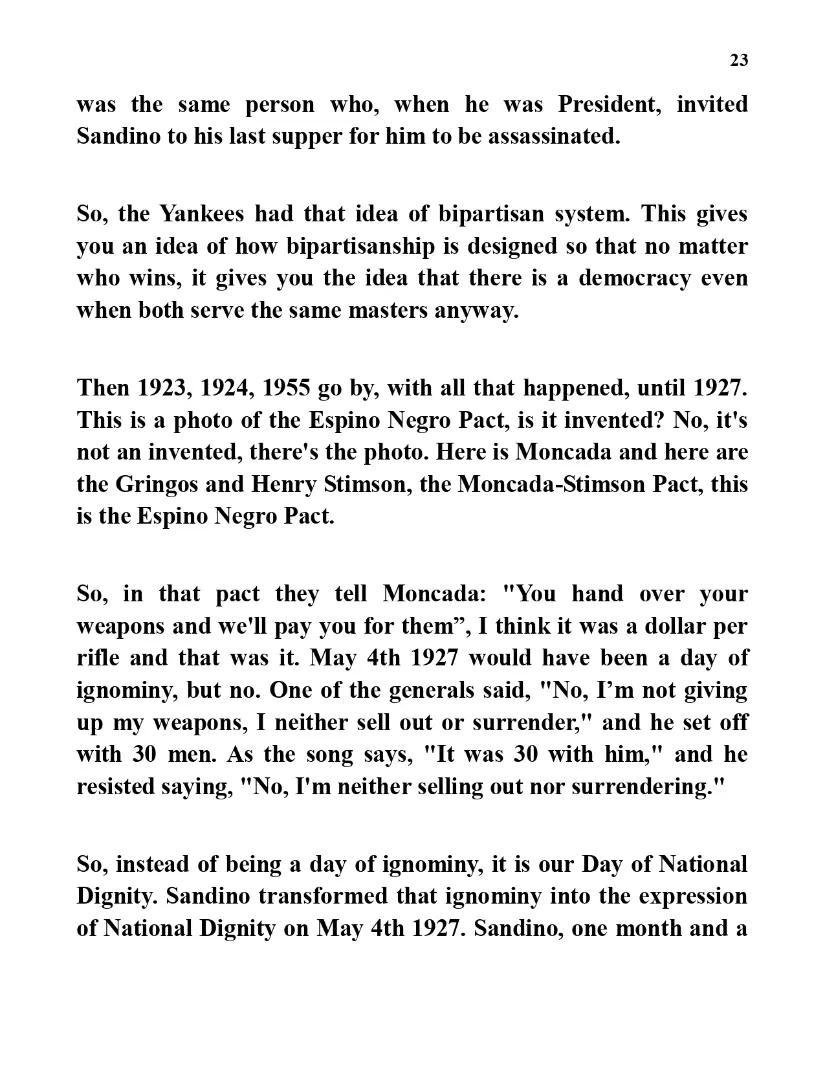
What's you can see here is the Dodds Act, this is the Official Gazette of April 3rd 1923. Very quickly, just to explain to you everything it says is this, the Yankees left the Dodds Act intact. They said, "That's what we're going to apply," and they put it into practice, but they suspended part of it with another law called the McCoy Law, to ensure that the presidents of the polling stations, the heads of the Supreme Electoral Council in each department, were Yankees. So they had to make an alternate system.
Look what they were saying. This is important, because if you read this,all the Compañeras and Compañeros who are connected, you’ll see the difference in thinking. This is the difference in the thinking of that time with the current thinking.
We say today: "Every Nicaraguan has the right to choose and be elected, except those who violate the Constitution or who have this...". No they did not say that, here is their law: "No citizen shall have the right to vote". First I tell you: "No”, from there I'm going to decide who complies and who does not comply. The concept is different: If someone does not meet the conditions and qualifications required by the Constitution. And the second point gives you an idea of what the kind of democracy they have tried to sell us looks like, although it is 100 years old, but at the grassroots the thinking is more or less the same.
Imagine, in the health sector we are made up of workers, 80% of whom are women, well only 30% would vote there, because look at what the second article says: "The right to vote belongs only to Nicaraguan men." That is, out of 100, if the matter were demographic, out of 100, 48 can vote. But who? Only those who are over 21 years of age.
Here are a few comments from Compañeras and Compañeros who know a lot about this. They know that now, little by little, our population and our population pyramid is increasingly moving towards old age. But 20 years ago we had a lot of people and 50% were around under the age of 20.
But imagine, 100 years ago, people over the age of 21 will have been like 35% of the population. The majority of the population was young, it was under 20. So, if you apply the woman and the man criteria to that, you're left with 48 voters out of 100. If you apply the age criteria, you get 20 out of 100, which is 40% of the men entitled to vote.
That was the reality of this democracy. And since the wealthy elite needed to guarantee they had a majority of votes, then they said: 18-year-olds, who were quite a few, could also vote, on two conditions: that they were married by the Church, which is already clear was a very small population, for which you had to have money. Anyone who got married in the church was because they had money. The majority of the Nicaraguan people were married under common law .
The Revolution has come and the free unions are recognized. That is why the Revolution really is one of dignity, one which returns rights to everyone. But also, the other condition to be able to vote aged 18 was that they had to to read and write. Imagine the illiteracy we encountered in 1979. Then imagine the illiteracy there was in the 1930s, or 1923. Who could then read and write? The oligarch families, if there were no public schools, the ones Zelaya had started had been disrupted. The schools were run by the religious orders. Who was able to go there? Who could? This was how the oligarchs were to rig the vote.
After this 1923 law they created a decree, which is what I was telling about how they ordered the 1923 law to be suspended in part as much as to say, "This is what we are going to do." And I just want to read to you, in this decree, the first paragraph so that, by looking at the dawn we can see the day to come:
The President of the Republic, in view of the fact that the Supreme Court of Justice, by agreement of the 17th of this month, has appointed, in place of Dr. Joaquín Gómez, who submitted his resignation, General Frank Ross McCoy, President of the National Elections Council, and that this high official is, in that capacity, and because he has been appointed by the President of the United States, he must direct the 1928 election of supreme authorities, as agreed so as to put an end to the civil war ravaging Nicaragua.
There it is clear that the Yankee President who says: "McCoy, you are going over there." The Supreme Court of Justice appoints him, he assumes that post and his mission is to elect Moncada. That's the reality. The reality that must not be repeated. Why won't it be repeated? Because after this what followed was the whole struggle of Sandino, the betrayal of Sandino, the triumph of Sandinismo, the expulsion of the last marine and all the contemporary struggle with which we know very well.
Still look at all the other attempts they made. For example, you may remember how Oliver Garza was giving out food here so that people would vote for the same representatives of the oligarchy. All those interventions we already know about. The intervention they made when they put a gun to our head and told us in '90, "If you vote for the Sandinistas, the war will return." The People are smart, the People said, "We don't want war." And we, the Sandinistas, and the Comandante and the Compañera, in essence, children of this People, simply say: "The People must be heeded." And the Comandante said, "We are going to return to office by way of votes. We are not afraid of that" and so it turned out.
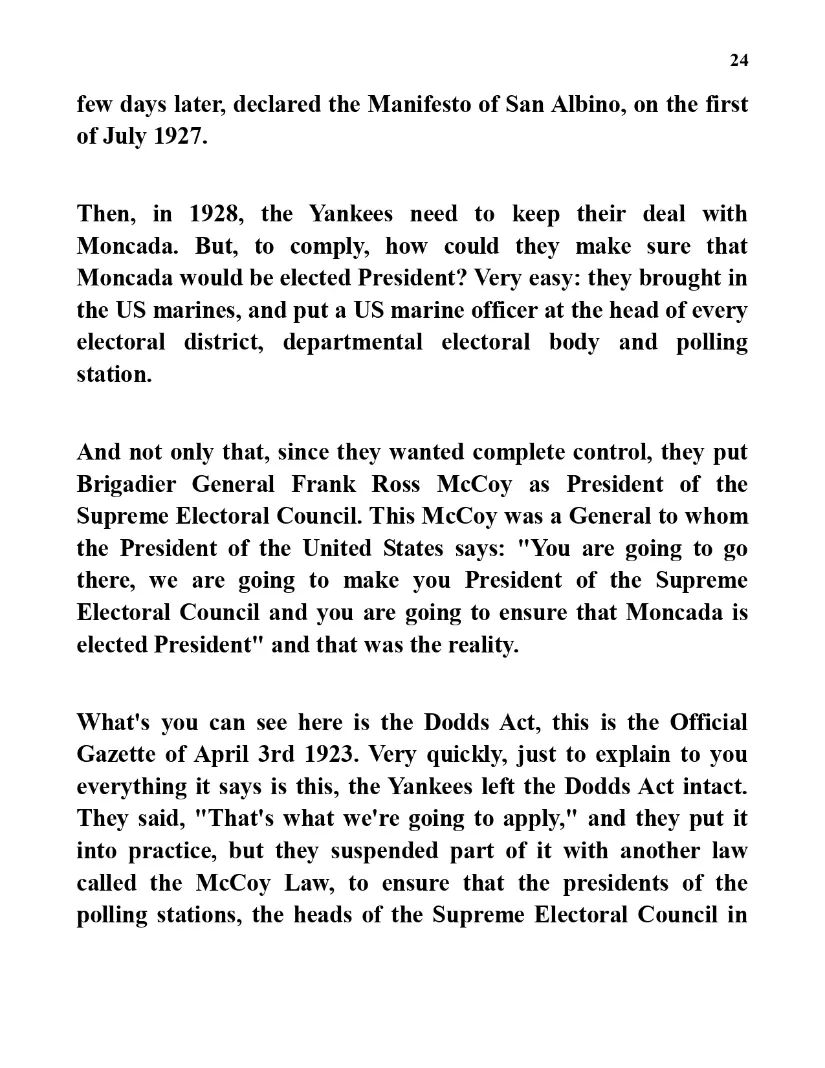
Then someone says, "But can it really be true?". There are the images and at this time there was no artificial intelligence. These are raw images, here you have the line of voters, here is the head of the polling station, a US Marine. Here's another line of voters. There are the employers in their bowler hats and their armed guards. These are voters and this is the gringo marine head of the polling station.
Here you have: a line of voters and there are members of the Constabulary, later the National Guard, keeping order, from start to finish. Here are the ones I was telling you, those who figure in that decree, because it was not enough for McCoy to be the President of the Electoral Council, but that in each department the US Marine officers, should also be, because they had to have complete control. Here is US Major Joseph Pate, here are his US marines, look: he was President of the Electoral Committee in Estelí and this is the Departmental Board.
All that struggle, everything we already know all too well, the resistance we made, the fight against the failed coup attempt, which was the Yankees themselves. No one doubts that the Yankees put up all the money, financed all those networks along with all the same old surnames who tried, in 2018, to break the constitutional order but could not prevail.
We began to rebuild, we began to grasp the path of growth, of the future of our people, and last year we completed a Constitutional Reform that gave us, as the First Article of the Constitution, this Article which is the First of the Constitution of the People President:
Independence, sovereignty and national self-determination, Security and Peace are inalienable rights of the People and foundations of the Nicaraguan Nation. Any foreign interference in the internal affairs of Nicaragua, any attempt to undermine those rights, threatens the life of the People. It is the duty of all Nicaraguans to preserve and defend these rights.
And here comes the incorporation of recent combative experience... "Consequently, all those who act against these sacred rights of the Nicaraguan people will be considered traitors to the Nation." Article 1, we must not forget, we must be consistent with the entire Constitution, but Article 1 guides us and guided us for what is coming: These are six elements, the six ideas that will constitute the electoral reform.
All that I have been telling you, all this historical struggle, all this feeling and all this experience leads us to define six ideas that we are going to transform into articles of the Constitution.
"They won't be able to." This is the first idea that we are going to translate into text: "Citizens have the right to choose and be elected and to run for public office, except for the limitations established by the Political Constitution." They will not be able to be candidates for positions of popular election nor will they be able to exercise public positions by appointment of the Presidency of the Republic or election of the National Assembly four types: the coup plotters, obviously, cannot.
Imagine that this roadblock thug is going to be able to take part so that it can disrupt things later, that's not going to bring us Stability, it's not going to bring us Peace, it's not going to bring us Security. They will not be able, moreover, on principle, they want to kill the cow and still drink its milk. The coup plotters cannot take part.
"Those who commit or have committed acts that undermine Independence, Sovereignty, Self-determination and Security and Peace." That is, those who commit any violation of Article 1, traitors to out Patriotic Nation, cannot take part. So, we are elevating this principle to constitutional rank against those who violate or have violated the Fundamental Principles of the Political Constitution.
This exists in all the Constitutions, we did not have it and what we have been told is correct, that is, the laws must be made to guarantee, shield, put up that wall, that barrier, the Comandante said. All those who will not be able to take part, we are clear.
When people ask, "Are there going to be no elections?". Yes, there are going to be elections. Everyone can part, except those who are coup plotters, traitors to the Nation, those who violate the Constitution, those who sell out our Independence and Self-determination. It's very simple: those cannot take part.
So, for example, this is a paragraph of the text that we are discussing. And this is about sovereignty "All those who insist on or promote foreign interference." No one can simply be allowed to go on TikTok and post, "We're looking forward to the liberation troops coming to liberate us from Sandinocommunism." You're asking for foreign intervention. Okay, that is your right and, as the song says“ "Outside you can say whatever you want”, but not here, here, you lose your civil rights.
Those calling for military intervention. That simply can't be, for people to say: "I want to participate in the elections and already being here, I ask that they come to guarantee my vote through an intervention, that the US Marines come or the UN Blue Helmets." Then too, those who organize with external financing, those who propose coercive measures, support economic blockades, commercial or financial blockades, or those who propose, prepare or manage sanctions against the State of Nicaragua, its institutions and its citizens, those are the ones who will not be able to take part.
The second concept is "Stability". If we are fighting against poverty, we cannot live in instability, we need Stability, and Stability happens during more longer electoral periods, of a more prudent duration. And then we say: we are proposing that the periods of elections in our country be seven years. In China there are ten, in Italy there are seven, in Ireland there are seven, in African countries the majority have seven. We had six, we say: let's move on to seven.
So, there I would say that the period established in the Constitution for the election of the positions of popular election or the positions of appointment by the President is seven years. Why? Because seven years, I have read, some say that the medium term is already five years. We now have very important projects that we will be able to develop and we can see how they progress in seven years.
The People can see everything and we can all say: "We are on a good path, we are pushing this, I give my vote for stability and continuity."
Because that's why in our politics, decisions of this type have no other objective. The thing is that before, the oligarchs, the enemies of the People, their goal was to get rich. The objective of all these processes is to develop the well-being of the People.
So, in this period, and you can see it: the new highway in Managua of the Heroes of the Resistance, you can see it in the hospitals and this is a permanent struggle, because now every new hospital, we have to ensure that it remains new.
That is, you have the Velez Paiz and they wanted to burn it down on us in 2018, because we inaugurated it in 2018. It's already an eight-year-old hospital, it's going to be nine. We have to manage to maintain it, a lot has been achieved. It is a hospital that you enter and see how beautiful it is and we cannot let it deteriorate.
But not only that, all, all our primary hospitals, all are important, all our Health Centers. We can't just get used to it, we can't see with indifference that something is failing and think that's fine, to the point where we may even miss the cobwebs or a hole somewhere.
And why am I going to worry about it? Well, because the President is coming. If you tell someone that the President is coming, they immediately jump to it or because the Minister is coming, but no. The President is going to arrive because they arrive every day, because the People are the President, that's the concept.
The next idea is: "Cohesion and Security" What does this mean? That if the popularly elected positions are going to be seven years in the Constitution, from there we need to reform the Army and Police law to say: the Commander-in-Chief, his term is seven years, and the Commander and the heads of the Police Forces, their term is going to be seven years. This is called Cohesion and Security.
Someone has to administer this electoral democracy. The electoral one, because our democracy which is the one that I have been talking about, is a much broader one, it is that of the right to health, the right to education, the right to school meals, the right to electric light. Look, now if the light goes out, we say, "The light went out. How odd. What must have happened?", today, in these times. Before, in the time of the neoliberals, our great surprise was: "The light’s have come on again."
So, make a point of ensuring that all the hospitals and Health Centers have checked their generating plants, because sometimes, when the power does goes out at some point, as now we have already forgotten, they neglect the power plant there and it’s not ready to work.
Now in this Supreme Electoral Council, it is our Compañera Heroine Brenda Rocha, who presides over it, she is no Yankee like the one we saw. Brenda Rocha is a Nicaraguan heroine, she presides over the Council and is a Nicaraguan for Nicaraguans, for Nicaraguans, where traitors, coup plotters and violators of the Constitution have no place.
The Council has to have the power to call, convene, direct, organize elections every seven years. The Constitution mandates them, but it also mandates that, if there is a political party that receives foreign financing, it cannot not give it legal personality and, if it has it already, then it is canceled.
Now, if there are any of its managers who receive funding from abroad, they are canceled too. That is what it says here: to verify and impose sanctions when there are candidates, Council officials or members of political parties who have committed actions that undermine independence, Sovereignty... which is what we read in the "They won't be able to" paragraph.
So, there we go with idea number four. Please note: "They will not be able to, Stability, Cohesion and Security, the Army and Police and the Guarantee of Electoral Democracy” which is a necessary but minor part. Why? Because democracy is integral, it is in health, education, electricity, etc.
We named this next idea “PAX" so that we don't forget, in honor of a poem by Rubén. And so the date of the inauguration is going to be January 18th. We are going to correct an oversight. We had January 18th which is the day of Rubén's birthday, but we were taking office eight days before. So, in the Constitution we are going to change that and let the inauguration be on the day of Rubeén Darío's birth.
The sixth idea is called "Coherence": once the Constitution is approved, the positions are already seven years, but those who had been elected or those who had been elected were for six, so it's about ensuring those who are elected now or those who are appointed go to seven years as well. The positions appointed by the Presidency of the Republic or their election or ratification by the National Assembly are expanded.
Take a good look at this: they are extended from the date of the last election, the last national, municipal or regional election, the last election of the Assembly, and in this they are extended from their appointment or election, from that date, it is that they are seven years. It's just that everything has to be equal.
Finally, a general rule is established: all the periods contemplated in all national legislation for the exercise of their public functions must be adjusted to seven years. This provision applies to public positions, not to private posts.
Well, Brothers and Sisters, Compañeras and Compañeros, a greeting to all those who are connected on line, thousands of workers, and to all of you who are here. Our mission is to understand this all as a natural result of Nicaragua’s historical process.
Thank you very much, Brothers and Sisters.
Compañera Dr. Meyling Brenes,
Minister of Health:
Thank you Dr. Gustavo Porras for this journey into our history, into our roots, into our historical memory that we have and into our struggles against foreign interference. We are going to open up an important space where we can share and ratify our support for the electoral reforms in our Political Constitution.
We are going to have a space where any of those who are here, on the panel, in this auditorium, can get up to participate and also, of the 308 connections that we currently have, they can also participate.
We have opened the space for a face-to-face participation of the auditorium. Who wants to participate?
Compañero Erick Uriarte Barrera,
Fernando Vélez Paiz Hospital:
Good morning, Compañeras and Compañeros, beloved friends presiding and the Brothers and Sisters connected by video. Erick Uriarte Barrera at your service, I have the honor of belonging to the Ministry and I have been listening to Doctor Porras and all these presentations since the Comandante mentioned this to us all on July 19th.
I did not want to miss the opportunity because, in particular, I thank Dr. Porras for this moment in which he has shown us the high level of vision and dynamism that our Co-Presidents have, and he has guided us through this modification, the adjustments in making this Reform, which demonstrates improvements, Progress and Stability. I personally believe that this will bring improvement, it will bring more stability, it will favor the synchronicity that exists between what is the legal framework and our social reality. It will bring us progress and it will favor us in giving what the Comandante and the Compañera are looking for, Stability and Peace.
So I personally consider that it translates into times of improvement, times of quality and of benefits for all of us Nicaraguans. For my part, I consider myself lucky to belong and to be able to participate in such efforts to help our Nicaragua grow. I thank you.
Compañera Dr. Meyling Brenes
Minister of Health:
Thanks to Dr. Uriarte, from the Fernando Vélez Paiz Hospital. We are going to open a space virtually, if there is anyone connected across our country who wants to participate.
Dr. Carlos Espinoza,
Hospital Escuela Óscar Danilo Rosales Argüello (León):
Good morning, Doctor, from the Hospital Escuela Doctor Óscar Danilo Rosales Argüello. I am Dr. Carlos Espinoza, intensive care pediatrician of this institution.
First of all, thank you to the national leadership for the space they have given us and thanking God for the fortune of doing so on August 13th which commemorates the passage to immortality of two great revolutionary leaders, as mentioned by the doctor, our Comandante Fidel Castro Ruz and our Comandante Tomás Borge Martínez. And I can do so because I am a graduate, I am a son trained as a doctor in the new ALBA medical training program, which was an idea of our Comandante Daniel, our Comandante Hugo Chávez and Fidel Castro to vindicate the right to health of our Latin American and Revolutionary Peoples.
And today I also want to thank him and I feel proud because my leader, Dr. Gustavo Porras, is making this path of history for us and that is why we must defend, remember, and it is what makes me feel proud to be a Nicaraguan and a Sandinista revolutionary, because in reality you cannot be a revolutionary in Nicaragua without being a Sandinista, and being a Nicaraguan allows us to be members of the most conscious, socially conscious country in the region.
Today I want us, like HEODRA, to ratify and support the Constitutional Reforms of our country, because they represent our Dignity as Nicaraguans. They drive away and reject any political interference from the United States and any country that wants to come to rule when they have no right to and, better yet, they defend us from all those traitors who were unfortunately born in our lands, among us all, and in the end only want to continue calling for political interference which makes no sense at any point.
However, we must emphasize, as the doctor said, that they are the same as always, the same families, the same interests and the same plans against our Sovereignty.
Therefore, today we defend and ratify the defense of our Sovereignty as an Army in White Coats, as our Comandantes once said. In addition to that, we are in favor of the stability that this law generates in terms of bringing the electoral and other periods up to seven years, for the Coherence that it will have, like this one, and above all the sanctions that our electoral power will be able to exercise on all these traitors and foreign interventionists who can say what they want outside, but not in our Nation. In our Patriotic Nation we are owners and lords and we are the People President, as has already been mentioned.
Therefore, today I want two things from the HEODRA auditorium. It is a recognition for both Comandantess, I am going to mention them, and then the slogan that represents us at this moment and is the first idea of the Reform of the Constitution.
Comandante Fidel Castro Ruz!
Comandante Tomás Borge Martínez!
They Could Not Prevail And Will Not Be Able To!
Thank you very much, everyone.
Compañera Dr. Meyling Brenes
Minister of Health:
A fraternal embrace for all the Brothers and Sisters of the health workers of the HEODRA Hospital, that with this ratification of the Electoral Reforms we are contributing to the progress and development of our country.
We are going to continue with our dynamic and we give the floor to a Compañero here in the room who wants to participate and do preparing, please, on line, to participate via one of the connection points that we have across the country.
Compañero Faisal Silwany:
A very good morning everyone. First of all, to the Special Commission, the Senior Health Directorate and to all the Compañeras and Compañeros of the Ministry of Health who are connected.
First, to congratulate all the hard work you have done in all this time to be able to explain to all sectors, both the public sector, the private sector, all Entrepreneurs, all Nicaraguans, that we are today looking after the future of Nicaragua.
It is important that these seven years, as the doctors said, give economic Stability, moral Stability, a Stability of Peace, because for Entrepreneurs, for all investments, always what you have to have is government support to be able to make this type of investments.
To our Co-Presidents, first of all, they are such wise people and one gets to analyze and says: What great wisdom? How can I ever give Nicaragua, which we have worked so hard for, to someone who wants to see Nicaragua on its knees? And, as the Comandante said, kneel only before God and never before the invaders.
As a young person, as Nicaraguan youth, I am proud that you have taken us into account to explain this law to us and rest assured, Comandante Daniel and Compañera Rosario, that the Ministry of Health supports all this proposed law and we support it in its entirety on all important points.
We will continue to strive, we will continue to build a better country, we will continue to inaugurate hospitals, roads, schools and all this thanks to our Comandante and our party. I am proud to be a Sandinista, I am proud to belong to the Ministry of Health and thank you all very much.
Compañera Dr. Meyling Brenes
Minister of Health:
We open the microphone for participants virtually.
Compañera Gema Monterrey,
Santiago de Jinotepe Regional Hospital:
Good morning, Compañeras and Compañeros. My name is Gema Monterrey, I am a medical anesthesiologist at the Santiago de Jinotepe Regional Hospital.
I feel very honored to be able to participate and to be able to listen to these very educational words of Comrade Gustavo Porras, who offers everything necessary to have the tools to continue in this struggle to have a Free and Sovereign Nicaragua clarified to us.
Today I would like to share my feelings and I would like to tell you that these women and these men, health workers of the Santiago Regional Hospital and the Department of Carazo, together with FETSALUD, categorically and unanimously support the constitutional proposals that we are completely safe and secure about. They will come to give continuity to this beautiful model of health care that has come to benefit our population so much.
We have the complete certainty that, with the help of our Co-Presidents, Comandante Daniel Ortega and Compañera Rosario Murillo, the integrity of the precious treasures of the Nicaraguan People will be practically guaranteed, such as strengthening Peace, Stability, Security and the Sovereignty of Nicaragua.
No to foreign interference. They wanted to destroy our Peace and Tranquility since 2018, but They Couldn't.
Thank you very much, Compañeras and Compañeros
Compañera Dr. Meyling Brenes,
Minister of Health:
We convey our fraternal greeting to all the Brothers and Sisters of Jinotepe who are connected via the different on line network.
And we are going to make way here for a Colleague who also wants to make an intervention.
Compañero Luis Urcuyo:
Good morning, Compañeras and Compañeros of the Special Commission, Brothers and Sisters of the Ministry of Health, of FETSALUD. My name is Luis Urcuyo.
I work at the central level of the Ministry of Health. I believe that the proposals for Partial Reforms to our Political Constitution are not just any regulatory adjustment. They are really one more victory of the People President. They are the historical armor for all our social conquests that the Revolution has made throughout all these years. And, above all, they are the guarantee that the right to health care will never again be the privilege of a few people in Nicaragua.
The management period extended to seven years is an act of Sovereignty and strategic vision that guarantees the social and political stability that our country requires to continue transforming our national reality.
A seven-year horizon will consolidate the construction of this public hospital network, which is the largest, the most extensive, the most modern in Central America. In such a way that all our infrastructure megaprojects and the acquisition of high-tech equipment do not suffer from sabotage, nor suffer from any bureaucratic hold ups.
It will also ensure that the long-term planning to allow the training of thousands of doctors, specialists, nurses and health technicians who can serve with a vocation of service, with commitment and with love for the People.
They are also a brake on the pretensions of the enemies of the People who have already privatized medicine in the past. Already, as the Doctor said and explained to us in his intervention, they turned health care into the privilege of those who could afford it.
There is no health care without Peace, nor can there be Peace without a Strong, Sovereign and Organized State in the face of the claims of those people who have tried and still intend to sow chaos and destruction in our Nation.
We support these proposals for Constitutional Reforms because supporting them means defending the People's hospitals, it means defending the right to free medicines, it means defending our families and it also means defending the Peace that has cost us so much to build up to this moment.
Thank you very much.
Compañera Dr. Meyling Brenes,
Minister of Health:
Thank you, Doctor. We are opening the space again for a Compañera who wants to connect and give her opinion on line.
Good morning, Compañera.
Compañera Carla Álvarez:
I am Dr. Carla Álvarez, a worker at the Altagracia Health Center. Thanks to Dr. Porras for the masterful intervention that gave us a tour of our history.
And we, as health workers, are 100% in agreement with the constitutional reforms, since it allows us for seven years to maintain all that support that our history has and all the social benefits, proposed by both our Comandante Daniel and our Compañera Rosario.
And we keep going, Compañero not one step back. We are all in agreement, all the workers of this Health Center, Onward in Victories with the Sandinista Front.
Thank you.
Compañera Dr. Meyling Brenes,
Minister of Health:
We will have another virtual participation from the North Caribbean Coast.
Intervention:
Good morning. I am, doctor in our Sandino Hospital in Nuevo Amanecer, Bilwi. In the presentation of all the workers of the Caribbean Coast we ratify our support for the Partial Reform of the Political Constitution of Nicaragua. This represents a momentous step for the Northern Caribbean Coast.
Thank you very much.
Not one step back!
Compañera Dr. Meyling Brenes,
Minister of Health:
We are going to open one more space here to the auditorium for some participation.
Compañero Marvin Villalta:
Good morning, Marvin Villalta, from the National Health Complex. In fact, the reforms to the law are of great importance because they will lay the foundations to be able to guarantee Peace and Sovereignty even more. As the previous speeches said, this is to ensure that no one comes to tell us what to do and what not to do.
It is Nicaragua, as the Comandante said, it is the People President to be able, in this way, to guarantee the Peace, Health and Education of the People of Nicaragua.
Thank you very much.
I
ntervention:
Good morning everyone, Comrades, Dr. Gustavo and Compañeras and Compañeros Deputies. 19 years ago we recovered and were given back the rights that had been stolen from us, the right to health, to free health, to dignified health and to health with quality.
When Comandante Daniel Ortega and Compañera Rosario Murillo assumed the Presidency, the Ministry of Health made a fundamental and profound transformation because the rights that we had been denied until then were really restored.
We, that day that the Commander assumed office, gave a constitutional mandate where he said that health, free, was a right. That we were going to reconstitute ourselves as a free and universal health system.
Then, from that, with great joy those of us who were working in the health sector, remembered and gave applause of joy because we knew that the privatization of hospitals had ended. That this inequality that we saw in our hospitals had ended.
There was no longer the part for the well-off, the private or the semi-private that hurt us in the soul when the hospitals on this side were without beds, without sheets or without medicine and those on this side were clean, painted and well accommodated.
So, that was an inequality which those of us who lived at that time felt pain in our soul to see. When the Comandante assumed the Presidency, obviously, we health workers saw that this was the way ahead.
This was the path of the rights of Nicaraguans. It is true that we have been advancing as protagonists of this transformation of the Ministry of Health because it has been making better hospitals, modern hospitals with more technology, with more specialized professionals and with more medicines. Of which we can say today that we do have more supply in inputs.
But it is an achievement that each of us has been carrying out as a result of this entire period. It has been a process in which year after year we have been adding more. And that commitment that we health workers have has been offered with all the love that we have for our People.
It's been difficult, we've had challenges. We've had struggles. But we consider that what we have today in health care does not compare with what the Nicaraguan people had in those years. It was an inequality in which, in order to be able to operate on a trauma, patients had to wash themselves and buy their materials because, otherwise, they could not be operated on.
There was no access for oncology patients with their treatments because they were not on our list. We also did not have access to renal health therapies, to alternative therapies because they were not there either. Today we have another story and I think that is the story we have to guarantee.
It is this sovereignty that we must take care of and support because health is a right that we must take care of. It is true that we are moving forward, we are making progress with our hospitals but we do have to improve day by day in this care.
But this Reform to the Constitution shows us that the will and love of Compañero Daniel and Compañera Rosario are evident and viable because as far as we have come, we would not have even thought about given what we were before.
But it has been a struggle and I think that this Sovereignty that we now have we must support it with these reforms because the enemy cannot and, as Doctor Porras said, they will not be able to, they will not be able to privatize the hospitals again.
They will not be able to tell us again: "There is no medicine, go buy them." They will not be able to tell us that health workers do not have rights, but we also have the duty and the commitment with love to give free quality care to our Nicaraguan population.
Stability, definitely, with the works and mega-projects that have been developed in our health system, that continuity is necessary, the continuity of more years to be able to develop the projects in health care and in other areas.
That is why we support the continuity of the seven years that are included to this Reform. Obviously, we try to develop ourselves in this environment where we have the capacity to develop, to be able to provide service with human warmth to our population.
We feel that only with the Government of the Sandinista Front can we continue to advance and we are going to continue to advance. I know that health workers are very committed because in our soul we feel the warmth of our Nicaraguan Brothers and sisters.
We are here to support Compañero Daniel Ortega and Compañera Rosario Murillo because we know that this is the way. We know that this is the path that leads us to Love, to Peace, to the Tranquility of the Nicaraguan People.
And as I was saying, what we are living now, we can say that the blood shed by the Heroes and Martyrs of the Revolution was not in vain. It was not in vain the words of sacrifice with love for the General of Free Men and Women and the legacy of Comandante Carlos Fonseca.
So, I think that we owe it to ourselves and have the great commitment to continue building, to continue improving and to continue guaranteeing that humanized care with quality and with great performance.
So, we, the health workers, give our support.
They Could Not And Will Not Be Able To!
Long live the health workers!
Thank you very much.
Compañera Dr. Meyling Brenes,
Minister of Health:
We are going to close this round of participations with a last participation on line.
We opened the space.
Intervention:
Good morning to everyone. Good morning, Dr. Gustavo Porras, President of the National Assembly. It is an honor for us and for me, in particular, to address this beautiful Assembly in which today we are talking about some Reforms of the Constitution that come to strengthen the Sovereignty, Independence and Self-Determination of Peoples. In this case, Nicaragua.
These Reforms come to strengthen Free, Democratic, Independent and Sovereign elections. They come to strengthen Peace, Tranquility, Sovereignty and Security. They come to strengthen the fight against poverty.
And they come to strengthen all the achievements that we have made through the Revolution in health care. More health centers, more hospitals, more health posts, more medicines. We have improved the health of our people, but not only in health care.
We are also talking about schools, bonuses for our students, roads, paths. Today we are united, Pacific and Atlantic. That hospital in Bilwi, that hospital in León. Electric light, water access, sport, creativity. These are all the achievements that we have to maintain and strengthen. And the reforms come to ensure this guarantee.
The Constitutional Reforms will also ensure that the traitors of the Nation, the criminals, those who carried out and attempted the failed coup of 2018 will not participate. That's why these reforms, as he says: they will not be able to participate in any of these elections. Not today, not tomorrow, never.
These reforms are to ensure the future. That is why the Health Workers of the SILAIS Masaya and all health workers support the constitutional reforms. Because it is the guarantee of the development of our People. It is the guarantee of escaping from poverty.
They Could Not Prevail And Will Not Be Able To!
Long live Sandino!
Long live Comandante Daniel!
Long live Comrade Rosario!
Onward to Victory always!
Thank you very much
Compañera Dr. Meyling Brenes,
Minister of Health:
Good morning, friends and colleagues.
A greeting full of affection from our co-presidents Comandante Daniel Ortega and Compañera Rosario Murillo to all Nicaraguan Families, to our People President, protagonist of all the transformations, all the conquests and all the victories that we have been achieving.
We greet Compañero Doctor Gustavo Porras, President of the National Assembly; the Compañeros and Compañeros Deputies, who make up this Constitutional Commission; and in a very special way to our Compañeros and Compañeros health workers, and members of the community network who are participating today from all over the Country, connected through 308 points, representing the thousands of workers who take care of the life of our People.
We are grateful for this opportunity to know, reflect and appropriate the scope of these reforms to our Political Constitution, from our own history, from what we have lived and, above all, from what we as a People have conquered and have the duty to defend, which is our Peace and Sovereignty.
On August 8th 1979, just three weeks after the triumph of our Sandinista Popular Revolution of July 19, the health workers who had been fired, imprisoned, tortured, for fighting against injustice, against evil, against the abandonment imposed by the opprobrious Somoza dictatorship were reinstated.
Nicaraguan families celebrated with their health workers that decision of the Revolution and we began to build a new Health Model, a health model for everyone. That is why today we can affirm with pride, with memory and with absolute certainty:
Health is a conquest of the Sandinista Popular Revolution. Health is a conquest of the Nicaraguan people. A conquest that meant beginning to recognize health not as a privilege, not as a commodity, but as a right.
But our people also know another story. During the dark neoliberal era, this conquest was brutally attacked. Our healthcare system was looted, weakened, dismantled and privatized.
Pain and illness became a business. Hospitals and health care units were abandoned. The possibilities of care for families were reduced and thousands of Nicaraguans learned what it means to lack medical attention. We lived that history, I caught the tail end of that history with an experience I had with my mother and that's why we know exactly what it means to lose rights and why we have the historical responsibility to defend them.
In 2007, with the Sandinista Front, with Comandante Daniel Ortega and Compañera Rosario Murillo, the People became President again. From the first day a new stage of restitution of rights to free health care and with delivery of medicines began. Health became a right again, health ceased to be a business.
We see this in the modern hospitals that our People have built, in the health centers and health posts, in the Maternity Homes, in the new technologies. In our doctors, specialists and subspecialists. In the fetal surgeries we perform today in Nicaragua. In our vaccination programs.
That's restitution of rights, that's what it means for the People to be President. And precisely from that historical experience, from what we have conquered, lost, recovered and built, we understand the importance of these reforms:
Because in order to continue guaranteeing rights we need Stability.
To continue building hospitals we need Stability.
To develop Health Projects we need Stability.
To continue fighting poverty we need Stability and Peace.
And that is what we also see reflected in these reforms: the will to ensure conditions that allow Nicaragua to continue moving forward. Because when we talk about stability we are not talking about a word foreign to Families.
Stability has a name and it has a face, it is a woman who receives medical attention. It has the face of a child undergoing surgery. It has the face of a cancer patient receiving their treatment.
These are the hospitals we are building today and they are the ones we are going to continue building. That is why we also talk about Sovereignty, Peace and Stability. Because without peace there is no development. Without stability we cannot plan for the future and without Sovereignty we cannot decide, as a Free People, the path we want to travel.
These reforms are the guarantee of Free and Sovereign Elections, they are the guarantee for our People to continue fully exercising their rights; so that in Nicaragua we can live our democratic processes in Peace, without threats and without traitors who bring destruction, violence and setbacks for families again.
That is why, from the health sector, we firmly express our support for these Constitutional Reforms, because we recognize in them Essential Principles to guarantee the continuity of the transformations that our People have been leading.
We support them because we want to continue advancing in new hospitals, in more health professionals, in continuing to incorporate cutting-edge technology and continue to bring health to the most distant community of our Nicaragua. And, above all, because we don't want to regress. We want health for everyone and everyone.
We have a memory, we know where we came from, we know how far we have come and we know where we want to continue making our way. That is why we support these Reforms, from our commitment to life, from our responsibility as health workers and from our commitment to Nicaraguan Families.
Because defending stability is defending our achievements, defending peace is defending life. It is to defend health for everyone, it is to defend a conquest of our Sandinista Popular Revolution, it is to defend the life of everyone.
Hand in hand with God, with our People President, we continue to work, build, serve and advance:
For more health.
For more rights.
For more victories.
For our Blessed, Sovereign and Forever Free Nicaragua.
Thank you very much, Compañeras and Compañeros.
They Couldn't Prevail, And They Won't Be Able To!
Closing words of Dr. Gustavo Porras:
That is the Revolution: We are transmitting ourselves, we are multiplying, it becomes an Invincible, Eternal force, an Indubitable Force.
We want to thank all of you, all the Brothers and Sisters who are connected, all that army of affection, of love, of strength, of resistance, of courage, ready to face any situation. How proud we are to see all those Health Workers, Doctors, Specialists, Nurses, Nursing Assistants, Health Workers, Epidemiologists, Janitor Brothers and Sisters, Compañeras and Compañeros Quartermasters, Kitchen Staff, Ambulance Drivers. Well, everyone, all the Compañeras and Compañeros, the administrative workers, our CPFs. To everyone, thank you for this connection, thank you for yout presence in the Revolution, your strength.
I was reading some surveys and we were sharing them. That is to say, we have an enormous responsibility, because the people value the health service as a force of the Revolution and value it very positively, very highly. Recently a survey of 19 countries came out and when they touched on the main problems in all countries and when the health problem was touched on, we occupied, of those 19 countries, the lowest place as a problem people referred to.
People feel Security, that is, it is the least thing they regard as a problem. But that's a huge responsibility and we were talking about it, because maintaining a place and getting better every day is a huge responsibility. It's like the responsibility we have with each of the new hospitals. There is Oscar Danilo Rosales hospital, we have to take care of them, we have to keep them in good shape, we have to be aware of any problem.
The Presidents demands this of us, President, I mean Co-President Daniel, the Comandante and the Compañera Co-President Rosario, they demands this of us, but the President of all of us, the People President, demands this of us too. It requires us to be efficient, it requires us to be careful, it requires us to be proactive, it requires us to reduce risks, it requires us to take care of each of the ambulances we have, it requires us to take care of each of the stretchers we have, it demands that, if we have a place, a table that’s rusty, we have to grab it, clean it, repaint it and make it beautiful, that is what the People President demands of us, because we work for it, we cannot get used to failings.
This demands that, if a problem occurs to a team today, we immediately have to look for a solution, a way to be able to solve it in a short time and not get used to the alternative poor solution, we need to see that the autoclave sterilization equipment was scrubbed or the washing machine and we are taking to wash and that's it, it's not to patch up the problem, it's to solving it definitively and getting things back working as the People demands of us.
But I am clear that here we are an army at the service of the People, Disciplined, one which has to be ever more disciplined, but victorious. We can do it, we are doing it, we have to build it, we have to combat all those things that cause medicines to be lost, to be not used well, that mean people are not taken care of well. We have to fight all that, it's not new, doing so is our way of being, it's what we are for, that's why we are here. So, it has been a pleasure for me to be with you.